

India’s Insurance Reset: The Road to Covering Every Citizen by 2047
In a country where a single medical emergency can wipe out years of savings, India is attempting something transformative turning insurance from a limited financial product into a universal safety net . This shift is not happening through loud policy overhauls alone, but through a series of calibrated, structural reforms that aim to change how insurance is accessed, delivered, and trusted.
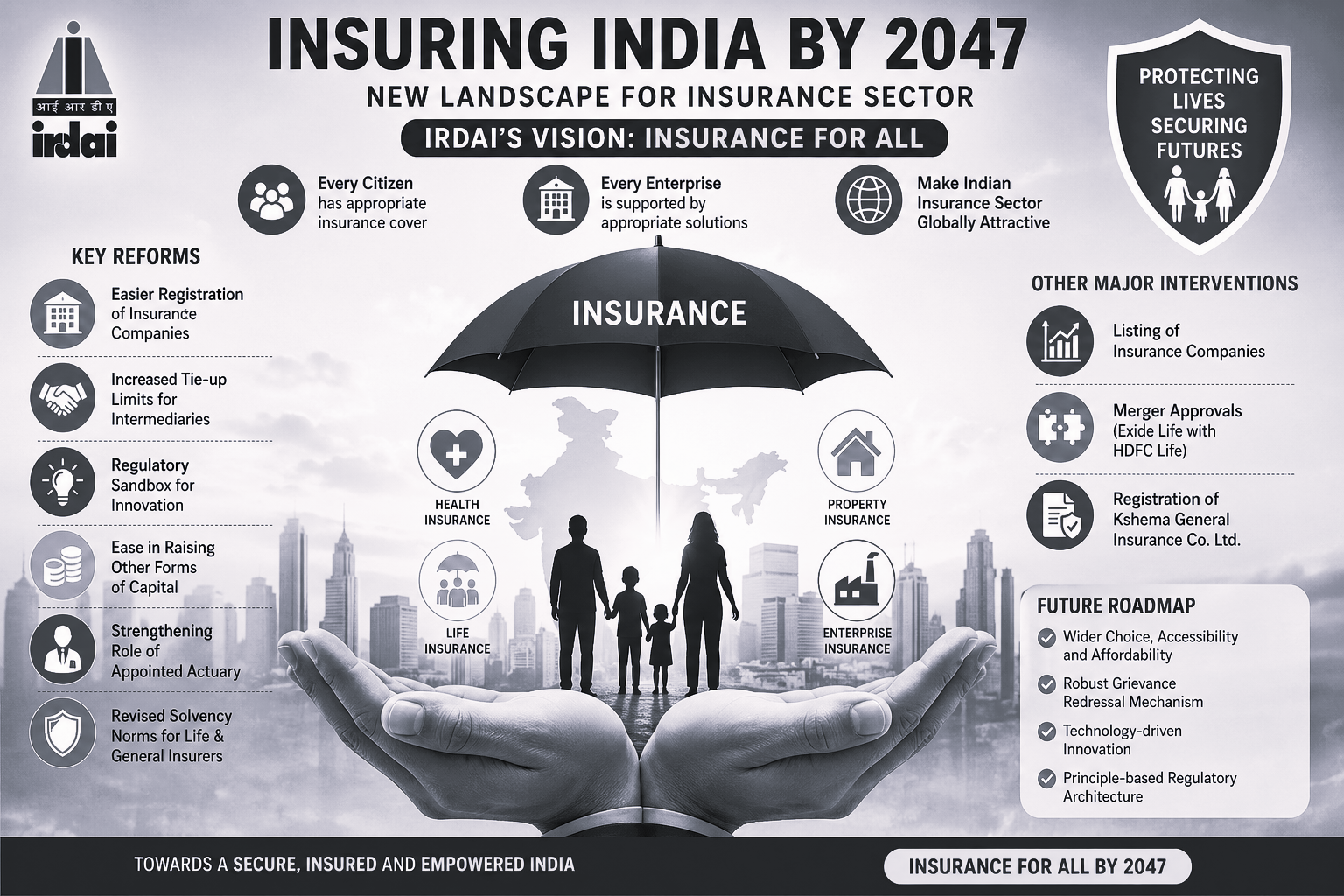
At the center of this transition is the Insurance Regulatory and Development Authority of India (IRDAI), which is redefining its role from a conventional regulator into a facilitator of growth and innovation. With the ambitious goal of achieving “Insurance for All” by 2047, the regulator is laying the groundwork for a system where financial protection becomes a basic entitlement rather than a privilege.
A System Built for Scale, Now Being Rebuilt for Access
India’s insurance sector has historically grown in scale, but not always in inclusivity. Life insurance has dominated the landscape for decades, accounting for a significant share of assets and premium income. However, this growth has not translated into universal access, leaving large sections of the population particularly in rural and informal sectors either underinsured or completely excluded.
This imbalance is now gradually correcting itself. Health insurance, once considered secondary, has emerged as a major driver of growth. Rising healthcare costs, coupled with increased awareness following recent global health crises, have made individuals more conscious of the need for financial protection against medical risks. As a result, insurance is no longer seen merely as a long-term savings instrument but as an essential component of everyday financial planning.
From Rules to Results: A New Regulatory Playbook
What distinguishes the current phase of reform is not just the scale of changes, but the shift in regulatory philosophy. Instead of prescribing rigid rules for every operational aspect, IRDAI is moving toward a principle-based approach that allows insurers greater flexibility while holding them accountable for outcomes.
This transformation is enabling faster decision-making and reducing compliance burdens. Companies can now design and launch products more efficiently, respond to market needs with agility, and operate with a level of autonomy that was previously constrained. At the same time, regulatory oversight has not been diluted. Stronger governance norms and consumer protection frameworks ensure that innovation does not compromise transparency or trust. The result is a more balanced ecosystem where growth and accountability coexist.
Capital Meets Opportunity
The insurance sector’s growth is closely tied to its ability to attract capital, and recent reforms have significantly improved this aspect. By easing investment norms, regulators have opened the door for a broader range of investors, including private equity funds and institutional players.
Ownership limits have been relaxed, allowing investors to take larger stakes without assuming promoter responsibilities. Promoters themselves have been given flexibility to adjust their shareholding under certain conditions, enabling better capital management. These changes are expected to increase liquidity within the sector, strengthen insurers’ financial positions, and create an environment conducive to long-term investment. In effect, capital is no longer a constraint but a catalyst for expansion.
The Last-Mile Challenge and Its Breakthrough
One of the most persistent challenges in India’s insurance journey has been last-mile delivery. While products and policies exist, reaching them to individuals in remote and underserved areas has remained a hurdle.
To address this, the sector has witnessed a significant expansion in its distribution network. The number of agents and intermediaries has grown substantially, supported by regulatory changes that allow them to collaborate with multiple insurers. This shift has transformed the distribution landscape from a limited, fragmented system into a more integrated and consumer-friendly model.
Customers now have access to a wider range of options through a single point of contact, making it easier to compare policies and choose what best suits their needs. Combined with digital platforms, this expanded network is ensuring that insurance is no longer confined to urban centers but is steadily reaching the grassroots.
Innovation Moves to the Center
Innovation has become a central pillar of the sector’s evolution, driven in large part by regulatory support. The expansion of the regulatory sandbox framework has given insurers the freedom to experiment with new ideas over longer timeframes, reducing the risks associated with product development.
This has paved the way for the emergence of technology-driven solutions such as usage-based insurance, micro-insurance products tailored for low-income groups, and digital-first policies designed for younger, tech-savvy consumers. Artificial intelligence and data analytics are also being increasingly used to streamline underwriting and claims processes, making insurance more efficient and responsive.
The focus is shifting from standardized offerings to customized solutions, reflecting a deeper understanding of diverse consumer needs.
A Stronger Financial Core
While outward expansion and innovation are important, the strength of the insurance sector ultimately depends on its financial stability. Recognizing this, regulators have introduced measures to improve capital efficiency and strengthen solvency frameworks.
Insurers now have greater flexibility in raising funds, allowing them to respond quickly to financial requirements. Adjustments in solvency norms and extended timelines in certain segments have also freed up capital, enhancing liquidity across the system. At the same time, the role of actuaries has been strengthened, ensuring better risk assessment and early identification of potential financial stress.
These changes are reinforcing the sector’s foundation, making it more resilient and capable of honoring commitments to policyholders.
What This Means for Everyday Indians
For the average citizen, these reforms are translating into meaningful improvements in both access and experience. Increased competition and a growing number of insurers are likely to drive down premium costs, making policies more affordable. The expansion of distribution channels ensures that individuals, even in remote areas, can access insurance services without significant barriers.
Service delivery is also improving. With better capital availability and streamlined processes, claim settlements are becoming faster and more transparent. Enhanced grievance redressal mechanisms provide policyholders with greater confidence that their concerns will be addressed promptly.
Perhaps most importantly, insurance is becoming more relatable and relevant, moving closer to the everyday realities of people’s lives.
The Long Road to 2047
The vision of providing insurance coverage to every Indian by 2047 is both ambitious and complex. Achieving it will require sustained effort, continuous policy refinement, and a strong focus on awareness and trust-building.
However, the direction is unmistakable. India is not merely expanding its insurance sector it is redefining its role within the broader economic framework. Insurance is evolving from a financial product into a critical pillar of social security and economic resilience.
If these reforms continue to gain momentum, the true impact will be seen not just in market growth, but in the lives safeguarded against uncertainty. In that sense, the journey toward “Insurance for All” is not just about coverage it is about creating a more secure and confident nation.