
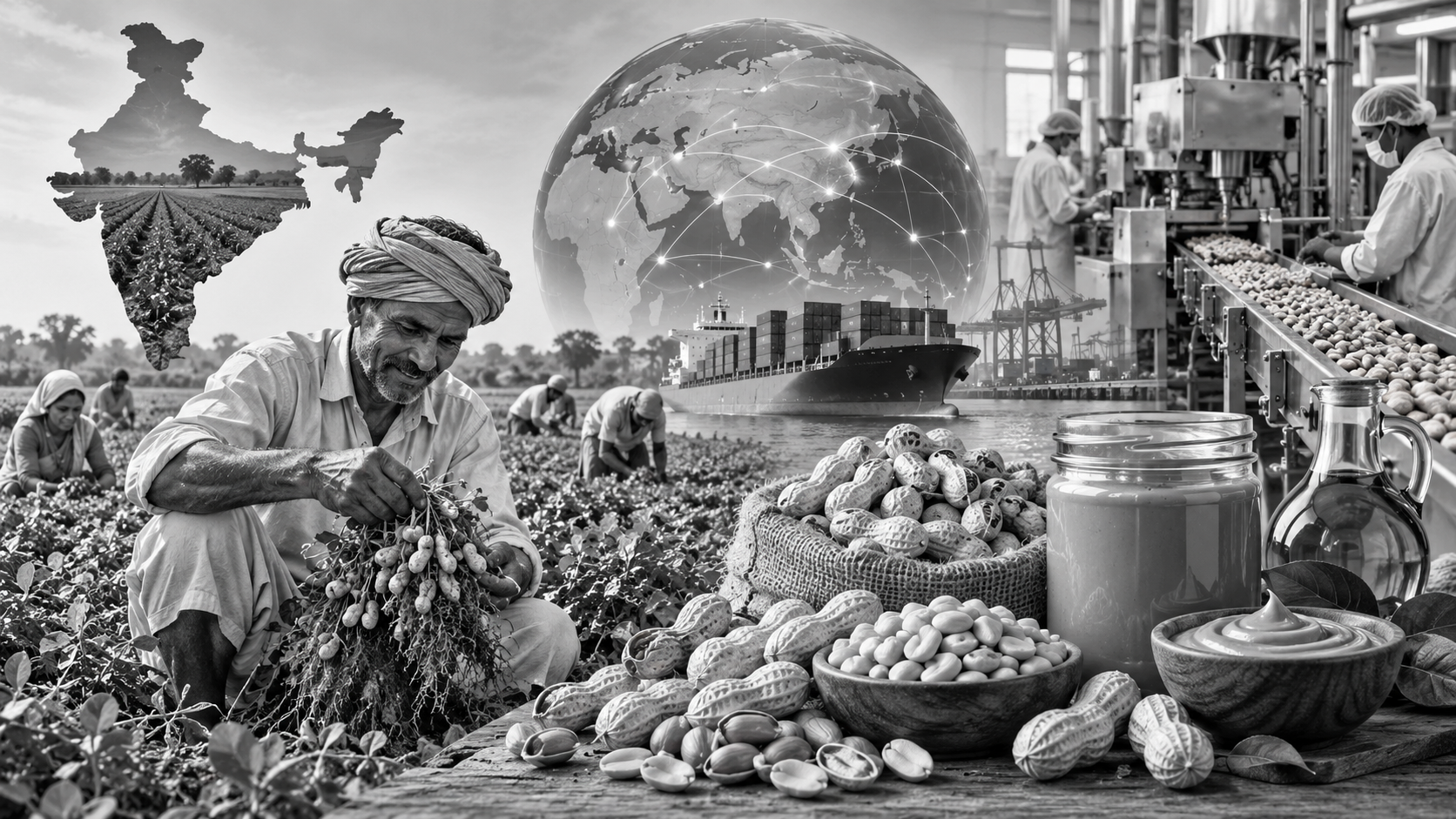
India’s Groundnut Paradox: Record Harvests, Untapped Value
India is among the world’s leading groundnut producers, supplying domestic oil mills, food manufacturers and international buyers. Yet, the country’s groundnut economy faces a fundamental challenge: high production does not automatically translate into higher farmer incomes or greater value addition. While groundnuts are widely cultivated and consumed, opportunities remain to expand branded products, improve processing, strengthen exports and increase productivity.
India’s estimated groundnut production for 2025–26 stands at approximately 13.07 million tonnes, cultivated across around 5.87 million hectares. However, production estimates vary according to the reporting agency and crop-season assessment. Globally, China remains the largest producer, followed by India, Nigeria, the United States and Myanmar. India’s position in the international market is therefore significant, but its long-term competitiveness will depend on productivity, quality standards and the ability to sell more value-added products rather than relying predominantly on raw commodities.
Gujarat Leads India’s Groundnut Industry
Gujarat occupies a central position in India’s groundnut economy, supported by extensive cultivation, established trading networks, oil mills, processing units and access to export channels. State-level production figures for 2024–25 place Gujarat at approximately 5.22 million tonnes, followed by Rajasthan at 2.14 million tonnes and Madhya Pradesh at 1.55 million tonnes. Tamil Nadu, Uttar Pradesh, Karnataka, Andhra Pradesh, Maharashtra, West Bengal and Telangana also contribute to national production.
Gujarat’s advantage extends beyond the farm. Its established ecosystem connects cultivators with traders, processors, packaging companies and food brands. This concentration of agricultural supply and industrial capacity makes the state an important centre for groundnut oil, roasted peanuts, peanut butter and other peanut-based products. Companies operating in the wider peanut-processing and food-manufacturing segment include DAS Super Foods, associated with Pintola, along with several other regional processors and packaged-food businesses.
However, the presence of manufacturers alone does not establish how much farmers earn from each product or how profits are distributed across the supply chain. Reliable comparisons require company-level procurement prices, processing costs, product sales and margins.
Productivity Remains a Major Challenge
India’s production strength is partly offset by relatively low yields. International yield comparisons based on 2024 estimates place Türkiye at approximately 4.28 tonnes per hectare, the United States at 4.11 tonnes, China at 4.04 tonnes and Egypt at 3.76 tonnes. India’s corresponding yield is around 2.11 tonnes per hectare. These figures illustrate the scope for improvement, although climate, irrigation, varieties, farming systems and reporting methods differ across countries.
Improving productivity requires better-quality seeds, timely sowing, suitable plant spacing, effective weed control and careful moisture management. Groundnuts also need adequate calcium and sulphur, particularly during pod development. Soil testing and balanced fertiliser application can help farmers address deficiencies without unnecessary input expenditure.
Research into beneficial microbial treatments, including plant-growth-promoting rhizobacteria, has reported encouraging yield improvements in evaluated conditions. Multi-location assessments have recorded gains in the range of 14–18.6% in some trials. Such results should not be treated as guaranteed outcomes for every farm, but they highlight the potential of locally tested technologies, improved seed systems and agricultural extension services.
Telangana and Andhra Pradesh Can Strengthen Their Position
Andhra Pradesh and Telangana contribute to India’s groundnut economy, although their output remains considerably below Gujarat’s. Their opportunities lie in improving yields, strengthening seed availability, expanding farmer training and connecting production areas with reliable procurement and processing networks.
Demonstrations reported in Telangana’s Vikarabad region have highlighted the potential of seed-treatment and coating interventions. In the reported comparisons, yields increased from 12.3 to 15.7 quintals per hectare during the early kharif season and from 17.85 to 22.74 quintals per hectare during rabi. A further reported assessment covering 24 hectares indicated a gain of approximately 27.5%. These results are promising but should be understood as demonstration outcomes rather than a universal prediction.
The wider lesson is that improved cultivation practices can raise output from existing farmland. For farmers, even a moderate yield increase can improve returns when combined with lower avoidable input costs, suitable market timing and access to buyers offering transparent prices.
MSP, Market Prices and Farmer Returns
For the 2026–27 marketing season, the minimum support price for groundnut has been fixed at ₹7,517 per quintal, equivalent to ₹75.17 per kilogram of groundnuts in shell. This represents an increase from ₹7,263 per quintal in the preceding season. MSP provides a policy benchmark, but the price actually received by a farmer depends on procurement access, quality, local demand, transport expenses and market conditions.
Indicative market-aggregator figures reported for October 2026 showed prices of approximately ₹7,725 per quintal in Gujarat, ₹7,400 in Andhra Pradesh, ₹7,335 in Telangana, ₹8,280 in Karnataka and ₹7,140 in Tamil Nadu. These are indicative market figures, not guaranteed prices or uniform statewide averages, and can vary by market, variety and quality.
For growers, the key issue is the difference between the selling price and the cost of cultivation. Higher output alone may not ensure better incomes if seed, labour, fertiliser, irrigation, harvesting and transport expenses rise. Accessible procurement, transparent grading and reliable price information are therefore essential.
Peanut Butter Offers a Value-Addition Opportunity
Peanut butter illustrates how groundnuts can move beyond commodity sales into higher-value food products. A selected range of Pintola one-kilogram products has been listed at retail prices of approximately ₹374 to ₹420, depending on the product and seller. These prices provide a useful illustration of the difference between the value of raw agricultural produce and a finished packaged product.
An indicative calculation using a 70% kernel recovery rate and allowing for a further 5% loss during sorting and roasting suggests that approximately 1.55 kilograms of in-shell groundnuts may be needed to produce one kilogram of usable peanut butter input. At an illustrative raw groundnut price of ₹7,517 per quintal, the corresponding raw-material cost would be around ₹116.50 per kilogram of finished peanut butter, before accounting for additional ingredients or processing.
The difference between this estimated raw-material cost and the retail price is not the manufacturer’s profit. Processing, energy, labour, packaging, quality testing, storage, transportation, marketing, retailer margins, taxes and distribution all affect the final price. Nevertheless, peanut butter demonstrates the potential to create additional economic value through processing, branding and direct access to consumers.
Quality Standards and Export Opportunities
India’s groundnut exports provide another route for strengthening the sector. APEDA data show exports of approximately 663,810 tonnes valued at US$690.93 million in 2025–26. This compares with US860.73 million in 2023–24. The figures indicate that export earnings and volumes can fluctuate, making market diversification and consistent quality important priorities.
Indonesia, Vietnam, Malaysia, China and the Philippines are among India’s export destinations. Indonesia alone imported approximately 162,950 tonnes of Indian groundnuts worth US$172.01 million in 2025–26. International demand also extends to prepared and preserved peanut products, although trade statistics for that category include products beyond peanut butter and should not be interpreted as peanut-butter-specific sales.
Export competitiveness depends on meeting buyer requirements for kernel size, moisture, foreign matter, damaged kernels, flavour, traceability and food safety. Aflatoxin control is particularly important, as contamination can restrict access to demanding markets. Consistent testing, appropriate drying and storage, better sorting and reliable traceability can help Indian suppliers protect market access and build long-term buyer relationships.
Government Support and the Road Ahead
Government initiatives can support the sector through improved seeds, demonstrations, training, processing infrastructure and market access. The National Mission on Edible Oils–Oilseeds has a financial outlay of ₹10,103 crore for 2024–25 to 2030–31 and targets primary oilseed production of 69.7 million tonnes by 2030–31. Its interventions include seed-system improvements, farmer demonstrations, training and cluster-based development. MSP procurement and schemes supporting eligible micro food-processing enterprises may also assist farmers and small businesses, subject to their respective rules and eligibility conditions.
India’s groundnut industry now needs to move beyond the pursuit of higher production alone. Better yields, quality assurance, stronger farmer-producer organisations, efficient processing and diversified export markets can help distribute more value across the supply chain. Gujarat offers an example of how cultivation, trading and processing can reinforce one another, while states such as Andhra Pradesh and Telangana can build on their agricultural base.
The real opportunity is to transform India’s groundnut advantage into a broader peanut economy - one that rewards farmers for quality, encourages processors to innovate and enables Indian brands to compete in domestic and international markets. Record harvests create the foundation, but productivity, processing and market access will determine how much of that potential becomes lasting prosperity.