
India's Gig Economy: New Opportunities, Uncertain Livelihoods
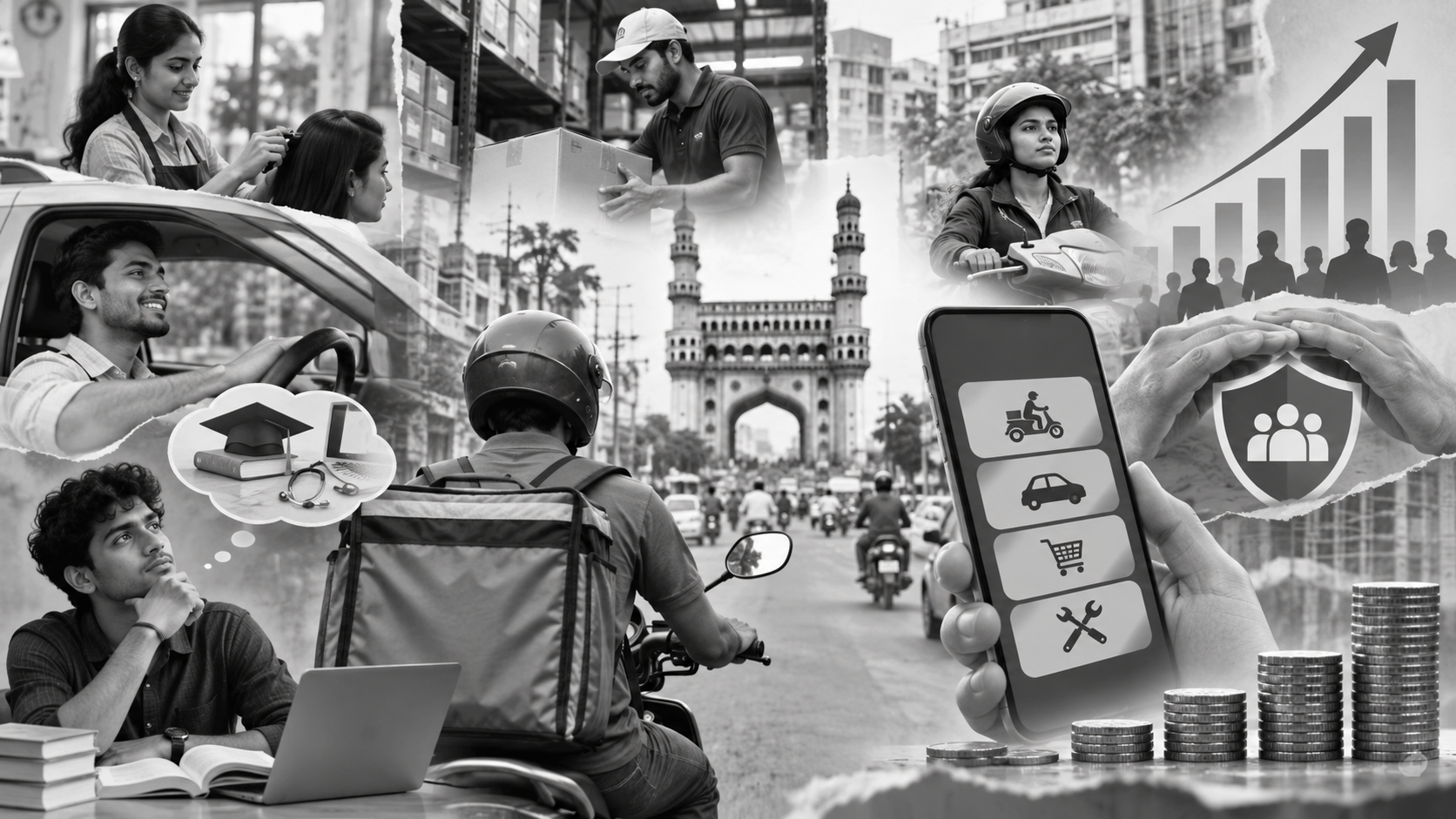
At any given moment, thousands of delivery executives are navigating crowded streets, cab drivers are waiting for bookings and warehouse workers are sorting packages. Their workplaces are no longer confined to conventional offices or factories. Instead, a smartphone has become their gateway to employment. India's rapidly expanding gig economy is transforming the labour market by creating new earning opportunities while raising questions about income security, workers' rights and the future of employment.
A Decade of Transformation
The expansion of digital platforms, smartphones, online payments and changing consumer preferences has accelerated the growth of India's gig workforce. According to NITI Aayog, the workforce increased from approximately 68 lakh in 2019–20 to 77 lakh in 2020–21. Subsequent government estimates placed it at around one crore in 2024–25, with projections indicating that it could reach 2.35 crore by 2029–30. A separate Redseer report published in July 2026 estimated that India's gig internet workforce had crossed 60 lakh monthly active workers, highlighting the growing importance of platform-based employment.
A Changing Employment Landscape
Young adults, migrant workers, students and unemployed graduates are among those attracted to gig employment. An IDinsight study found that approximately half of its surveyed platform drivers were migrants, while 23 per cent were also pursuing education. Interestingly, 57 per cent identified meeting household financial requirements as their primary motivation for joining platforms, while 14 per cent cited the possibility of higher earnings than their previous occupations. This indicates that economic necessity, rather than flexibility alone, is driving participation.
The sector is also expanding beyond food delivery and transportation into grocery distribution, quick commerce, healthcare, beauty services, household maintenance and professional freelancing. Platforms such as Swiggy, Zomato, Rapido and Uber, alongside Blinkit, Zepto, Amazon Now and Flipkart Minutes, are increasing their reach as demand for app-based services grows. Redseer estimated India's quick-commerce market at approximately $13 billion in FY2026 and projected that it could reach $90 billion by FY2031. This expansion is creating opportunities not only for delivery partners but also for warehouse personnel, inventory handlers, logistics operators and customer-support employees.
Bridging the Unemployment Gap
Platform-based employment offers an accessible entry point for people who may struggle to secure conventional jobs. Individuals with two-wheelers can undertake delivery assignments, drivers can offer transportation services, while skilled professionals can find customers through digital platforms. A February 2026 report by Business Standard, citing TeamLease Services estimates, indicated that e-commerce and quick-commerce companies could generate approximately nine lakh to 10 lakh employment opportunities during 2026, with logistics and warehousing potentially adding another five lakh.
However, registration does not necessarily mean permanent employment. Workers may receive assignments intermittently, operate across multiple platforms or leave when earnings become insufficient. Therefore, the actual contribution of gig work to reducing unemployment must be assessed through active participation, consistent income and the availability of sustainable opportunities.
The Earnings Reality
Despite the growing number of opportunities, workers' actual earnings remain a major concern. A Telangana government study conducted in May 2025 among 1,300 gig workers found that carpenters and electricians earned an average of approximately Rs 27,000 monthly, followed by four-wheeler drivers at Rs 25,425 and food-delivery workers at Rs 24,053. Two-wheeler and three-wheeler riders earned around Rs 16,138, while e-commerce delivery workers reported approximately Rs 13,753. The overall average stood at around Rs 20,000.
Nationally, an IDinsight study examining 669 consistently active full-time platform drivers found average monthly gross earnings of Rs 27,814. However, operating expenses, including fuel, electricity, vehicle maintenance, rentals and connectivity, amounted to approximately Rs 9,054, leaving around Rs 18,761. The study also found that workers spent an average of 62.2 hours weekly logged into platforms, earning approximately Rs 75 per hour after the listed operating expenses. These findings demonstrate how extended working hours and operational costs reduce the financial benefits of platform employment.
Hyderabad's Ground Reality
Telangana is emerging as an important centre for platform-based employment, with an estimated three to four lakh gig workers, according to the state's 2025 study. Approximately 91 per cent of surveyed workers were men, while the predominant age group was 26–35 years. Workers generally reported working 10–12 hours daily. The study also highlighted platform commissions ranging from 20 to 30 per cent.
A November 2025 Deccan Chronicle report quoted Hyderabad delivery rider Syed Umar, who described earning approximately Rs 500 after nine hours of work, with fuel, maintenance and food expenses sometimes reducing the remaining amount to just Rs 200. His experience illustrates the financial pressures faced by workers, although it should not be treated as representative of the entire workforce.
Women's Participation and the Gender Divide
Despite the expansion of platform employment, women remain significantly underrepresented. A July 2026 Redseer report estimated that women accounted for approximately one per cent of India's gig internet workforce in 2025, compared with 0.5 per cent in 2020. Their participation is considerably higher in home-service platforms, particularly beauty and wellness, where they account for an estimated 35–45 per cent of workers. In contrast, their presence in delivery and ride-hailing remains below one per cent.
Safety concerns, limited access to vehicles, financial constraints and household responsibilities continue to restrict women's participation. An August 2026 ILO–NCAER policy brief also highlighted the digital financial divide, reporting that 25.2 per cent of women could undertake online banking transactions compared with 47.1 per cent of men. Greater access to finance, safer working environments and flexible employment arrangements will be essential to improving women's participation.
Insurance and Government Protection
Several companies have introduced welfare measures for their platform workers. Swiggy has disclosed accidental death and disability coverage of up to Rs 10 lakh and accident hospitalisation coverage of up to Rs 2 lakh for eligible delivery partners. Zomato has reported providing accidental and medical insurance, disability and death benefits, maternity protection and emergency assistance. Rapido has advertised accident and medical benefits of up to Rs 5 lakh for captains and their families, subject to applicable conditions. However, insurance coverage does not guarantee a fixed income or universal access to benefits.
The government's Code on Social Security, 2020, which came into force on November 21, 2025, formally recognises gig and platform workers and provides a framework for life and disability protection, accident insurance, health and maternity benefits and old-age security. It also provides for aggregator contributions ranging from one to two per cent of annual turnover, subject to a prescribed ceiling. Meanwhile, the e-Shram initiative seeks to register workers and facilitate access to eligible welfare schemes. Telangana has also undertaken research to strengthen worker registration, welfare funding and grievance-redressal mechanisms.
The Road Ahead
India's gig economy is likely to expand further as digital consumption, quick commerce and app-based services penetrate smaller cities. However, its success should not be measured solely by the number of workers registered or orders delivered. Predictable earnings, transparent payment systems, accessible insurance, safer working conditions and effective grievance mechanisms must become central to its development. Ultimately, the real measure of India's digital employment revolution will be whether the people powering these platforms can earn a dependable livelihood while working with dignity and financial security.