
India’s Future Is in Youth Hands: Vivekananda’s Call, Today’s Challenge
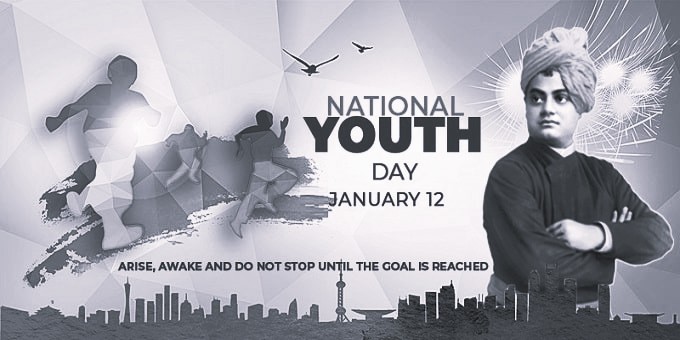
Every year on January 12 , India observes National Youth Day to commemorate the birth anniversary of Swami Vivekananda , one of the country’s most influential philosophers and youth icons. The Government of India declared the day in 1984 , and it has been celebrated nationwide annually since 1985 , with the objective of inspiring young citizens through Vivekananda’s ideals and teachings. But the significance of this day goes beyond ceremonial remembrance. It serves as a powerful reminder that the nation’s future depends on the energy, values, and clarity of today’s youth. Swami Vivekananda’s unwavering belief in young minds remains deeply relevant even in the modern era especially his message that youth are the real wealth of a nation and the strongest force behind change. In a world shaped by rapid globalisation, intense competition and relentless technological transformation, the questions facing young people have become sharper: what direction are they moving toward, which values are being forgotten, and what kind of goals should guide their lives?
Today’s youth live amid enormous opportunities, but they also face complex challenges. On one side there are expanding choices in education, employment and entrepreneurship; on the other, unemployment, mental stress, confusion and a growing sense of uncertainty. The pressure to succeed quickly, combined with the constant comparison culture created by social media, is widely seen as contributing to dissatisfaction and loss of confidence among young people. In this environment, Swami Vivekananda’s teachings feel less like motivational quotations and more like a practical guide for survival and progress. His message “Believe in yourself first” has become essential for a generation that often doubts itself despite having more resources and exposure than ever before. Youth must understand that confidence is not arrogance, and ambition must be rooted in discipline, values and clarity of purpose.
India’s development story cannot be written without youth leadership. The role of young people should not be limited to securing jobs alone. The need of the hour is holistic progress where knowledge is combined with skill, and ambition is balanced with responsibility. The encouraging reality is that Indian youth have already proved their strength globally through science, technology and innovation. Whether in IT, Artificial Intelligence, data science, startup culture, space research, medical sciences, sports, civil services or creative industries , youth talent is becoming a defining identity of India. However, progress without values is fragile. For India to truly benefit from its youth energy, the growth of talent must walk alongside integrity, social responsibility and discipline. If youth become highly skilled but socially disconnected, the nation’s progress will remain uneven and incomplete.
At the same time, it is equally important to recognise the destructive paths that threaten youth potential. Habits such as laziness, hopelessness, violence, addiction and drug abuse do not harm only individuals they weaken families, destabilise communities and damage the country’s social fabric. The rising tendency to chase shortcuts and instant fame has also created a dangerous environment where wrong choices appear attractive. Swami Vivekananda strongly rejected weakness and defeatist thinking, famously asserting that weakness is a sin not in a religious sense, but as a reminder that fear, helplessness and lack of courage destroy human potential. His philosophy calls young people to build strength not just physically, but mentally and morally.
One of the most powerful foundations of Vivekananda’s vision is service . According to him, true achievement is not only personal success but also contribution to society. A nation becomes strong when its youth develop compassion for the underprivileged, take responsibility for collective progress, and understand that nation-building is not limited to government policies but also depends on citizen character. His belief that service to humanity is the highest form of devotion carries even greater meaning in today’s world, where individual achievements often dominate public life. A service-driven youth force becomes not only employable but also ethical, accountable and capable of real leadership.
India’s demographic structure further highlights why the youth question has become crucial. The country is increasingly described as a youth-dominant nation at a time when many major powers are becoming older societies. The United Nations has noted that India overtook China as the world’s most populous country in 2023 , signalling a long-term shift in global population balance. UN projections also indicate that India’s population is likely to continue growing for several decades, while China has already begun to face decline. The broader meaning of this shift lies in workforce strength and economic momentum. Multiple credible analyses point out that India’s median age is around 28–29 , while China’s median age is close to 40 , highlighting that India’s working-age base is significantly younger. This demographic advantage has the potential to become India’s greatest strength provided the youth receive quality education, employment opportunities, and the moral direction required to avoid social and economic instability.
China’s trajectory underlines the contrast. With falling birth rates and increasing ageing, China has been witnessing population decline and a growing elderly burden, which is expected to create labour shortages and economic pressure over time. India, in comparison, is expected to remain youthful for decades. Experts often describe this as India’s potential “demographic dividend” but it is not automatic. If youth remain unemployed, stressed and under-skilled, the dividend can quickly turn into a demographic challenge. Therefore, the responsibility lies both with youth themselves and with institutions that shape their opportunities.
However, there is one area where the gap between India’s youth population and reality becomes impossible to ignore: political representation . Though India has a massive youth population, that youth presence is scarcely reflected in its legislatures. Data from the 18th Lok Sabha illustrates this clearly. According to ADR analysis, the average age of MPs in the 18th Lok Sabha is around 56 years , the highest in India’s parliamentary history, despite India being considered one of the world’s youngest nations. Youth representation remains strikingly low. The imbalance is not only limited to Parliament, many state assemblies also have very few representatives below 40. The reasons are complex: political party structures, candidate selection practices, preference for seniority, high campaign costs and limited openings for young entrants. Analysts warn that this lack of youth representation reduces the space for youth concerns, aspirations and economic-social priorities to convert into policy and law, ultimately weakening the responsiveness of democracy to India’s largest demographic group.
In this context, National Youth Day becomes far more than an annual tribute. It is a national call\ reminding young people that India’s future is not something they will inherit by default, but something they must actively create. Vivekananda’s dream of a strong India was built on three foundations: a life with purpose, thoughts filled with confidence, and actions guided by service . If India’s youth combine ambition with values, talent with discipline, and success with responsibility, then India’s demographic advantage can transform into lasting global strength. As the nation marks National Youth Day, the hope is that it renews the spirit of determination among the youth and reaffirms one truth above all: the nation’s destiny is shaped in the hands of its young citizens.