
India’s electronics revolution - Powering growth and global leadership
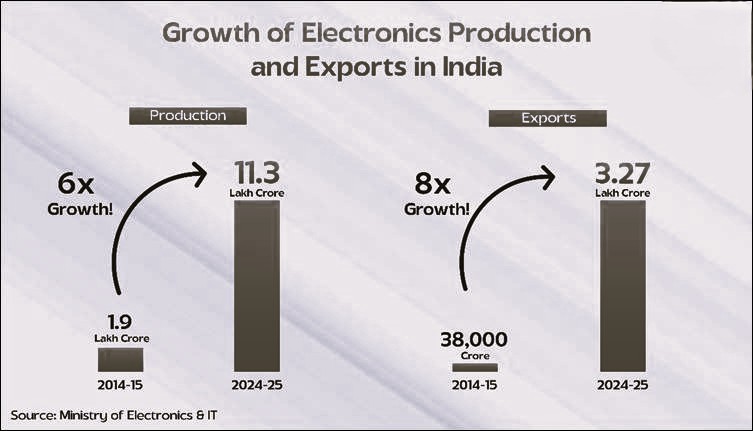
Over the past decade, India has emerged as a major hub for electronics manufacturing, transforming from a net importer to a global exporter. Electronics production surged nearly six-fold from ₹1.9 lakh crore in 2014–15 to ₹11.3 lakh crore in 2024–25, underpinned by government policies, technological advancements, and strong industrial investment. The sector has not only expanded India’s industrial base but also generated over 25 lakh jobs, highlighting its critical role in employment and economic growth. With the ambitious vision of creating a $500 billion domestic electronics ecosystem by 2030–31, India is poised to become a global technology leader.
India’s electronics export sector has witnessed unprecedented growth in the past decade. Exports rose eight-fold from ₹38,000 crore in 2014–15 to ₹3.27 lakh crore in 2024–25. Mobile phone exports alone increased 127 times, from ₹1,500 crore to ₹2 lakh crore, driven by the expansion of manufacturing units from just two in 2014 to over 300 today. Around 330 million mobile phones are produced annually, with nearly a billion devices in active use nationwide. In 2024, Apple exports from India hit a record ₹1.1 lakh crore (US$12.8 billion), reflecting a 42% year-on-year growth. In the first five months of FY 2025–26, smartphone exports already reached ₹1 lakh crore, a 55% increase over the same period last year. India has achieved near self-reliance in mobile production, reducing imports from 78% in 2014–15 to nearly full domestic manufacturing today. Notably, India overtook China in Q2 FY 2025–26 to become the top smartphone exporter to the United States.
India’s electronics sector is now integrated into global supply chains, with the United States, United Arab Emirates, Netherlands, United Kingdom, and Italy being top export destinations. The surge in exports is a result of strategic government initiatives, such as the Production-Linked Incentive (PLI) scheme, which incentivizes incremental production and export growth. In addition, the Scheme for Promotion of Manufacturing of Electronic Components and Semiconductors (SPECS) and the Electronics Components Manufacturing Scheme (ECMS) have encouraged domestic manufacturing of high-value components, bridging critical supply chain gaps and attracting significant investment. These programs, along with improvements in ease of doing business, have strengthened India’s competitiveness in the global electronics market.
Electronics now form the backbone of modern industries, permeating every sector of the economy. Consumer electronics such as televisions, refrigerators, and washing machines have become integral to daily life, while electronic components power both simple appliances and complex industrial systems. Automotive electronics, including sensors, infotainment, and electric vehicle technologies, are transforming mobility, safety, and connectivity. Medical electronics, ranging from oximeters to digital monitoring devices, are enhancing healthcare accessibility and patient outcomes. These advancements underscore how electronics are enabling innovation, efficiency, and quality across sectors.
Globally, electronics manufacturing is dominated by established players such as Foxconn, Pegatron, Flex, and Jabil, with the market projected to grow at a 6.6% CAGR from 2025 to 2029. India, while still a rising player, is leveraging its growing capabilities, policy support, and manufacturing ecosystem to increase its share. Strategic steps to become a global leader include strengthening domestic semiconductor production, expanding research and development capabilities, fostering skilled workforce development, building global trade partnerships, and adopting Industry 4.0 technologies for smart manufacturing. By implementing these measures, India can move beyond assembly-based manufacturing to design-led, high-value electronics production.
India’s electronics journey is a story of ambition, innovation, and global integration. Through initiatives such as the PLI, ECMS, SPECS, and the National Policy on Electronics (NPE 2019), the country has expanded its manufacturing base, boosted exports, and attracted billions in foreign investment. With sustained policy support, innovation, and global collaboration, India is on track to realize its $500 billion domestic electronics ecosystem goal, positioning itself as a major player on the world stage in electronics and mobile technology.