
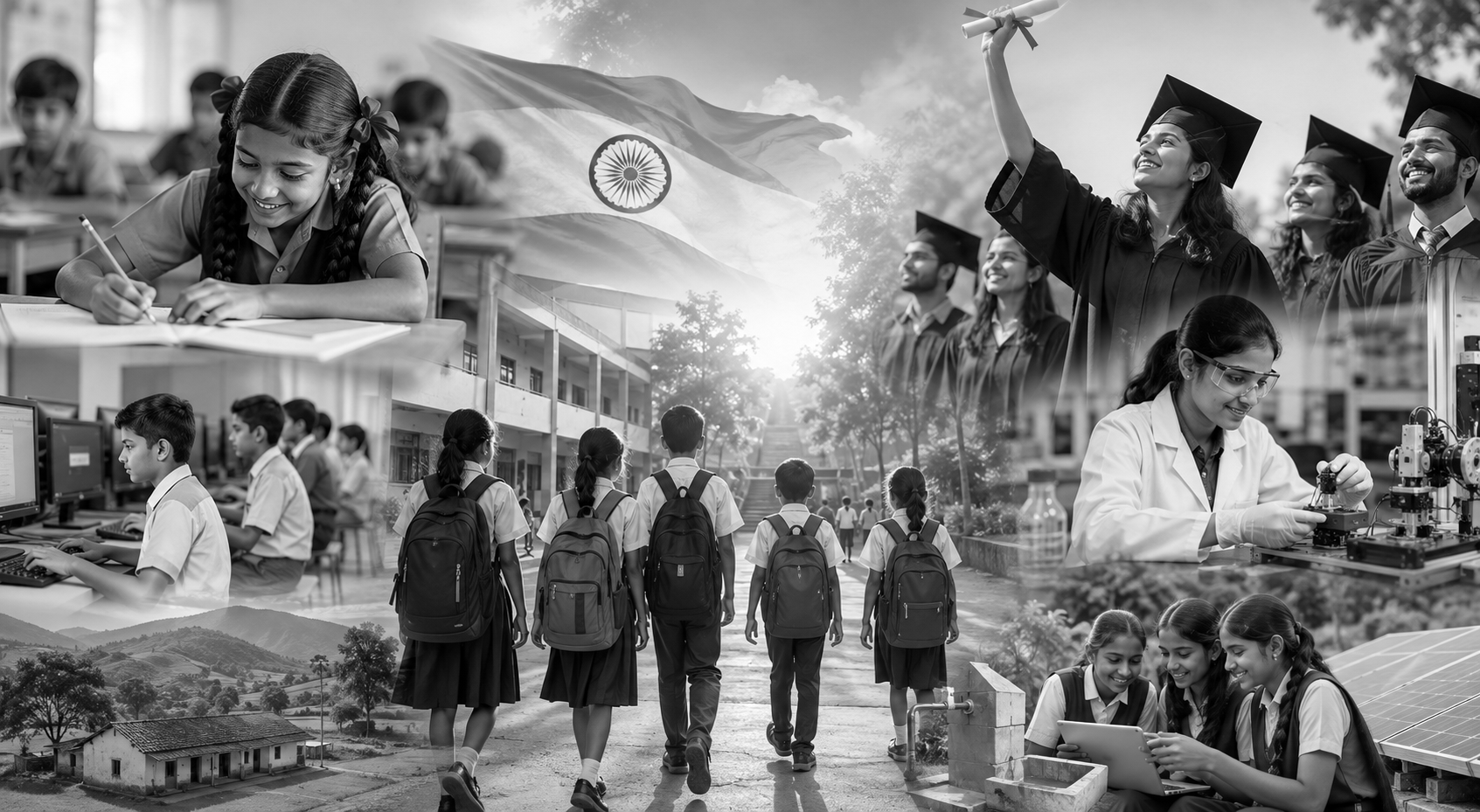
India’s Education Journey: Bigger Classrooms, Better Access, Bigger Challenges
India’s education system is undergoing a transformation that extends far beyond putting children in classrooms. The latest UDISE+ 2025–26 data shows a vast school network with improvements in teacher availability, enrolment, retention, infrastructure and digital access. But when these findings are viewed alongside learning assessments and the government’s higher education ambitions, a larger question emerges: can India turn wider access into better learning, stronger skills, higher education participation and greater innovation?
The scale of the system is immense. India now has 14.67 lakh schools, 1.03 crore teachers and 24.72 crore students, making UDISE+ one of the world's largest integrated education databases. The overall pupil-teacher ratio stands at 24:1, while stage-wise ratios are 10:1 at the Foundational stage, 12:1 at Preparatory, 17:1 at Middle and 21:1 at Secondary. These figures remain below the 30:1 benchmark envisaged under NEP 2020.
Yet averages can hide persistent gaps. The number of single-teacher schools declined by about 3% to 1,00,843, while zero-enrolment schools fell 29% to 5,663. The improvement suggests better resource deployment, but the continued presence of more than one lakh single-teacher schools highlights the difficulty of ensuring equitable staffing, particularly across remote and underserved areas.
The Secondary-School Challenge
India has made progress in getting children through the early stages of schooling, but the transition into and completion of secondary education remains a critical weakness. The Gross Enrolment Ratio at the Secondary stage has risen to 71.7%, compared with 89.6% at the Middle stage. Retention is 98.5% at the Foundational stage, 91.1% at Preparatory and 83.7% at Middle, but falls sharply to 51.9% at Secondary level.
Dropout rates, however, are moving in the right direction. Preparatory-stage dropout has fallen to 1.8%, Middle-stage dropout stands at 3.6% and Secondary-stage dropout at 7%. Transition rates are also strong, with 99.2% moving from Foundational to Preparatory, 93.8% progressing to Middle and 88.3% reaching Secondary education.
The figures point to a crucial policy challenge: getting children into school is no longer enough; keeping them there until the end of secondary education is becoming the decisive test.
Enrolment Does Not Automatically Mean Learning
This is where UDISE+ needs to be read alongside the Annual Status of Education Report (ASER). UDISE+ measures the functioning of the education system, while ASER provides an important window into children's actual foundational learning, particularly in rural India.
ASER 2024 covered nearly 6.5 lakh children across 17,997 villages in 605 rural districts. Its findings showed a recovery in reading and arithmetic levels compared with 2022. Among government-school children in Standard III, 23.4% could read a Standard II-level text, while the figure for all schools was 27.1%. Among Standard V children, 48.8% across all schools could read a Standard II-level text.
These improvements are encouraging, but they also underline the unfinished learning challenge. A substantial proportion of children remain in school without acquiring age-appropriate foundational competencies. This explains why Foundational Literacy and Numeracy (FLN) has become one of the central pillars of NEP 2020 and the NIPUN Bharat mission.
Schools Are Becoming More Connected
Infrastructure is another area where the transformation is visible. UDISE+ 2025–26 shows computers available in 69.9% of schools and internet connectivity in 67.4%. Electricity reaches 95% of schools, safe drinking water 99.5%, girls’ toilets 98.5%, boys’ toilets 97.2%, handwashing facilities 96.9% and libraries 90.5%.
The digital expansion is significant when compared with earlier years. Government data has shown a steady rise in computer and internet availability since 2019–20. But the remaining gap is substantial: around one-third of schools still lack internet connectivity. Accessibility also requires attention, with ramps and handrails available in only 58.2% of schools.
The next phase must therefore move from digital infrastructure to digital learning. Computers and connectivity matter only when teachers and students can use them effectively to improve classroom outcomes.
Inclusion Is Expanding
Gender participation has also strengthened. Girls constitute 48.4% of school enrolment, while women account for 54.9% of teachers. OBC students represent 44.9% of enrolment, Scheduled Castes 17.7% and Scheduled Tribes 10%, showing the broad social reach of India's school system.
The challenge now is to ensure that inclusion continues beyond school. Students from disadvantaged communities need pathways into secondary education, higher education, skills training and employment rather than merely access to the first stages of schooling.
From School to Higher Education
The second half of India's education challenge begins after school. Vice President C. P. Radhakrishnan, addressing SASTRA Deemed University in Thanjavur on August 17, described NEP 2020 as a guiding pillar of educational progress from KG to Ph.D. He said India's higher education GER is expected to rise from around 30% to 50% by 2035.
The ambition is substantial. The latest available AISHE data has already shown a long-term rise in higher education participation, with GER reaching 28.4% in 2021–22 from 23.7% in 2014–15. More recent government reporting has also pointed to continued expansion in higher education enrolment, including rising female participation and growing STEM enrolment.
Achieving 50% GER, however, will require much more than creating additional seats. India will need stronger universities, adequate faculty, research infrastructure, affordable financing, industry partnerships and flexible academic pathways.
Research, AI and the New University
The SASTRA event offered a glimpse into this emerging higher education model. Six initiatives were launched, including SASTRA.AI, SASTRA-MAITRI for academic mobility and internationalisation, the STRIDE Fund for faculty and research capacity-building, DRISHTI for technology-enabled higher education and the Tata Communications Centre for Resilient and Unified Secure Technologies.
The emphasis on AI, cybersecurity, research and industry collaboration reflects a wider shift in the role expected from universities. Institutions are increasingly being asked to produce not just graduates but researchers, innovators, entrepreneurs and technology professionals capable of contributing to India's economic and strategic ambitions.
Radhakrishnan also stressed innovation and continuous skill upgradation, telling students to use their time productively and restrict excessive social media use. His message reflects a growing recognition that employability in an AI-driven economy will depend on continuous learning rather than a degree obtained once.
The Education Ladder Is Still Incomplete
India's education transformation has clearly moved forward. More children are entering and progressing through school, teacher availability has improved, dropout rates have declined, infrastructure has expanded and digital connectivity is growing. At the same time, learning gaps, secondary-stage retention, single-teacher schools, accessibility and unequal digital access remain important concerns.
The real measure of success will therefore be the entire education-to-opportunity pipeline.
UDISE+ provides the system-wide picture. ASER shows what children are actually learning. Higher education data reveals whether school graduates are reaching colleges and universities. NEP 2020 attempts to connect these stages into a single framework centred on access, equity, quality, skills, research and flexibility.
For India, the next decade will not simply be about expanding the education system. It will be about making that system work better at every stage from a child's first reading lesson to a university laboratory developing the technologies of tomorrow.