
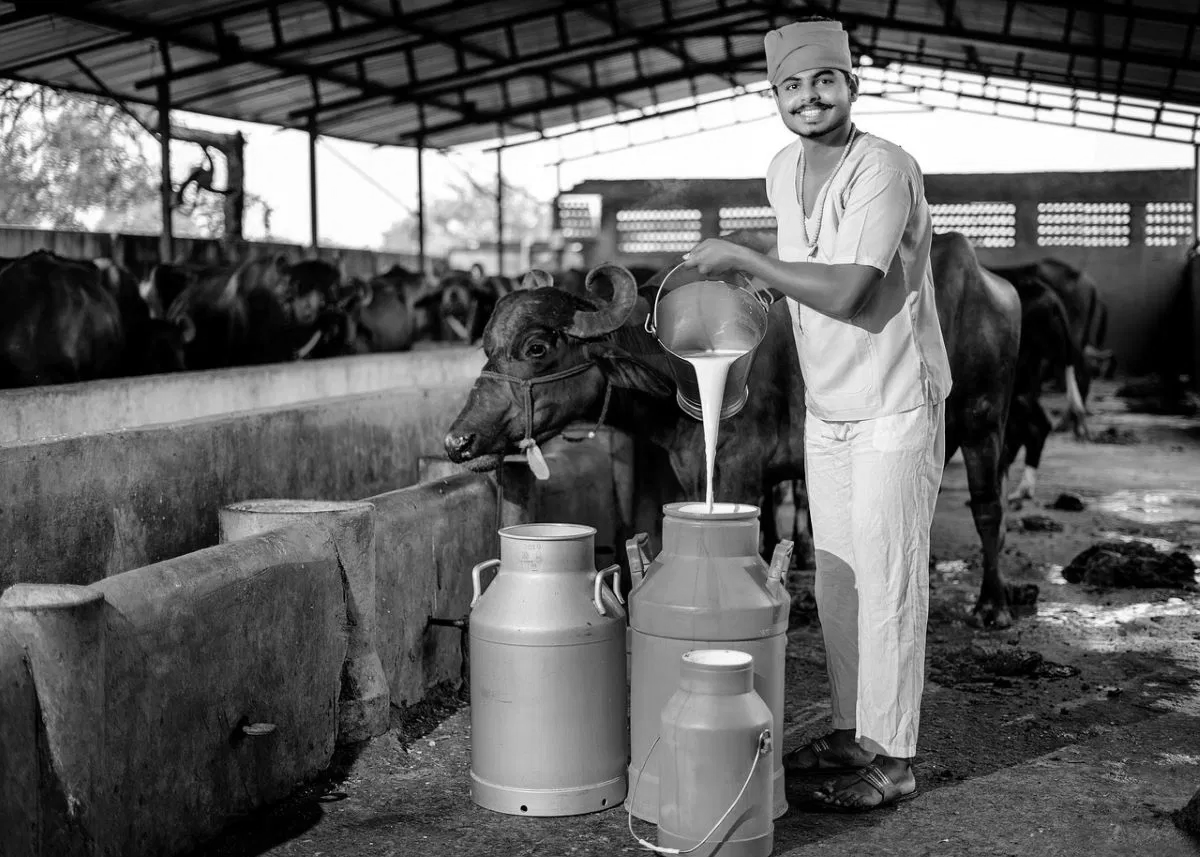
India’s dairy sector tightens as demand rises, exposing deeper supply challenges
India’s dairy sector is entering a phase of tighter supply after three turbulent years marked by sharp price swings, disrupted production, and shifting demand patterns, according to insights from an expert session hosted by Systematix Institutional Equities , a domestic brokerage and research firm that tracks trends across India’s consumer and agri linked industries. While demand for milk and dairy products remains strong heading into 2026, the industry is grappling with rising procurement costs and limited surplus.
The report notes that the post Covid period of 2022 and 2023 was particularly difficult for dairy farmers. Milk prices fell to levels that did not cover production costs, forcing many farmers to reduce feed, delay cattle induction, or exit expansion plans altogether. This led to a visible drop in milk production across several regions.
Supply conditions improved from mid 2023 as leading cooperatives and private players engaged with farmers through better procurement practices and sustainable fodder programmes. These efforts resulted in a sharp rebound during the October 2024 to March 2025 flush season , when milk output jumped by nearly 25 percent, creating a short lived surplus.
To absorb excess milk, dairy companies expanded value-added products such as curd, paneer, ghee, and ice cream. Investments were also made in cold chain infrastructure, advertising, promotions, and last mile distribution. However, this surplus did not last long.
In 2025, early and unseasonal rains disrupted the usual summer demand supply cycle. Geopolitical disturbances linked to the India Pakistan conflict affected key northern milk producing belts including Punjab, Haryana, and Jammu and Kashmir. At the same time, strong festive demand reduced inventories faster than expected, leaving the industry with limited surplus towards the end of the year.
Milk procurement costs have since firmed up across most regions, even as retail prices have largely remained stable following the recent GST cut . Some regional price increases of around Rs 1 to Rs 1.5 per litre have been reported in states such as Bihar and Andhra Pradesh. Industry participants expect procurement costs to ease only around April 2026.
India’s current situation highlights a deeper paradox. Despite being the world’s largest milk producer , with annual output estimated at nearly 250 million tonnes and accounting for about 25 percent of global production, the country continues to face supply tightness and price volatility.
A key reason is that a large share of milk never enters the organised market. Significant volumes are consumed by producing households themselves or sold locally in informal channels. Only a limited quantity flows through cooperatives and private dairies, reducing availability for packaged and urban markets.
Production is also highly fragmented. Millions of small farmers, often owning just two or three animals, drive India’s dairy output. When prices fall below costs, farmers cut back quickly, but when prices rise, supply cannot increase overnight. This natural lag creates instability.
Seasonality further complicates matters. Milk production peaks during winter and drops sharply in summer, while demand remains steady or rises during festivals and heat waves. Weak cold chain infrastructure makes it difficult to store or transport surplus milk across regions, turning local imbalances into shortages.
Rising input costs such as fodder, fuel, and labour also influence supply decisions. When these costs rise faster than procurement prices, farmers reduce production. At the same time, policy interventions like delayed price revisions or tax cuts help consumers in the short term but often squeeze margins for farmers and dairy companies.
Despite these challenges, demand for dairy products continues to grow. Lower prices and increased grammage after the GST cut have supported consumption, especially in small packs. Milk based and value added products are gaining popularity as consumers move away from carbonated beverages. Ice cream demand, once limited to peak summer months, is now spread across a longer seasonal window.
Distribution patterns are also evolving. Quick commerce and e-commerce platforms are expanding rapidly, while general trade continues to lose share. Modern trade offers visibility but lower margins, forcing dairy companies to make cautious strategic choices.
Experts say the current supply tightness is real but largely short term. India does not face a long term milk shortage, but rather a challenge of managing supply efficiently within a fragmented and seasonal system. Companies are now evaluating selective price hikes or volume adjustments to restore profitability as the sector moves into 2026.
In simple terms, India’s challenge is not how much milk it produces, but how well it manages, moves, and prices that milk.