
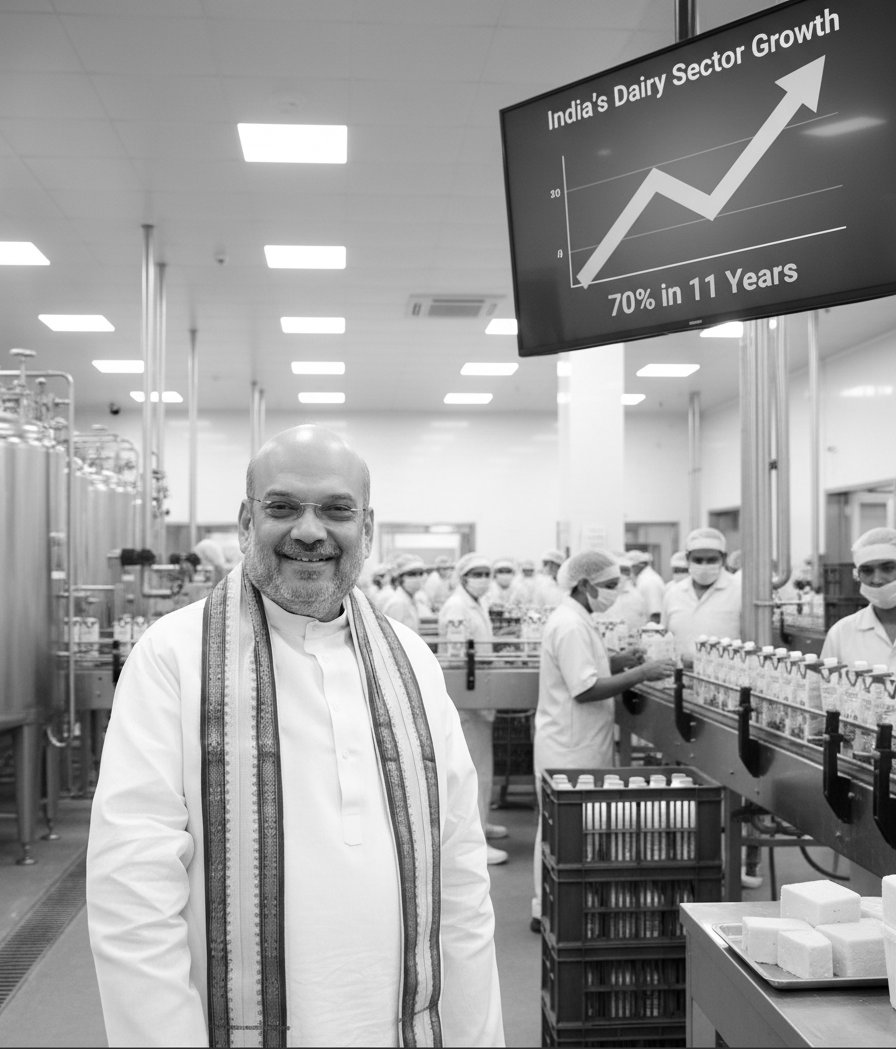
India’s dairy sector grows 70% in 11 years: Amit Shah
India’s dairy sector has seen remarkable expansion over the past 11 years, growing by 70 per cent and emerging as the fastest-growing dairy industry globally, union home minister Amit Shah said on Friday. Speaking at the inauguration of the Vijaya Dairy plant in Industrial Model Township, Rohtak, Shah highlighted both the progress made and the road ahead for the sector.
The newly inaugurated Vijaya Dairy facility, built at a cost of Rs 325 crore, is the country’s largest for curd, buttermilk, and yogurt, with a daily capacity of 150 metric tonnes of curd, 3 lakh litres of buttermilk, 10 lakh litres of yogurt, and 10 metric tonnes of sweets. Equipped with modern machinery, it will serve the National Capital Region and northern states, while generating employment opportunities for local communities.
Shah emphasized that the government has strengthened the cooperative system, ensuring farmers have better access to markets. “By 2029, not a single Panchayat will be without a cooperative Samiti,” he said. The government’s ambitious White Revolution 2.0 initiative aims to increase milk procurement to 1,007 lakh kg per day by 2028-29 and modernize dairy plants nationwide.
Production vs. farmer benefits
India’s milk production has risen from 146 million tonnes in 2014-15 to 239 million tonnes, and per capita milk availability has jumped from 124 grams to 471 grams per day. While 8 crore farmers are connected to the sector, the reality on the ground varies:
• Cooperative farmers linked with Amul, Vijaya Dairy, or other organized players generally receive stable prices and fair returns, often accounting for 80-85% of the consumer price.
• Marginal farmers in remote regions often rely on middlemen, face delayed payments, and struggle with rising input costs, limiting the income gains from increased production.
Quality and safety
Large cooperatives implement strict quality checks, using modern testing methods to prevent adulteration. However, milk from unregulated sources may still be adulterated with water, starch, or detergents, making vigilance necessary. Government agencies like FSSAI continue to monitor standards and promote awareness, but challenges persist in the informal sector.
Environmental and economic sustainability
Rapid growth brings sustainability concerns. Milk production is water-intensive and contributes to greenhouse gas emissions. Expansion of fodder cultivation can pressure land resources, while small farmers bear rising costs of feed and veterinary care. Meeting ambitious targets like White Revolution 2.0 requires modern, climate-smart practices, efficient cooperatives, and strong infrastructure, especially in regions currently underserved.
The big picture
India’s dairy sector is a remarkable success story, transforming the country into the world’s largest milk producer and increasing farmers’ incomes in many regions. But the path ahead requires careful attention to environmental impact, quality control, and equitable distribution of benefits. As Shah noted, modern infrastructure, cooperative expansion, and government support must work hand-in-hand to ensure that growth is both sustainable and inclusive, reaching every farmer across the nation.
The inauguration event was attended by Gujarat Vidhan Sabha Speaker Shankarbhai Chaudhary, union ministers Rao Inderjit Singh and Krishan Pal, Amul chairman Ashok Chaud, and Haryana BJP president Mohan Lal Badoli, among others, signaling a strong push for modernization and cooperative-driven growth across India’s dairy sector.