
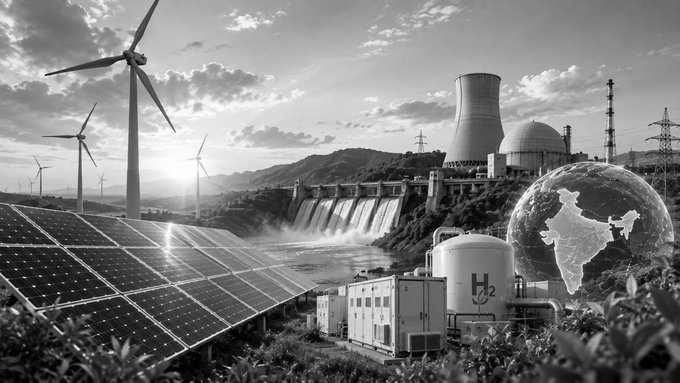
India’s Clean Energy Surge: 54% Non-Fossil Capacity, 2030 Goal Achieved Five Years Early
India’s clean-energy transition is gathering significant momentum, with non-fossil fuel sources now accounting for 54.18% of the country’s total installed electricity capacity, putting India well ahead of its original climate target and within striking distance of its enhanced 2035 goal.
The latest milestone, recorded as of June 30, 2026, comes after India crossed the 50% non-fossil capacity mark in June 2025, achieving its original Nationally Determined Contribution (NDC) target five years ahead of schedule. Under its enhanced climate commitments, India now aims to raise the share of non-fossil sources to 60% of installed electricity capacity by 2035.
At the current level, India needs to add only 5.82 percentage points to reach the 60% target. Given the country's rapid economic growth and accelerating expansion of renewable energy, the goal appears highly achievable if the current momentum is sustained.
However, the headline capacity figure needs some context. Having more than half of installed capacity from non-fossil sources does not mean that more than half of the electricity consumed in India is already coming from clean energy. In FY 2025-26, non-fossil sources accounted for roughly 29% of actual electricity generation, while fossil fuels continued to provide around 71%, with coal alone contributing nearly 68%.
This gap highlights the next challenge for India’s energy transition: converting its rapidly expanding clean-energy capacity into a much larger share of actual electricity generation. Greater investment in transmission networks, energy storage and grid integration will be crucial as solar and wind capacity expands.
India has also made progress on other climate commitments. Emissions intensity of GDP declined 37.38% between 2005 and 2022, against a 2030 target of 45%. The country also created an additional 2.44 billion tonnes of CO₂-equivalent carbon sink during the same period, close to its 2030 target of 2.5-3 billion tonnes.
The numbers underline a broader transformation. India has already won the race to cross its original clean-capacity milestone; the next challenge is ensuring that clean power increasingly replaces coal in the electricity actually generated and consumed.