
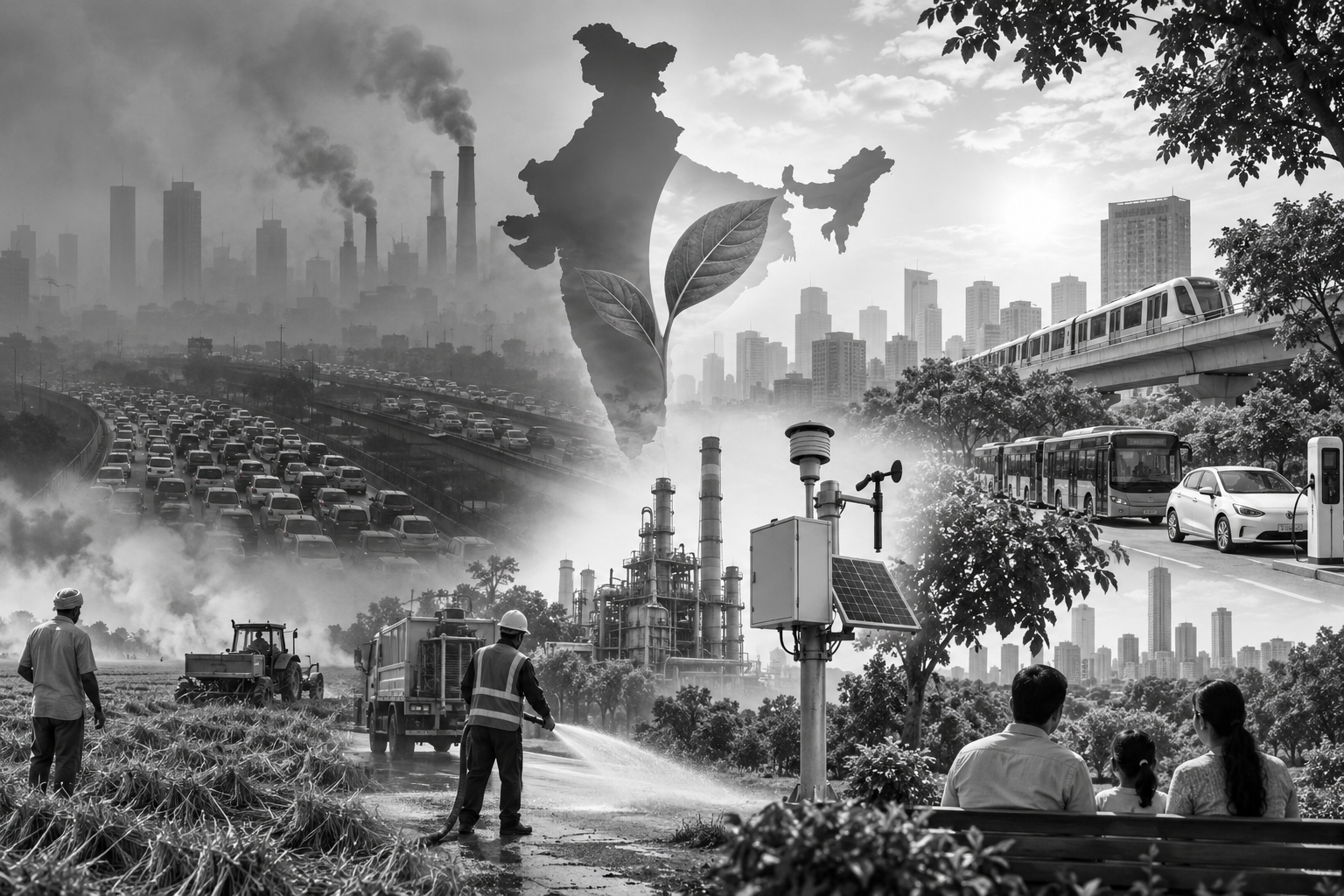
India’s Clean-Air Push: 108 Cities Record Lower PM10 Levels, 26 Cut Pollution by Over 40%
India’s multi-sectoral fight against air pollution is showing measurable results, with 108 of the 130 cities covered under the National Clean Air Programme (NCAP) recording lower annual PM10 concentrations in 2025–26 compared with the 2017–18 baseline. Of these, 72 cities registered reductions of more than 20%, 26 recorded reductions exceeding 40%, and 14 met the National Ambient Air Quality Standards (NAAQS). The figures were highlighted around Swachh Vayu Diwas, observed in India on September 7 alongside the International Day of Clean Air for Blue Skies.
Launched in 2019, NCAP initially targeted a 20–30% reduction in particulate pollution before its goal was strengthened to up to 40% reduction in PM10 or achieving the national standard of 60 µg/m³ by 2025–26. Clean Air Action Plans have been prepared by 24 States/UTs and 130 cities, backed by ₹16,423.55 crore between FY2019–20 and FY2025–26, of which cities reported utilisation of ₹11,575.54 crore.
India’s monitoring network has expanded to 1,646 stations across 603 cities in 28 States and seven UTs, while SAMEER provides near-real-time AQI information for more than 292 cities. The AQI tracks PM10, PM2.5, NO₂, SO₂, CO, O₃, NH₃ and lead across six categories from Good to Severe.
The government is targeting pollution at source through BS-VI vehicles, electric mobility, public transport, cleaner fuels, industrial emission controls, dust management and waste regulation. In Delhi-NCR, CAQM has mandated cleaner public buses from November 1, 2026, while revised industrial PM norms of 50 mg/Nm³ take effect from October 1.
Road and construction dust contributes around 40–50% of PM10 in many cities. Meanwhile, stubble-burning instances reportedly fell 93% in Punjab and 91% in Haryana in 2025 compared with 2021, supported by ₹4,233.84 crore in crop-residue management funding, more than 3.53 lakh machines and 43,535 Custom Hiring Centres.
The 2026 Swachh Vayu Survekshan placed Lucknow, Rourkela and Kalinganagar first in their respective categories, with assessments extending to more than 7,400 wards. Yet progress does not always mean clean air: Lucknow's PM10 fell from 250 to 137 µg/m³, still above the national standard of 60.
India’s next challenge is therefore to convert reductions into consistently healthy air, with greater focus on PM2.5, year-round enforcement, real-time monitoring, cleaner mobility, industrial compliance and stronger city-level implementation.