
India’s chip story finds a new chapter in Telangana
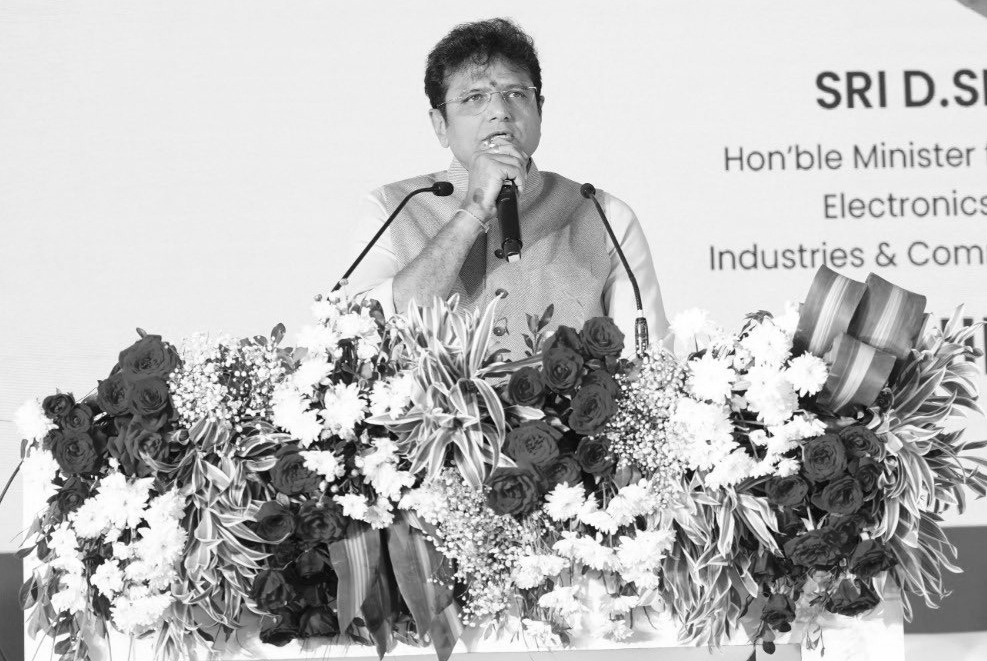
At the T-CHIP (Technology Chip Innovation Program) Semicon Constitution Summit held in Hyderabad, Telangana’s IT Minister Sridhar Babu Duddilla announced that the state is now focusing on expanding from chip design to manufacturing, marking a major shift in its semiconductor ambitions. He said Telangana already has a strong pool of design talent and is now preparing to take the next step toward establishing manufacturing and assembly units, provided there is sufficient support from the Central Government. “We have the design talent over here. The next is the process of manufacturing,” he remarked, emphasizing the state’s readiness to move up the semiconductor value chain.
Telangana has been strengthening its semiconductor ecosystem through several recent collaborations and investments. A Hyderabad-based company, ASIP Technologies, in partnership with South Korean firm APACT, has proposed a ₹890 crore Outsourced Semiconductor Assembly and Testing (OSAT) facility in the state. Telangana has also partnered with Japan’s Toho Koki Seisakusho to set up India’s first CMP Pad Technologies Hub at T-Works, Hyderabad, which will aid research and training in wafer polishing. In the academic sphere, IIT Hyderabad has signed a three-year Memorandum of Understanding with Renesas Electronics of Japan for research in VLSI and embedded systems. Additionally, Hyderabad-based Resolute Group and Taiwan’s SixUnited have joined hands to manufacture tablets and laptops in Telangana. In another major initiative, Malaysia’s Spring Semiconductors will train 10,000 Telangana youth in chip design and manufacturing by 2030, including international internships, while Cyient and Allegro MicroSystems have established a Centre of Excellence in Hyderabad for automotive sensor and semiconductor design.
These developments signal that Telangana is building a strong foundation across different stages of the semiconductor industry. The chip sector involves several key phases: design, where the chip architecture and layout are created; fabrication, where chips are produced on silicon wafers using advanced photolithography; assembly, packaging, and testing, where chips are cut, sealed, and verified; supply chain support, which ensures access to critical materials; and finally, integration into end-use products such as electronics and automobiles. Telangana already excels in design and is now expanding into assembly and testing, while working toward the long-term goal of full-scale fabrication.
However, experts caution that semiconductor manufacturing is one of the most complex and capital-intensive industries globally. A single fabrication plant can cost over $5–10 billion, and the process requires ultra-pure materials, precision tools, and cleanroom environments. Most raw materials and advanced lithography equipment are supplied by a handful of nations, primarily China, Japan, Taiwan, and South Korea. This makes India heavily dependent on imports, and without strategic partnerships and policy support, fabrication cannot be sustained at the state level alone.
In this context, the Government of India’s Semiconductor Mission (ISM) plays a crucial role, offering up to 50% financial support for approved projects and establishing international partnerships with the United States, Japan, and Taiwan to access technology and supply chains. The central government has also introduced incentive schemes such as PLI (Production Linked Incentives) and invited global firms like Micron and Foxconn to invest in India’s semiconductor sector. The Telangana government complements these efforts through local policy incentives, infrastructure, skill-building programs, and partnerships with institutions like IIT Hyderabad and organizations such as TITA.
Minister Duddilla praised the efforts of the Telangana Information Technology Association (TITA), which organized the T-CHIP summit and launched initiatives like Pitch2Press to help innovators connect with media and investors. A new technology journal was also unveiled to track semiconductor trends and research. “This is a novel initiative, a very vibrant step taken by TITA. We will try to encourage them too,” the minister said.
Industry experts note that Telangana’s current approach strengthening design, building OSAT capabilities, nurturing talent, and fostering international collaborations is a realistic and sustainable path toward manufacturing. With continued central support, foreign partnerships, and ecosystem building, Telangana could emerge as a major semiconductor innovation hub, gradually progressing from design and assembly toward full-scale chip fabrication in the years ahead.