
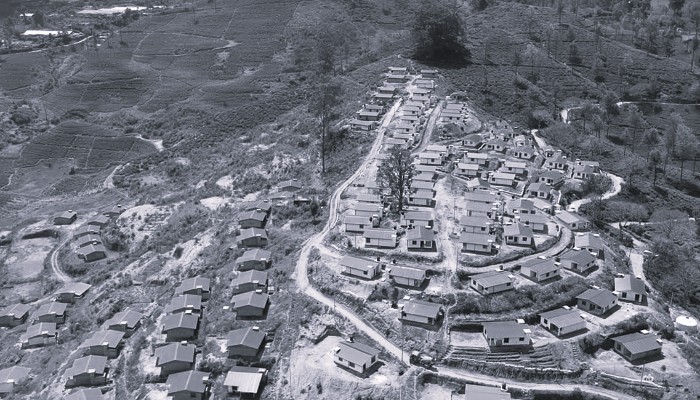
India's Brick-by-Brick Bond - 65,000 homes rise for Sri Lanka's forgotten Tamils
In the verdant hills of Bandarawela, Sri Lanka's central highlands, a ceremony on October 12 symbolized more than just construction milestones. Sri Lankan President Anura Kumara Dissanayake and Indian High Commissioner Santosh Jha inaugurated the second stage of Phase IV of the Indian Housing Project, a program that has become a cornerstone of bilateral ties.
Attended by ministers, deputies, and over 2,000 beneficiaries from plantation districts, the event highlighted India's commitment to uplifting the Indian-origin Tamil community descendants of laborers who arrived two centuries ago.
This initiative, pledging 65,000 houses across Sri Lanka's 25 districts, represents one of India's largest overseas development efforts. Fully grant-funded, it addresses shelter needs for war-displaced families and estate workers living in cramped "line rooms."
High Commissioner Jha emphasized, "India’s development cooperation is guided by a sense of family responsibility," while announcing a Rs 2.5 billion special package for the community's bicentennial. The project not only builds homes but fosters skills, infrastructure, and dignity, amid Sri Lanka's economic recovery.
Roots in Reconciliation: The Proposal's Genesis
The project's origins trace to the end of Sri Lanka's civil war in 2009, which displaced hundreds of thousands, mainly Tamils in the north and east. On June 8, 2010, during President Mahinda Rajapaksa's visit to New Delhi, Indian Prime Minister Manmohan Singh proposed constructing 50,000 houses as grant assistance, costing Rs 33 billion (about US$270 million). This was framed within India's "Neighborhood First" policy, honoring shared Tamil heritage and aiding post-conflict resettlement.
The Indian-origin Tamils, or Up-Country Tamils, added urgency. Brought from Tamil Nadu by British colonizers starting in 1825 for coffee and tea plantations, they number around one million today. For generations, they've endured poverty in substandard barracks, contributing to Sri Lanka's tea economy but lacking basic rights until citizenship reforms in the 1980s and 2000s. By 2010, over 244,000 families needed better housing.
A 2012 Memorandum of Understanding formalized the "owner-driven" model: beneficiaries receive staggered grants (up to Rs 550,000 for new builds) for self-construction, with technical aid from partners like UN-Habitat. This empowered locals, training thousands in masonry and carpentry, while promoting gender inclusion with women builders.
The Cost to India: A Strategic Investment
India's financial outlay totals approximately INR 1,835 crore (US$220 million) for the expanded 60,000-house scope, now at 65,000 with grants exceeding LKR 64 billion (US$213 million). The initial phases cost US$270 million, with Phase II at Rs 1,300 crore alone. Phase IV added LKR 11 billion. Funds cover materials, training for 17,000 people, and community facilities like water systems often matched by Sri Lankan inputs.
While substantial, the investment yields diplomatic dividends: stabilizing a neighbor, countering influences like China, and commemorating the Tamil diaspora's 200 years. Amid India's domestic needs, it's justified as humanitarian kinship. As Jha noted at the event, it builds "futures" beyond bricks, with disbursements surpassing LKR 33 billion by 2024.
Phases Unfolded: A Structured Evolution
The project adapts across phases, blending urgency with sustainability:
• Pilot Phase (2010-2012): 1,000 agency-built homes in Northern Provinces like Jaffna tested feasibility, completed swiftly for IDPs on state land.
• Phase I/II (2012-2018): Core commitment of 43,000 owner-driven units in war-torn north and east. Launched in 2012, it repaired or built over 46,000 homes by 2018, overcoming delays from land disputes. UN-Habitat handled 16,000, turning camps into villages with electricity and roads.
• Phase III (2016-Ongoing): 4,000 homes for plantation Tamils in Central and Uva regions. Community-led via cooperative societies, it began in 2016; by 2025, 3,900 are done, featuring model villages of 24 houses each across districts.
• Phase IV (2018-Ongoing): 10,000 additional units, announced by PM Narendra Modi in 2017 and formalized in 2018. Targeting 11 districts, construction started post-2023 agreements. The Bandarawela launch advances this, with 1,100 underway; Phases III-IV total 14,000, emphasizing low-income estate families.
Expansion to 65,000 reflects evolving needs, integrating smart features like health clinics.
A Legacy of Lives Rebuilt
At Rathnapura's Ven. Dhammavansa Nahimigama Model Village, also unveiled on October 12, joy was palpable. Beneficiaries, including estate workers, received keys amid cheers, escaping line-room squalor for modern homes. "This means education and health for my kids," shared one resident.
Challenges like material inflation and Sri Lanka's 2022 crisis persist, but progress endures training breaks cycles of poverty, empowering women and youth. President Dissanayake praised India's role in "social well-being," signaling deeper ties. Ultimately, this saga transcends aid; it's a testament to enduring partnerships. As homes rise in tea-scented hills, they weave India's narrative of regional prosperity, ensuring the Tamil legacy thrives in solidarity and stone.