
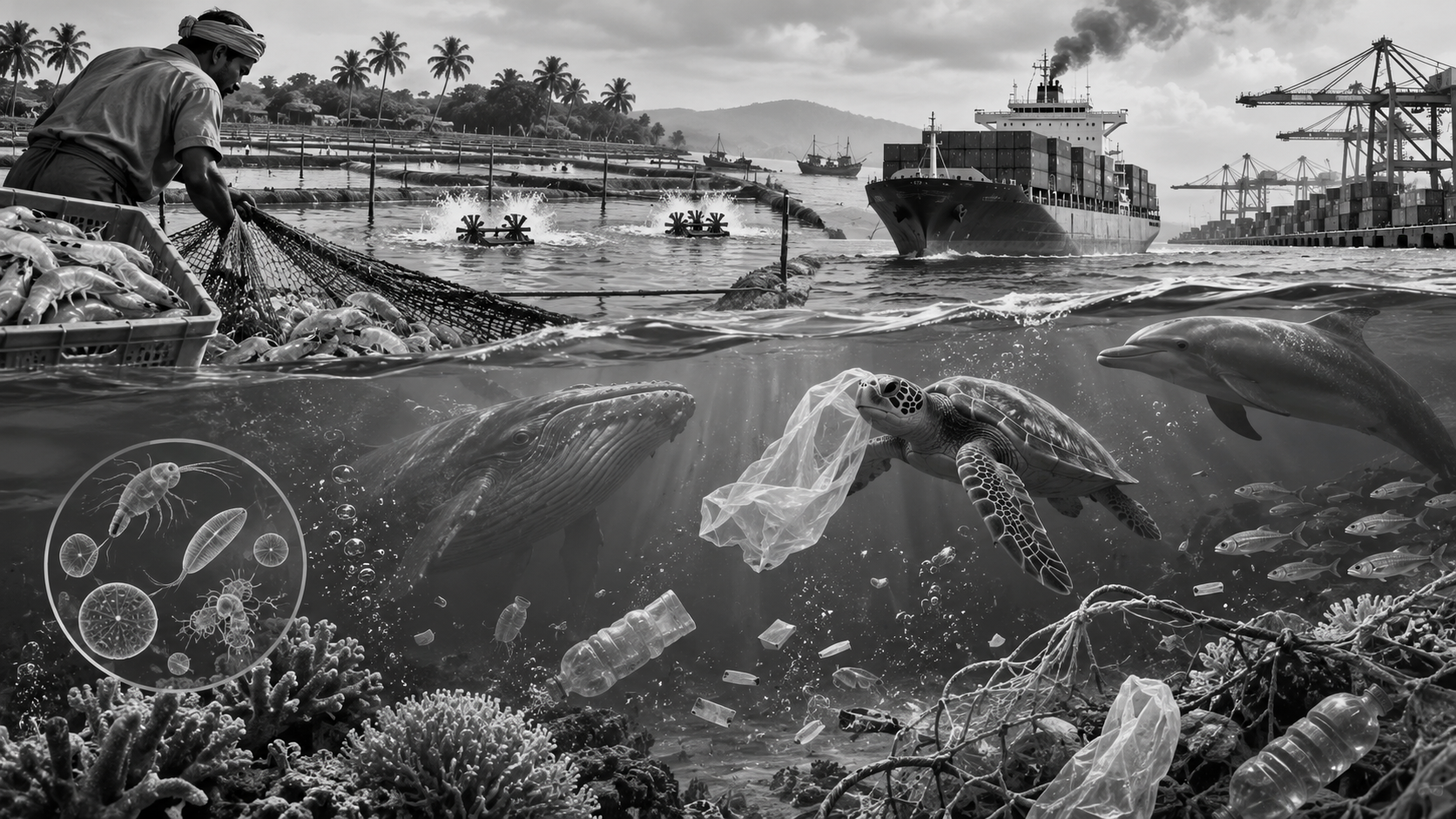
India's Blue Economy: Rising Seafood Exports, Shrinking Marine Ecosystems
The oceans are among the world's most valuable natural resources, supporting biodiversity, regulating the climate and providing food and livelihoods to millions. As India expands its seafood production, aquaculture industry and maritime infrastructure, its dependence on marine resources is increasing. However, beneath this economic growth, marine ecosystems are facing mounting pressure from plastic pollution, chemical contamination, shipping activities and climate change. The challenge is no longer simply how much seafood India can produce and export, but whether it can sustain this growth without damaging the ecosystems that support it.
India's Expanding Marine and Aquaculture Economy
India has emerged as the world's second-largest fish-producing and aquaculture nation, with total fish production increasing from 95.79 lakh tonnes in 2013–14 to 197.75 lakh tonnes in 2024–25, representing growth of more than 106%. The sector supports approximately three crore fishers and fish farmers. According to government estimates, fisheries contributed ₹1,65,075 crore to India's gross value added in 2022–23, accounting for 1.12% of the national total and 7.26% of agricultural gross value added. Globally, the FAO's State of World Fisheries and Aquaculture 2026 reported that aquatic animal production reached 195 million tonnes in 2024, with aquaculture contributing 103 million tonnes for the first time, surpassing capture fisheries.
A Decade of Seafood Exports and Growing Imports
India's seafood exports have expanded considerably over the past decade. According to the Marine Products Export Development Authority (MPEDA), export earnings increased from $5.78 billion in 2016–17 to a record $8.46 billion in 2025–26, while shipment volumes rose from approximately 11.35 lakh tonnes to 19.72 lakh tonnes. The industry experienced a setback during the COVID-19 pandemic, with earnings declining to $5.96 billion in 2020–21, before recovering to $8.09 billion in 2022–23. After fluctuating over the following two years, exports reached a new high in 2025–26, generating ₹73,890 crore.
Frozen shrimp remains the backbone of India's seafood exports, contributing $5.62 billion, or approximately 66.52% of total export earnings, in 2025–26. Other important products include frozen fish, squid, cuttlefish and dried seafood. The United States remained the largest individual destination at approximately $2.33 billion, followed by China at $1.61 billion, the European Union at $1.59 billion and Southeast Asia at $1.35 billion. However, exports to the US declined by approximately 14.2% in dollar value in 2025–26, highlighting the industry's exposure to international trade policies and market fluctuations.
Despite being a major exporter, India also imports seafood. International trade statistics show that imports under HS Chapter 03 increased from approximately $64.2 million in 2015 to $194.2 million in 2024. Bangladesh and Myanmar were among the major suppliers. Differences in species availability, seasonal demand and specialised processing requirements contribute to these imports. Separately, the aquaculture industry also depends on imported feed ingredients, fishmeal, fish oil, specialised equipment and technology, making domestic supply-chain development important.
Andhra Pradesh: The Centre of Shrimp Aquaculture
Andhra Pradesh occupies a leading position in India's seafood export industry because of its extensive shrimp-farming operations and processing infrastructure. The state exported approximately 3.66 lakh tonnes of marine products worth ₹21,246 crore in 2024–25. Its earnings increased from ₹15,832 crore in 2020–21, demonstrating the growing importance of aquaculture to the regional economy. However, shrimp farmers face rising feed costs, disease outbreaks, international price fluctuations and increasingly demanding export requirements. Intensive farming can also increase nutrient loading and organic waste in surrounding waters if farms do not follow appropriate water-management and wastewater-treatment practices.
International Quality Standards and Export Challenges
Maintaining international market access requires compliance with stringent food-safety and traceability requirements. In India, FSSAI, MPEDA, the Export Inspection Council and the Coastal Aquaculture Authority oversee different aspects of food safety, export quality and aquaculture regulation. International frameworks such as Codex Alimentarius and HACCP establish important food-safety principles, while the US FDA and European Union enforce importing-market requirements covering hygiene, contaminants, antibiotic residues and traceability. Certifications such as ASC, BAP and GlobalG.A.P. encourage responsible aquaculture, while MSC focuses on sustainable wild-capture fisheries. Prohibited antibiotic residues, heavy metals, microbial contamination and inadequate cold-chain management remain important risks for seafood exporters.
Plastic Pollution and the Invisible Marine Ecosystem
Beyond commercial fishing, the health of marine ecosystems depends on microscopic organisms such as phytoplankton, zooplankton, marine bacteria, cyanobacteria and diatoms. Phytoplankton contribute approximately half of global oxygen production through photosynthesis, while bacteria recycle nutrients and microscopic animals support larger marine food webs. Changes in these organisms can eventually affect fish populations and ecosystem productivity.
Plastic pollution threatens marine life at multiple levels. Turtles can mistake plastic bags for jellyfish, while whales, dolphins, seabirds and fish may ingest plastic or become entangled in discarded fishing nets. Smaller plastic fragments, known as microplastics, can enter marine food webs. A 2021 study published in The ISME Journal estimated that between 2.1 and 3.4 sextillion microbial cells inhabit floating plastic debris, demonstrating how plastic surfaces support distinct microbial communities known as the plastisphere. An Indian study published in Marine Pollution Bulletin that examined zooplankton along six eastern Arabian Sea locations detected an average of 22 ± 7 microplastic particles per cubic metre of sampled zooplankton. Fish larvae recorded 0.57 ± 0.18 particles per individual, compared with 0.03 ± 0.01 in copepods.
The National Centre for Coastal Research, under the Ministry of Earth Sciences, conducted microplastic surveys between 2022 and 2025 along India's eastern and western coastlines. Its assessments identified riverine inputs and abandoned fishing gear as important sources of marine debris. Industrial discharge, untreated sewage and agricultural runoff create additional threats by introducing chemicals and excessive nutrients into coastal waters. These nutrients can trigger algal blooms, followed by oxygen depletion when dead algae decompose, creating conditions in which marine organisms struggle to survive.
Ship Propellers, Underwater Noise and Marine Animals
Commercial shipping presents another growing environmental challenge. Cargo vessels, tankers and fishing boats generate underwater noise through engines, machinery and rotating propellers. Propeller cavitation, caused by the formation and collapse of bubbles around rotating blades, is a significant source of underwater noise. Such disturbances can interfere with the communication, navigation and feeding behaviour of whales, dolphins and other marine animals. Vessel collisions can also cause severe injuries or death. A 2024 study published in Science, analysing more than 435,000 whale-location records and over 35 billion ship-position records, found that shipping routes overlapped with approximately 92% of the modelled ranges of four globally distributed whale species. Fewer than 7% of identified collision-risk hotspots had management measures in place.
Ships can also transport potentially harmful aquatic organisms through ballast water. The International Maritime Organization (IMO) regulates this risk through its Ballast Water Management Convention. Its revised 2023 guidelines also encourage commercial shipping operators to reduce underwater radiated noise through improved vessel design, propeller maintenance and operational changes.
Climate Change and the Future of Marine Biodiversity
Rising sea temperatures, ocean acidification, marine heatwaves and declining oxygen levels are adding pressure to already vulnerable ecosystems. Coral bleaching, damage to seagrass habitats, changes in fish migration and disturbances to breeding grounds can affect marine biodiversity and fisheries productivity. Mangroves and coastal wetlands, which provide breeding habitats and protect shorelines, also require stronger conservation measures.
Building a Sustainable Blue Economy
India has several safeguards, including MARPOL, UNCLOS, the Ballast Water Management Convention and domestic coastal and environmental regulations. However, effective implementation requires stronger pollution monitoring, improved wastewater treatment, responsible aquaculture, recovery of discarded fishing nets and greater investment in marine research. Shipping companies must adopt quieter technologies and consider sensitive marine habitats when planning routes, while seafood producers need better traceability and environmental management.
India's record seafood exports demonstrate the economic potential of its oceans, but production and earnings alone cannot define the success of its blue economy. Protecting marine habitats, microscopic organisms and coastal biodiversity is equally important. The real measure of sustainable ocean development will be how effectively India balances economic growth with the preservation of the natural resources that sustain it.
Strengthen the opening news angleAdd a sharper central argument