
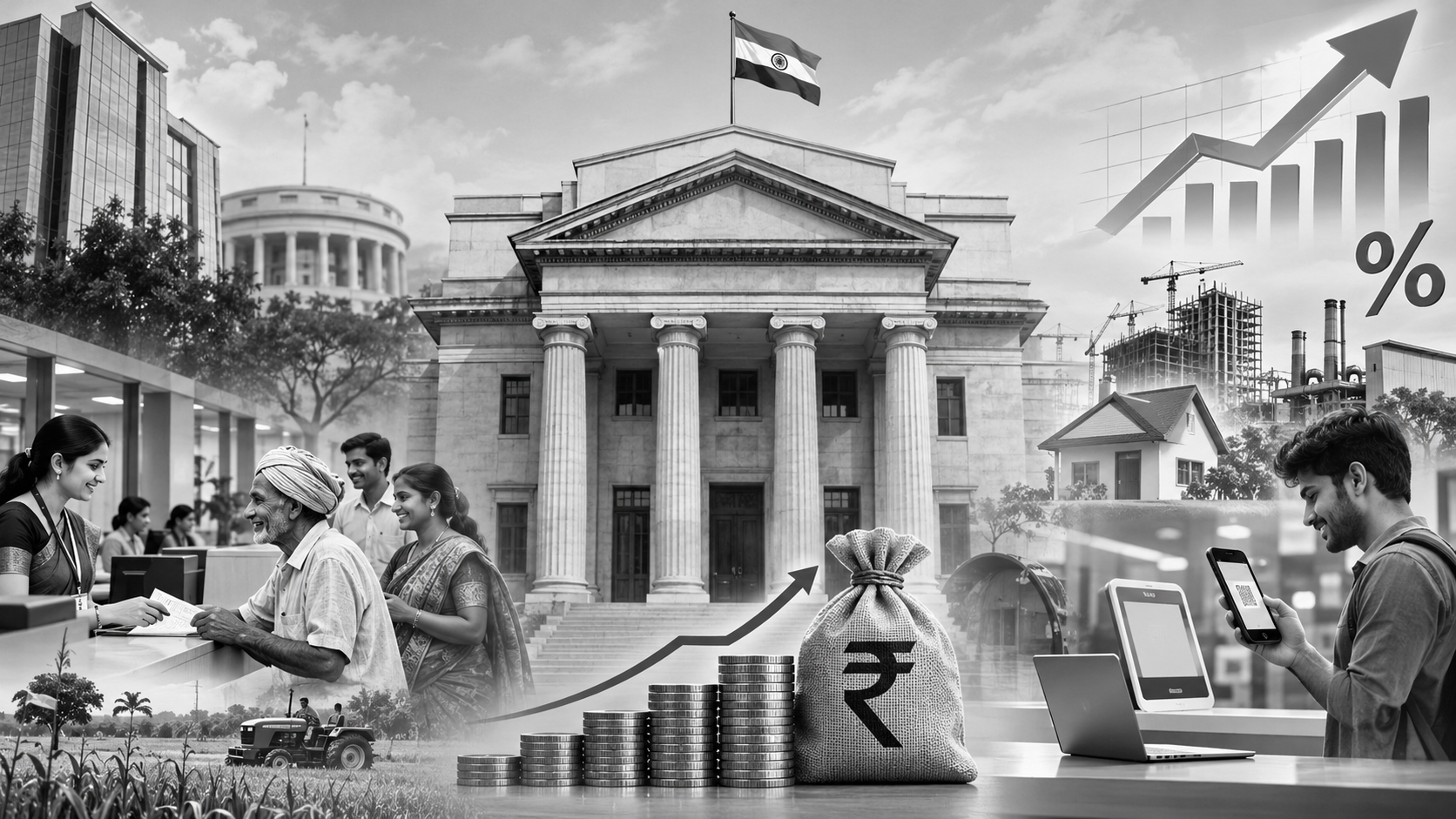
India's Banking Sector: The Changing Economics of Money and Credit
India's 12 public sector banks have reported a combined net profit of ₹1.09 lakh crore in the first half of FY 2026–27, registering a 16.9% increase over the corresponding period last year. Their aggregate business crossed ₹300 lakh crore for the first time, reaching ₹301.6 lakh crore as of September 30, 2026. Gross non-performing assets (NPAs) declined to 1.69%, while the net NPA ratio stood at 0.33%, reflecting improved asset quality. Operating profits increased 13.9% to ₹1.81 lakh crore, highlighting the strengthening financial position of government-owned lenders. Credit growth was particularly encouraging in the retail, agriculture and micro, small and medium enterprises (MSMEs) segments, at 17%, 19.5% and 20.4%, respectively. These developments indicate a significant recovery in public sector banking, which had previously struggled with mounting bad loans and weak profitability. However, the sector's progress also raises a broader question about how banks can balance commercial success with their responsibility towards economic development.
Evolution of India's Banking System
India's banking structure has evolved through several major policy decisions. Before nationalisation, commercial banking facilities were concentrated largely in urban centres, while farmers, small traders and rural communities struggled to access institutional credit. The nationalisation of 14 major commercial banks on July 19, 1969, under Prime Minister Indira Gandhi, sought to expand banking access and direct financial resources towards agriculture and other priority sectors. Six more banks were nationalised in April 1980. Economic liberalisation in 1991 subsequently introduced greater competition, encouraged private sector participation and strengthened banking regulation. Reforms involving capital adequacy, governance, supervision and loan recovery further transformed the industry. Consolidation through mergers reduced the number of public sector banks from 27 in 2017 to the present 12, with the objective of creating stronger and more competitive institutions.
India's Extensive Banking Network
According to the Deposit Insurance and Credit Guarantee Corporation (DICGC), India had 1,950 insured banks as of March 31, 2026, comprising 124 commercial banks and 1,826 cooperative banks. The commercial banking network includes 12 public sector banks, 21 private sector banks, 44 foreign banks, 28 regional rural banks, 11 small finance banks, six payments banks and two local area banks. Cooperative institutions include 1,440 urban cooperative banks, 352 district central cooperative banks and 34 state cooperative banks. While public and private commercial banks serve households and businesses, cooperative and regional institutions play an important role in extending financial services to rural communities. The government owns majority stakes in public sector banks, while private banks operate independently under the country's banking regulations.
RBI's Role in Managing the Banking System
Established on April 1, 1935, under the Reserve Bank of India Act, 1934, the Reserve Bank of India (RBI) was nationalised on January 1, 1949. As the country's central bank, it regulates financial institutions, manages monetary policy, issues currency and maintains financial stability. Although the RBI is wholly owned by the Government of India, its specialised monetary policy functions operate through a statutory framework. The Monetary Policy Committee, established in 2016, determines the policy interest rate to achieve the government's inflation target. The government manages taxation, expenditure and borrowing, while the RBI oversees currency issuance, liquidity and banking regulation. The Fiscal Responsibility and Budget Management Act, 2003, also restricted direct government borrowing from the RBI, with the relevant prohibition taking effect in April 2006, subject to specified exceptions. These safeguards aim to prevent excessive monetary financing and strengthen economic discipline.
How Banks Earn Money Through Lending
Banks primarily generate income by mobilising public deposits and providing loans to individuals, businesses and industries. Deposits are liabilities because banks are obligated to repay customers, while loans are assets that generate interest income. According to RBI data, scheduled commercial banks held approximately ₹282.51 lakh crore in deposits, ₹231.82 lakh crore in outstanding credit and ₹10.53 lakh crore in borrowings as of October 31, 2026. The resulting credit-deposit ratio was approximately 82.1%. Banks lend to sectors such as agriculture, manufacturing, infrastructure, housing, education and personal consumption. During FY 2024–25, scheduled commercial banks earned ₹22.69 lakh crore in interest income, compared with ₹20.10 lakh crore in the previous year. After paying ₹13.48 lakh crore in interest expenses, their net interest income stood at ₹9.21 lakh crore. Following operating expenses, provisions and taxes, their combined net profit reached approximately ₹4.01 lakh crore. Public sector banks accounted for ₹11.89 lakh crore of interest income, while private banks contributed ₹9.11 lakh crore.
Affordable Credit and Government Intervention
Government ownership of banks allows policymakers to influence lending priorities, particularly towards agriculture, MSMEs and economically weaker sections. However, public sector banks cannot continuously provide loans at extremely low interest rates because they must pay interest to depositors and meet operational expenses. Lending below the cost of funds could weaken their financial position. Instead, the government uses interest subvention, subsidies and credit guarantee schemes to reduce borrowing costs for eligible beneficiaries. Priority sector lending requirements also encourage banks to support agriculture, small businesses, education and other specified activities. The objective is to ensure that financial resources reach underserved sections without compromising banking stability.
Financial Inclusion and Digital Transformation
The Pradhan Mantri Jan Dhan Yojana has significantly expanded access to formal banking. By August 2026, the initiative had recorded 59.09 crore accounts with deposits of approximately ₹3.17 lakh crore, with women holding 55.7% of the accounts. The RBI's Financial Inclusion Index also improved to 67.0 in March 2025 from 64.2 a year earlier. Digital payments have further transformed the sector, with UPI processing approximately 25.47 billion transactions worth ₹31.53 lakh crore during October 2026. Banks are increasingly adopting artificial intelligence, data analytics and automated services to improve efficiency and detect fraudulent transactions. Nevertheless, cybersecurity threats, phishing, identity theft and unauthorised transactions remain serious concerns.
NPAs, Depositor Protection and Financial Stability
Bad loans remain an important measure of banking sector health. Under RBI norms, loans generally become non-performing assets when principal or interest remains overdue for more than 90 days. India's gross NPA ratio declined to 1.8% in March 2026, while the capital-to-risk-weighted-assets ratio reached 17.7%, indicating stronger financial buffers. The Insolvency and Bankruptcy Code, 2016, and improved recovery mechanisms have contributed to better resolution of distressed assets. Depositor confidence is supported by DICGC insurance, which protects eligible deposits up to ₹5 lakh per depositor per bank, including principal and interest, subject to applicable rules.
The Road Ahead
India's banking industry must now balance profitability with financial inclusion, responsible lending and technological security. Public sector banks will remain important for agricultural finance, infrastructure and welfare programmes, while private lenders will contribute through competition and innovation. Institutions such as NABARD, SIDBI, EXIM Bank and NaBFID support specialised development financing. However, slower deposit mobilisation compared with credit growth, emerging cyber risks, climate-related financial exposure and governance challenges require continued attention. Ultimately, the strength of India's banking system will not be measured solely by its profits or lending volumes, but by its ability to protect public savings, provide affordable credit, finance productive enterprises and support sustainable economic development.