
India’s 100 GW Nuclear Plan Signals Major Shift in Energy Strategy
India’s nuclear energy programme is moving beyond policy ambition into tangible execution, with rising electricity generation reinforcing its long-term 100 GW capacity target by 2047 . The latest data underscores this shift: nuclear power generation climbed to 56,681 million units (MU) in 2024–25 , up sharply from 47,971 MU in 2023–24 and 45,855 MU in 2022–23 .
This is not merely incremental growth it reflects a step change in reactor performance and capacity utilisation , signalling improved efficiency across India’s nuclear fleet.
Currently, India operates 24 reactors with a combined installed capacity of around 8,780 MW , contributing roughly 3% of total electricity generation . However, the real momentum lies in what’s coming next. A strong pipeline of 18 reactors (about 13,600 MW) is under construction or in advanced planning stages, forming the backbone of near-term expansion.
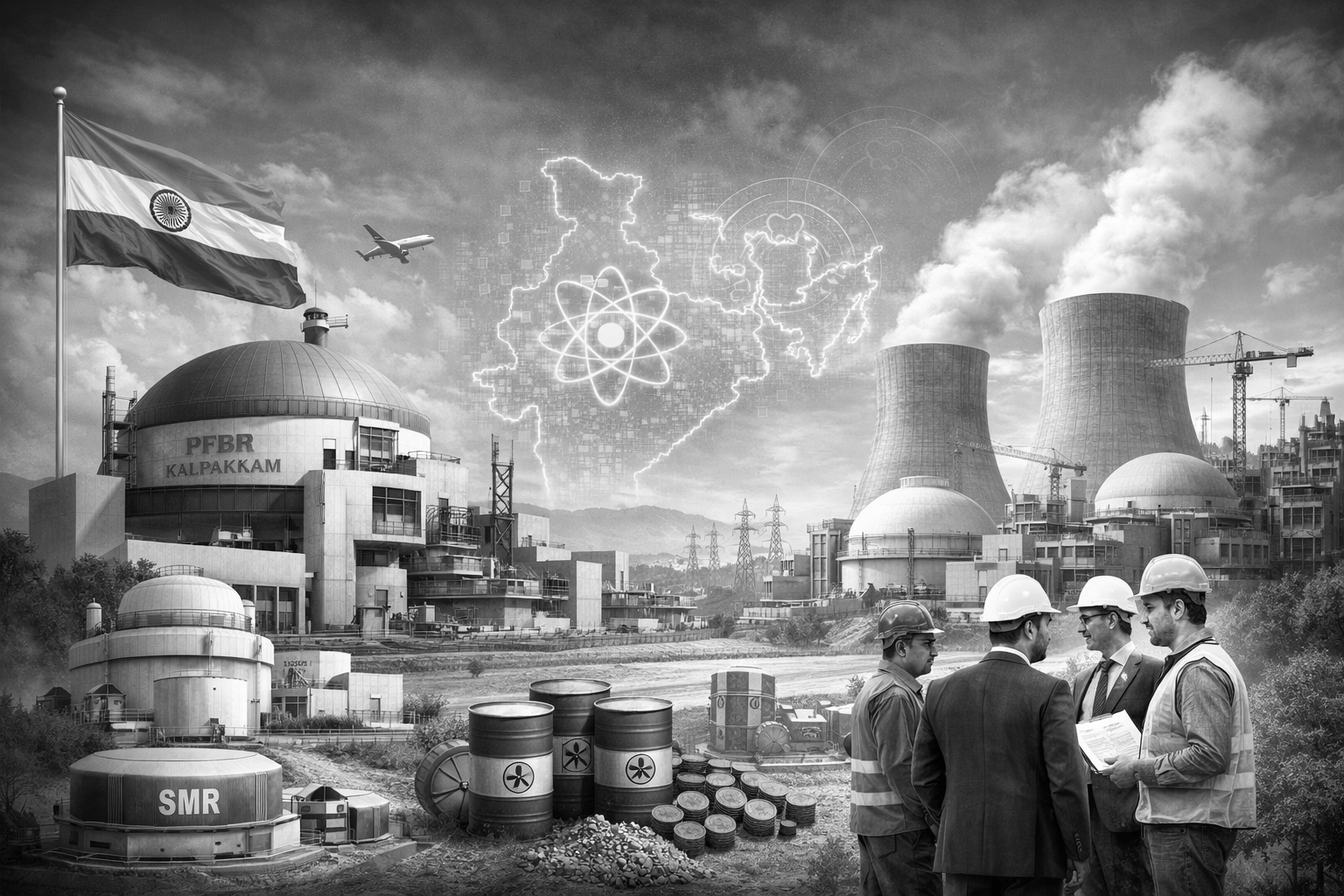
Key projects are driving this surge. The expansion of the Kudankulam Nuclear Power Plant with additional Light Water Reactors, alongside a fleet of 700 MW indigenous Pressurised Heavy Water Reactors (PHWRs) at Kakrapar, Rajasthan, and Gorakhpur, is accelerating capacity addition. At the technological frontier, the 500 MWe Prototype Fast Breeder Reactor (PFBR) at Kalpakkam developed by BHAVINI marks a critical milestone in India’s three-stage nuclear programme, with plans for further breeder reactors already underway.
The broader roadmap remains ambitious. Capacity is expected to reach 22 GW by 2031-32 , then expand to 54 GW through NPCIL-led projects , with the remaining 46 GW to be developed via public-private partnerships enabled by the SHANTI Act .
Strategically, nuclear energy is gaining importance as a reliable baseload power source , especially amid rising demand from AI-driven data centres, industrial growth, and grid stability needs . It also reduces dependence on volatile energy imports.
Yet the gap between potential and reality remains stark. Despite recent gains, nuclear still plays a limited role in India’s energy mix.
The real question now is whether India can transition from steady progress to sustained large-scale expansion turning its nuclear ambition into a defining pillar of its future energy security.