
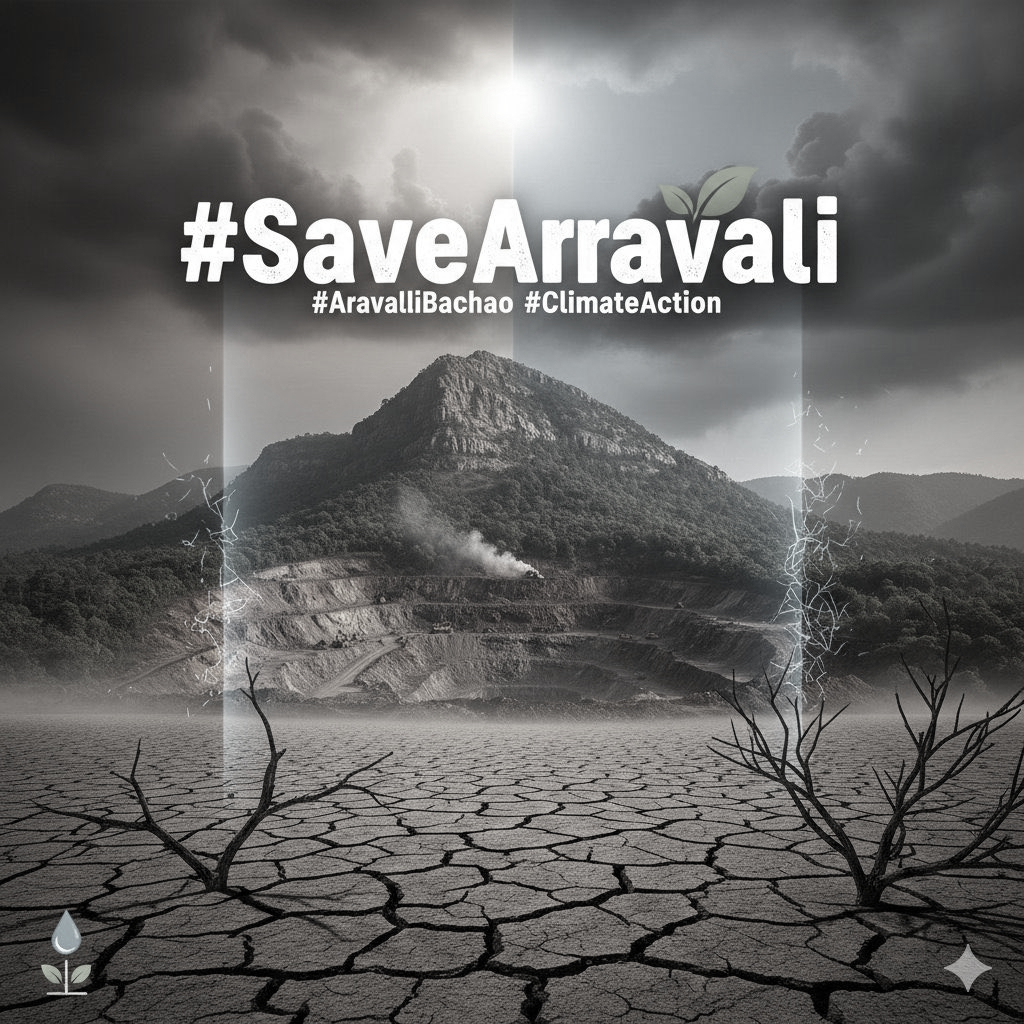
Indians rally behind #SaveAravalli campaign as debate over hills redefinition intensifies
A growing number of Indians, including senior opposition leaders, have joined the #SaveAravalli campaign by changing their social media profile pictures, as concerns mount over a recent Supreme Court-backed redefinition of the Aravalli hills that critics say could expose vast stretches of the ancient range to mining and environmental damage.
The controversy stems from a Supreme Court ruling on November 20, 2025, in which the court accepted a definition submitted by the Centre through the Ministry of Environment, Forest and Climate Change. Under this interpretation, only landforms with a local relief of at least 100 metres are to be officially recognised as Aravalli hills across 12 districts in Gujarat, Rajasthan and Haryana. Environmental groups warn that this narrow criterion could exclude up to 90 per cent of the Aravalli landscape, stripping smaller hills and ridges of legal protection.
Congress leader and former Rajasthan chief minister Ashok Gehlot on Thursday sharpened his criticism of the Centre, alleging that the revised definition effectively opens large parts of the fragile mountain system to mining and commercial exploitation. According to Gehlot, landforms below 100 metres in height are no longer treated as part of the Aravallis, allowing mining activities in ecologically sensitive “gap areas” and low-lying ridges.
The former chief minister clarified that there is no separate government order (GO) redefining the Aravallis. Instead, the change has come through the Centre’s submission to the Supreme Court, which has now been accepted for regulatory and mapping purposes. Environmentalists and opposition leaders argue that this judicially accepted definition is already influencing decisions on mining and construction permits.
Calling the move “dangerous and shortsighted,” Gehlot said the Aravallis should not be assessed by height alone but by their ecological importance. In support of the nationwide SaveAravalli campaign, he changed his display picture on social media and appealed to citizens to do the same to amplify public awareness.
Gehlot warned that excluding hills below 100 metres could accelerate desertification from the Thar desert, intensify heatwaves, and worsen air pollution across north India. Describing the Aravallis as the “lungs of northern India,” he said the hills and forests act as a natural barrier against dust storms, help absorb pollutants and moderate temperatures, particularly for Delhi, Haryana and western Uttar Pradesh.
“With pollution already at alarming levels even with the Aravallis standing, the consequences of weakening this range would be disastrous,” he said.
Highlighting the region’s water stress, Gehlot noted that the rocky terrain of the Aravallis plays a vital role in groundwater recharge, allowing rainwater to percolate underground. Damage to the hills, he warned, would deepen drinking water shortages, threaten wildlife and push the region’s ecology towards irreversible harm.
From a scientific standpoint, Gehlot argued that the Aravallis form a continuous mountain chain, and that smaller hillocks are as crucial to the ecosystem as higher peaks. He urged the Centre and the Supreme Court to reconsider the definition in the interest of environmental security and future generations.
Other Congress leaders, including Pawan Khera and Sonia Gandhi, have also voiced support for the campaign, underscoring the growing political and public push to protect one of the world’s oldest mountain ranges.