
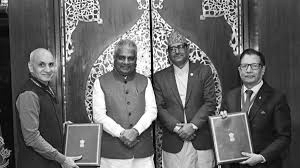
India,Nepal sign MoU to deepen cooperation on forests,wildlife and climateaction
India and Nepal on Wednesday signed a memorandum of understanding (MoU) to strengthen bilateral cooperation in the areas of forests, wildlife, environment, biodiversity conservation and climate change, officials said.
The agreement will focus on joint conservation initiatives across key transboundary landscapes along the India–Nepal border , including the Terai Arc Landscape spanning Uttarakhand, Uttar Pradesh and Bihar in India and adjoining regions of southern Nepal, the Kangchenjunga Landscape covering Sikkim and eastern Nepal, and high-altitude Himalayan areas of Uttarakhand and western Nepal.
The MoU envisages landscape-level biodiversity conservation strategies with emphasis on transboundary species such as elephants, Gangetic dolphins, rhinoceroses, snow leopards, tigers and vultures.
Joint projects will be implemented through a bilateral coordination mechanism involving designated nodal agencies and technical working groups, with funding mobilised through national allocations and international climate and biodiversity finance. Priority projects are expected to be identified within the first year, followed by phased implementation and periodic review. The agreement also provides for structured data-sharing on wildlife movement, habitat connectivity and emerging conservation threats.
The MoU covers strengthening forest and protected area management, restoration of wildlife corridors, combating forest and wildlife crime, capacity-building of frontline staff and promotion of smart green infrastructure in biodiversity hotspots. Local communities will support conservation through participatory forest management, wildlife monitoring and measures to reduce human–wildlife conflict, backed by training and livelihood-linked incentives.
Officials said the new MoU marks a shift from earlier India–Nepal environmental agreements , which were largely sector-specific or project-based, by adopting an integrated, landscape-level and transboundary approach , with defined implementation mechanisms, timelines and systematic data-sharing, aimed at long-term conservation outcomes rather than standalone initiatives.
The document was signed in the presence of Bhupender Yadav , Union Minister for Environment, Forest and Climate Change, and Madhav Prasad Chaulagain , Nepal’s Cabinet Minister for Forests and Environment. Officials said India and Nepal share rich biodiversity and protected area networks, making closer coordination essential to address conservation and climate challenges across shared ecosystems.