
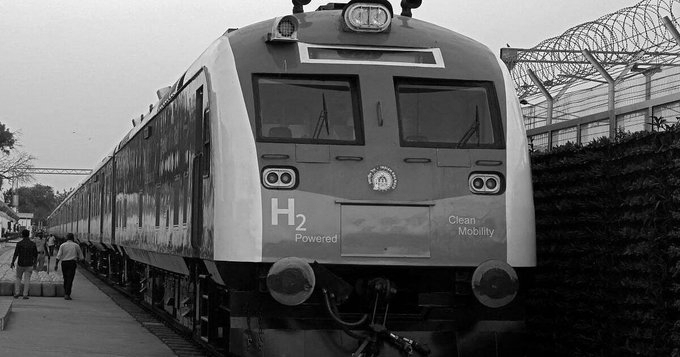
Indian Railways Targets 110 Kmph Speed for Hydrogen-Powered Train
Indian Railways is working to operate the country’s first hydrogen-powered train at speeds of up to 110 kmph, after successfully completing trials at 120 kmph, Railway Board Chairman and CEO Satish Kumar said on Sunday.
“The operational speed of the hydrogen train has so far been kept at 75 kmph. However, trials have been completed for a speed of 120 kmph. After that, efforts are now underway to operate it at a maximum speed of 110 kmph,” Kumar told reporters in Indore.
The Railway Board is consulting stakeholders to identify suitable routes for the hydrogen train. Technical requirements, operational arrangements and hydrogen fuel supply are also being examined before its wider deployment.
Prime Minister Narendra Modi had on July 17 flagged off India’s first hydrogen-powered train, which operates on the 89-km Jind-Sonipat route in Haryana. Unlike conventional electric trains, the hydrogen fuel-cell train generates electricity onboard through a chemical reaction between hydrogen and oxygen. Water vapour and heat are its only by-products, eliminating combustion, smoke and tailpipe carbon emissions.
Kumar also said India’s first Vande Bharat sleeper express is currently operating between Howrah and Kamakhya, while four more sleeper trains have been completed and are expected to be formally inaugurated soon. The Railways is likely to receive another 11 Vande Bharat sleeper trains this year.
As many as 200 Vande Bharat sleeper trains are being manufactured under the public-private partnership model, with each train expected to take around 12 to 18 months to complete.
Ahead of the 2028 Simhastha festival in Ujjain, the Railways plans to operate 100-125 special trains and strengthen infrastructure to manage the expected passenger rush.
Kumar said AI-enabled CCTV systems were being integrated to enhance railway security, while measures were also being taken to address rat-related problems.
On the ₹18,500-crore Indore-Manmad railway line, Kumar said land acquisition was progressing rapidly. The project is expected to be completed within four to five years.