
Indian Railways Plants 81 Lakh Trees, Powers Nationwide Green Transformation
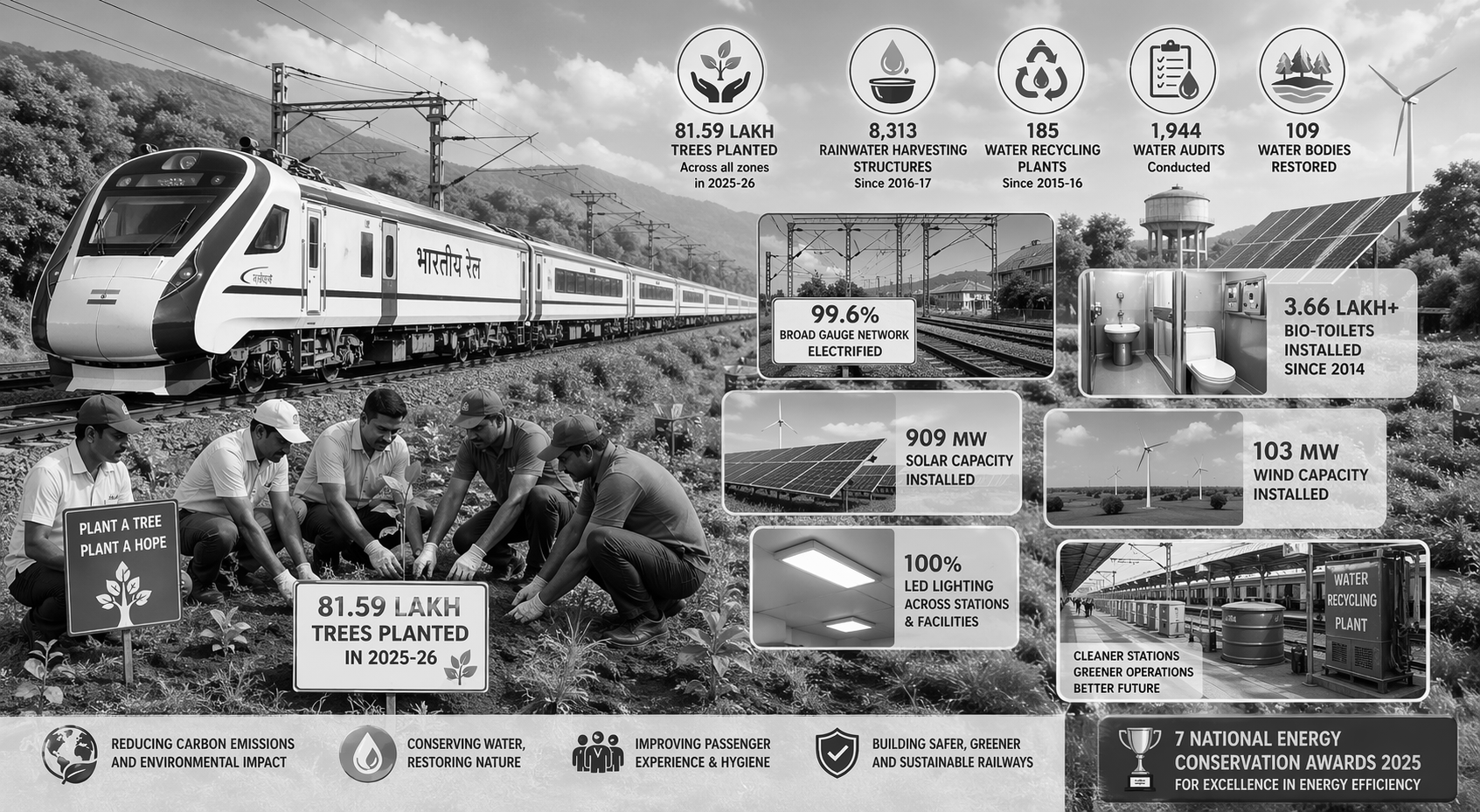
In a major sustainability push aligned with World Earth Day 2026 , Indian Railways has planted 81.59 lakh trees during 2025–26 , while accelerating efforts in electrification, water conservation, and renewable energy. The initiative underscores the Railways’ growing role as a central force in India’s environmental transition, as it continues to serve over 2 crore passengers daily .
The large-scale plantation drive, carried out across all railway zones, stands out as one of the biggest afforestation efforts by a public sector organisation. The Northeast Frontier Railway emerged as the top contributor with 9.3 lakh trees , followed by South Central Railway (9 lakh) , Northeast Railway (8.7 lakh) and Northern Railway (8.5 lakh) . These plantations along railway tracks, station premises, and available land are improving biodiversity, reducing carbon emissions, and enhancing the overall travel experience.
Beyond environmental benefits, the initiative is also strengthening infrastructure safety. Tree cover along tracks helps bind soil, reducing erosion and mitigating landslide risks , particularly in high rainfall and hilly regions. Vegetation also improves water absorption and controls surface runoff, ensuring more stable railway operations.
Notably, the programme has been executed largely as a government-led, in-house effort , driven by railway zones and departments. While there is no evidence of direct corporate or private sector partnerships in this specific initiative, certain activities have seen coordination with government agencies such as state forest departments . The absence of corporate involvement highlights the Railways’ internal capacity to implement large-scale environmental programmes across its vast network.
Indian Railways has also adopted a comprehensive water management strategy. Since 2016–17, it has installed 8,313 rainwater harvesting systems , commissioned 185 water recycling plants , conducted 1,944 water audits , and restored 109 water bodies . These measures are helping reduce water dependency while improving groundwater recharge and ecological balance, especially in water-scarce regions.
A key pillar of this transformation is near-total electrification. With 99.6% of the Broad Gauge network electrified , the Railways has saved 178 crore litres of diesel , significantly cutting emissions and reducing dependence on imported fuel. This shift is supported by a strong renewable energy push, with 909 MW solar and 103 MW wind capacity installed , and an additional 3,300 MW tied up for future use.
Passenger hygiene has also improved with the installation of over 3.66 lakh bio-toilets in coaches, eliminating direct discharge of waste on tracks and promoting cleaner stations and travel conditions.
Despite the scale of these initiatives, no separate budget allocation has been specified for the plantation drive, as such efforts are typically funded through the Railways’ broader operational and infrastructure expenditure. Similarly, while no exact employee participation figures are available , the initiative is described as a nationwide coordinated effort involving multiple departments and extensive field-level workforce across zones .
The Railways’ sustainability efforts have earned national recognition, with 7 National Energy Conservation Awards in 2025 , reaffirming its leadership in energy efficiency and green infrastructure.
As Indian Railways continues to expand its environmental initiatives, its integrated approach spanning afforestation, water conservation, clean energy, and sanitation signals a long-term commitment to building a resilient, efficient, and environmentally responsible transport system for the country.