
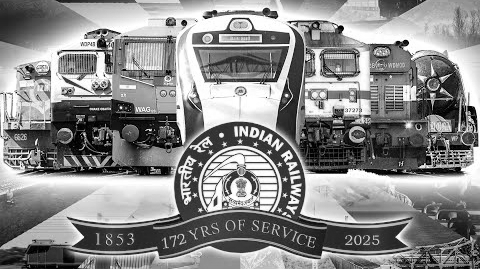
Indian Railways 2025: Big Gains, Bigger Challenges Ahead
As 2025 comes to an end, Indian Railways presents the year as a defining moment in its long journey one marked by scale, speed and ambition. From the rapid expansion of modern trains such as Vande Bharat and Amrit Bharat , to airport-like station redevelopments, large-scale track renewals, AI-backed safety systems and record freight movement, the national transporter has pushed itself closer to the image of a future-ready, world-class rail network. At the same time, the year also exposed deep structural challenges that Indian Railways will have to confront as demand grows sharper and expectations rise further in 2026.
During 2025, Indian Railways focused strongly on improving passenger experience. A total of 164 Vande Bharat train services were operational across the country by the end of December, with 15 new services introduced during the calendar year alone. The much-awaited Vande Bharat Sleeper trains are expected to begin operations soon, promising faster and more comfortable overnight travel for long-distance passengers. Parallelly, affordable comfort for non-AC travellers was expanded through Amrit Bharat trains. Thirteen new Amrit Bharat services were introduced in 2025, taking the total to 30 nationwide, positioning them as a major upgrade for the common passenger.
Regional and short-distance connectivity also received attention with the introduction of Namo Bharat Rapid Rail services on select high-demand corridors such as Bhuj–Ahmedabad and Jaynagar–Patna . These services are intended to reduce travel time and improve frequency in areas where daily commuter and regional travel demand is rising steadily.
To manage heavy passenger volumes, especially during festivals and peak seasons, Railways operated over 43,000 special train trips in 2025. This included more than 17,000 trips for the Maha Kumbh, along with thousands of additional services for Holi, the summer rush and Chhath Puja. While these numbers underline the scale at which Indian Railways operates, they also reflect a recurring challenge—demand during peak periods far outpaces normal capacity, forcing the system to rely on temporary operational solutions year after year.
Infrastructure upgrades formed the backbone of the 2025 push. Between April and November, more than 900 kilometres of new track lines were commissioned. Track renewals were carried out across thousands of kilometres, alongside turnout renewals and upgrades to support higher speeds. Over the past 11 years, Railways has laid over 34,000 kilometres of new track , more than doubling the pace achieved in the preceding decade. Sectional speeds were raised to 130 kmph on key stretches, and 110 kmph speeds were enabled across thousands of kilometres, helping reduce journey times on busy routes.
Electrification also moved closer to completion, with about 99.2 per cen t of the Broad Gauge network now electrified. Fourteen railway zones and 25 states and Union Territories have achieved 100 per cent electrification, supporting the broader shift toward cleaner and more energy-efficient rail operations.
Safety was highlighted as one of the strongest achievements of the year. Consequential train accidents declined sharply, falling to just 11 in 2025–26 (up to November), compared with an annual average of 171 during 2004–14. The safety budget has nearly tripled over the last decade. Central to this improvement has been the rollout of the indigenously developed Kavach Automatic Train Protection system, with Version 4.0 commissioned across 738 route kilometres. CCTV surveillance was expanded to more than 1,700 stations and nearly 12,000 coaches, while AI-based intrusion detection systems were deployed in wildlife-sensitive corridors.
Passenger-facing infrastructure saw a visible transformation under the Amrit Bharat Station Scheme. Out of 1,337 stations selected for redevelopment, 155 were fully modernised by December 2025, offering facilities such as upgraded toilets, lifts, escalators, wider concourses, modern waiting halls, digital signboards and better accessibility for Divyang passengers. Stations are increasingly being reimagined as city hubs rather than mere transit points. Railways also introduced changes in catering, bringing local cuisine and improved hygiene standards into the onboard food experience.
Several landmark connectivity projects were showcased as symbols of engineering capability. The completion of the Udhampur–Srinagar–Baramulla Rail Link provided all-weather rail connectivity to Kashmir through tunnels and iconic bridges such as the Chenab Bridge and Anji Bridge. In the Northeast, the Bairabi–Sairang line brought Mizoram onto the railway map for the first time, promising long-term gains in mobility and economic access. The New Pamban Bridge, India’s first vertical-lift railway sea bridge, strengthened pilgrimage and tourism connectivity to Rameswaram while being projected as a gateway for future regional transport possibilities.
Freight emerged as another major pillar of growth. Indian Railways crossed the milestone of one billion tonnes of freight loading in FY 2025–26, positioning itself as the world’s second-largest freight carrier. Dedicated Freight Corridors handled more than 400 trains daily on average , easing congestion on conventional lines. Gati Shakti Cargo Terminals, record wagon production, and new logistics services strengthened Railways’ role in national supply chains, including first-ever freight movements to regions such as Kashmir and Mizoram.
Alongside these achievements, however, long-term setbacks remain visible. One of the most critical challenges is maintenance pressure . While capital expenditure on new assets has risen sharply, audits and expert assessments have consistently pointed to backlogs in renewals and replacement of ageing tracks, bridges and signalling systems. Without sustained and timely maintenance, safety gains and speed improvements risk being diluted over time.
Capacity constraints and congestion continue to trouble the network, especially on high-density routes where passenger, freight and suburban services compete for limited paths. Despite new lines and DFCs, many corridors remain saturated, leading to delays and operational stress. This problem becomes acute during peak seasons, when demand surges sharply and Railways must depend heavily on special trains and last-minute adjustments.
Train availability and ticketing uncertainty remain major passenger pain points. Long waitlists, especially during festivals and holidays, create unpredictability for travellers. While measures such as Aadhaar-authenticated booking and capping waitlists aim to prioritise genuine passengers, they have not fully resolved the mismatch between demand spikes and seat availability.
Digital dependence has also brought refund and booking-related frustrations into sharper focus. IRCTC outages during Tatkal booking windows, slow transaction responses and confusion around refund eligibility often lead to public dissatisfaction. Although refund rules exist for delays, cancellations and service failures, the process can appear complex and time-sensitive for ordinary passengers, affecting trust in the system.
Financial structure adds another layer of pressure. Passenger services continue to be heavily subsidised, with freight revenues cross-subsidising operations. As Railways invests more in safety, maintenance and modernisation, balancing affordability with financial sustainability remains a persistent challenge.
The Mumbai–Ahmedabad High-Speed Rail (bullet train) project symbolises both ambition and complexity. The project has crossed the halfway mark in physical progress, with significant advances in viaducts, piers and girder work. However, land acquisition delays, execution bottlenecks and the sheer scale of engineering involved have pushed timelines forward. The Gujarat section is targeted for completion by 2027, with the full corridor expected by around 2029. While the project is expected to redefine intercity travel, it also underscores the difficulties of delivering mega rail projects on schedule and within cost in India.
Taken together, the story of 2025 is one of strong momentum paired with unresolved structural stress. Indian Railways has clearly improved its performance—trains are faster, stations are better, safety indicators are stronger, and freight capability is expanding. But the coming year will test how well the system can balance performance with pressure . In 2026, rising passenger volumes, sharper peak-hour demand, higher expectations of service quality, and the need for continuous maintenance will demand a more agile and dynamic railway system.
The challenge ahead is not only to build new infrastructure, but to manage what already exists with precision and reliability. If Indian Railways can align expansion with maintenance discipline, digital reliability with passenger trust, and capacity planning with real-time demand, it can sustain the gains of 2025. Otherwise, the very success that has raised expectations could become its toughest test in the years ahead.