
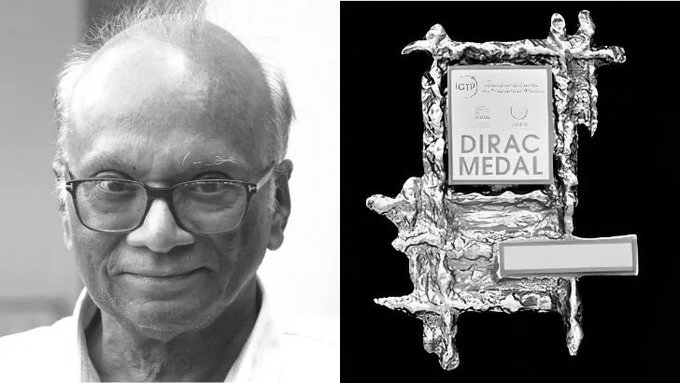
Indian Physicist Deepak Dhar Wins 2026 Dirac Medal, Joins Stephen Hawking And Physics Giants
Indian physicist Deepak Dhar has won the 2026 Dirac Medal, one of theoretical physics' leading honours, for his important contributions to statistical mechanics. He shares the award with Bernard Derrida, Marc Mézard and Haim Sompolinsky. Their work has helped expand statistical mechanics into areas such as AI, biology, finance, computer science, optimisation and neuroscience.
The Dirac Medal was started in 1985 in honour of physicist Paul Dirac and is awarded every year on August 8, his birthday. Past winners include Stephen Hawking. Eight Dirac medallists have later won the Nobel Prize in Physics. The award is not given to scientists who have already won the Nobel, Fields or Wolf Prize.
Dhar was born in 1951 in Pratapgarh, Uttar Pradesh. His father worked in the state judicial service, so the family moved often. His mother wanted him to become an IAS officer, while his father encouraged science. He brought home science magazines, including Understanding Science. Dhar, who studied in Hindi, read them to improve both his science knowledge and English.
He completed his BSc at Allahabad University in 1970 and MSc in Physics at IIT Kanpur in 1972. He then went to Caltech, where he earned his PhD in 1978. During his time there, he worked as a teaching assistant to Nobel laureate Richard Feynman.
Instead of staying in the US, Dhar returned to India in 1978 and joined TIFR Mumbai as a visiting fellow. He became a regular faculty in 1980 and spent decades there. He later worked at IISER Pune and is now a distinguished professor at ICTS-TIFR in Bengaluru.
His best known work is the Abelian sandpile model. It explains how a system can remain stable while small changes build up, before one small event triggers a much larger change. Dhar showed that the model has a special structure that allows many of its properties to be calculated exactly.
The idea has uses beyond physics. Sandpile models help researchers study earthquakes, avalanches, traffic jams, financial shocks, networks and other systems where small changes can spread into much larger events. Researchers have also used the model to study how trouble at one bank could spread through a financial system.
Dhar's wider research includes percolation, random walks, fractals, disordered systems, stochastic processes and phase transitions. His honours include the Shanti Swarup Bhatnagar Prize in 1991, S N Bose Medal, TWAS Prize, the Boltzmann Medal in 2022 and the Padma Bhushan in 2023. He became the first Indian to receive the Boltzmann Medal, sharing it with John Hopfield. On that honour, Dhar said, “I am not the first Indian who has done good work in the area of statistical physics.” He pointed to earlier Indian scientists such as S N Bose and Meghnad Saha.
For young scientists, Dhar has also said: “Science is a very exciting journey and it keeps giving you its own rewards.” He added that awards are incidental and are not the reason scientists do research.