
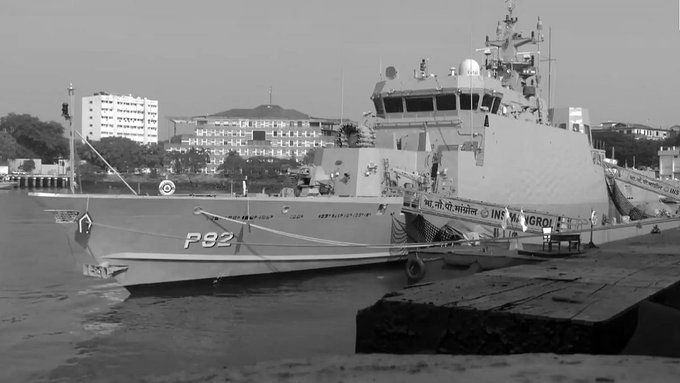
Indian Navy Commissions INS Mangrol: Inside the Indigenous Warship Built to Hunt Submarines
The Indian Navy has strengthened its coastal defence capabilities with the commissioning of INS Mangrol, its third Mahe-class anti-submarine warfare shallow water craft, in Mumbai on Monday. Designed to detect and counter underwater threats in coastal waters, the vessel will help protect ports, harbours and strategically important maritime approaches where larger warships may face operational limitations.
Built by Cochin Shipyard Limited (CSL) in Kochi, Mangrol is the third of eight shallow-water anti-submarine warfare craft being constructed under the Mahe-class programme. The first two vessels, INS Mahe and INS Malvan, have already entered service, with Malvan commissioned in July this year. The remaining vessels in the series are expected to expand the Navy’s specialised coastal warfare capabilities.
The commissioning ceremony was presided over by Vice Admiral Sanjay Vatsayan, Flag Officer Commanding-in-Chief of the Western Naval Command.
With more than 80 per cent indigenous content, Mangrol highlights India's growing ability to design, build and equip warships domestically. The vessel is equipped with the Abhay hull-mounted sonar, lightweight torpedoes, an indigenous anti-submarine rocket launcher and the Maareech Advanced Torpedo Decoy System, designed to help protect the ship against incoming torpedoes.
The sonar helps detect underwater threats, while torpedoes and anti-submarine rockets provide the means to engage hostile submarines. The Maareech system adds a defensive layer by helping divert incoming torpedoes away from the vessel.
Powered by three diesel engines and waterjet propulsion, Mangrol has the manoeuvrability needed to operate in shallow and confined waters. The Mahe-class craft are approximately 78 metres long, with a displacement of around 900 tonnes and a maximum speed of about 25 knots. Their capabilities extend beyond anti-submarine warfare to underwater surveillance, low-intensity maritime operations and mine warfare-related tasks.
The vessel can also operate alongside maritime patrol aircraft, helicopters and other warships, allowing the Navy to coordinate surveillance and responses to potential underwater threats.
Mangrol takes its name from the coastal town and prominent fishing harbour of Mangrol in Gujarat's Junagadh district. It also revives the legacy of the earlier INS Mangrol (M85), a minesweeper that served the Navy until April 2004.
The commissioning comes amid India's continuing efforts to modernise its naval fleet and strengthen maritime security. By combining specialised shallow-water operations with indigenous weapons and sensors, Mangrol adds another layer to the Navy's efforts to protect the coastline and critical maritime infrastructure while advancing the country's Aatmanirbhar Bharat defence manufacturing drive.