
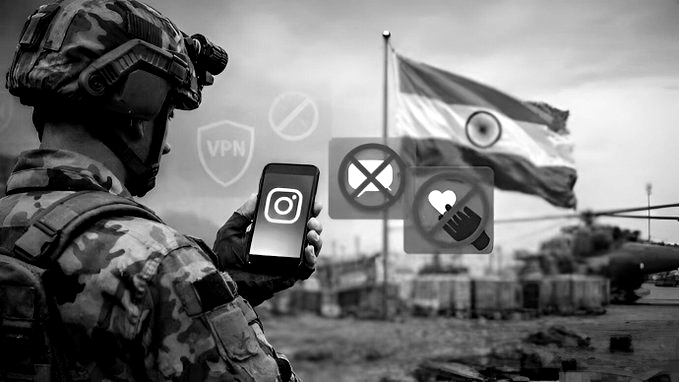
Indian Army updates social media rules: Personnel can now view but not interact
The Indian Army has issued updated social media guidelines , allowing its personnel to access platforms such as Instagram, YouTube, X, and Quora strictly for viewing and monitoring purposes. Defence officials clarified that soldiers and officers cannot post, comment, like, share, or otherwise interact on these platforms. While similar restrictions have existed earlier, especially for X and messaging apps, this update formally extends the rules to Instagram and clarifies permitted usage across platforms. The move is aimed at minimizing the risk of inadvertent leaks of sensitive information while allowing personnel to stay digitally aware. The updated guidelines were issued recently and are effective immediately.
Messaging applications such as WhatsApp , Telegram, Skype, and Signal are permitted for exchanging unclassified, general information , but only with known contacts. LinkedIn access is restricted to professional purposes, such as uploading resumes or gathering information about potential employers or employees. Defence sources said the policy sets clear guidelines for personal social media use , rather than imposing major operational changes.
The policy comes after past incidents where personnel were targeted through social media traps or honey traps, highlighting potential security risks. “For apps like YouTube, X, Quora, and Instagram, only passive participation to obtain knowledge or information has been permitted. Uploading user-generated content or messages is not allowed,” officials said.
It is likely that many Army personnel, particularly younger soldiers, already have personal Instagram accounts . The new policy does not require creating new accounts but instead formalizes their access and provides a clear framework: view content only, without posting, commenting, liking, sharing, or messaging. In practice, this has minimal impact on daily activity but gives the Army disciplinary and legal clarity in case of security breaches.
Previously, most social media platforms were completely off-limits . Soldiers had to avoid creating accounts or even delete certain apps, which often pushed usage underground. The new policy is a significant formal shift, allowing passive viewing, but it does not create operational disruptions. The main effect is regulating behavior rather than altering work routines.
While there is no technical system to enforce the “view-only” rule, the Army relies on discipline, training, and accountability. Violations may result in warnings, service record entries, or other disciplinary action. Random checks and reporting mechanisms act as deterrents, but the policy is primarily a risk-reduction measure rather than a strict surveillance system.
India’s “view-only” policy for personal social media use is stricter than most major militaries. In the US and UK, soldiers can post, comment, and interact, provided they follow conduct rules, while India allows only one-way content consumption . Full compliance cannot be guaranteed since personnel use personal devices. Some countries, like Russia, have considered outright bans, which would be even stricter.
The Indian Army ’s new social media rules mainly formalize personal account use , allowing soldiers to watch and learn, but not interact , while minimizing security risks. Most personnel likely already had accounts, so the policy is more about disciplinary clarity than operational change. At the same time, the Army continues to focus on AI-driven innovation, signaling broader modernization and strategic readiness.
In related developments, the Indian Army signed a MoU with Netaji Subhas University of Technology (NSUT) to collaborate on software and AI-based solutions. Under the MoU, NSUT students and faculty will participate in live problem-solving projects with the Army and contribute to capacity-building programs. While the MoU signals a push toward innovation, it does not materially affect daily operations or departmental workflows.