
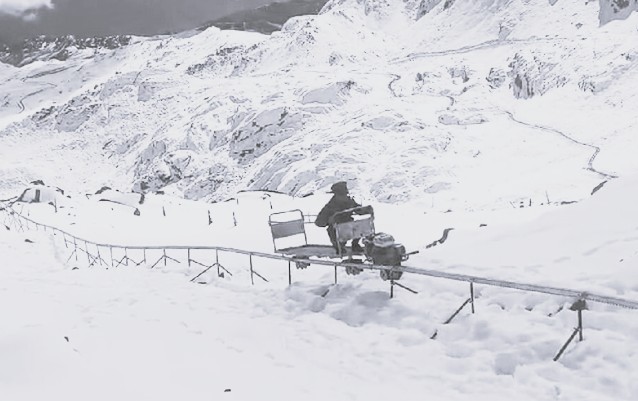
Indian Army deploys indigenous mono rail to boost high-altitude logistics
In a landmark boost to high-altitude logistics, the Indian Army’s Gajraj Corps has operationalised an indigenous mono rail system at an altitude of 16,000 feet in the Kameng Himalayas of Arunachal Pradesh. Designed entirely in-house, the system represents one of the most significant logistical innovations for troops stationed in some of India’s toughest terrains, where weather and topography frequently sever traditional supply routes.
Army officials said the mono rail was conceptualised, engineered, and deployed to overcome recurring operational hurdles faced by soldiers posted in forward locations that remain cut off for months due to heavy snowfall, unpredictable weather, and sheer vertical cliffs. Defence spokesperson Lt Col Mahendra Rawat described the deployment as a major breakthrough that will ensure uninterrupted and reliable access to mission-critical supplies.
A mono rail system is a transport system where the vehicle runs on a single rail instead of traditional two tracks. It is a special high-altitude cable-and-rail setup designed to carry loads safely across steep mountains, allowing supplies and equipment to move where roads or vehicles cannot reach.
The newly operational system can transport more than 300 kg of load in a single run, making it a lifeline for remote posts that lack motorable routes or routine helicopter access. According to Lt Col Rawat, the mono rail enables the secure and steady movement of ammunition, rations, fuel, engineering equipment, and other heavy or irregularly shaped stores across steep and unstable gradients where mules, porters, and even specialised vehicles often fall short.
A key advantage is its ability to function round the clock, with or without escort, and in harsh conditions including storms, hail, and heavy winds. This all-weather capability offers a level of logistical assurance previously unavailable in the region. “Operations in the Kameng Himalayas demand solutions that work despite terrain and climate. This system fills a long-standing gap,” Rawat said.
Beyond supporting logistics, the mono rail has also shown promise in medical evacuation. In high-altitude areas where helicopters cannot land and manual evacuation is risky and time-consuming, the system offers a safer and faster alternative to transport casualties to lower heights.
Officials said the innovation showcases the ingenuity and adaptability of the Gajraj Corps, which has been working on practical, mission-driven solutions to support troops in challenging environments. The deployment is expected to enhance operational readiness, strengthen sustainability at isolated posts, and set a new benchmark for indigenous military innovation in extreme altitudes.
The Army considers the system a decisive step toward modernising last-mile connectivity in sectors where infrastructure development is extremely limited, reaffirming its commitment to equipping frontline soldiers with reliable and efficient support mechanisms.
Gajraj Corps is a key Indian Army formation under the Eastern Command that safeguards the Arunachal Pradesh and Assam sectors along the India–China border. It specialises in high-altitude operations, border defence, and maintaining readiness in some of the Northeast’s toughest terrains.
China maintains high-altitude troop readiness through specialised all-terrain vehicles, robust oxygen-supply networks, and integrated plateau infrastructure, ensuring reliable logistics across its Himalayan frontier.