
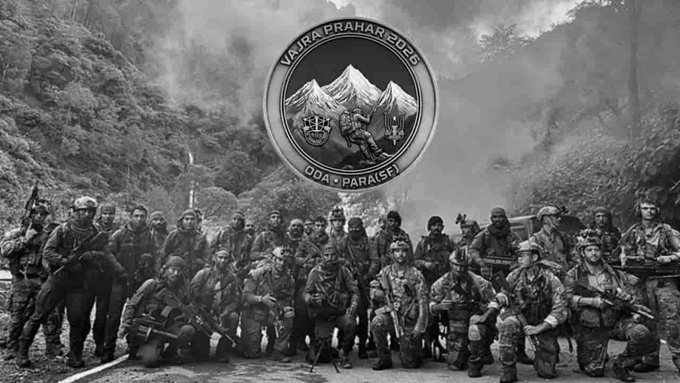
Indian and US armies kick off 3-week ‘Vajra Prahar’ exercise in Himachal Pradesh
The Indian and US armies on Tuesday began the 16th edition of the joint military exercise ‘Vajra Prahar’ at Bakloh in Himachal Pradesh, aimed at strengthening operational interoperability and enhancing the capabilities of special forces in difficult terrains.
‘Vajra Prahar’, first launched in 2001 , is a biennial exercise focused on joint special forces operations , allowing troops from India and the United States to train together, share operational experience, and learn each other’s tactics, techniques, and procedures. Such India-US joint drills are conducted to build mutual trust, improve coordination, and ensure that both armies can work together effectively during real-world operations .
The term operational interoperability refers to the ability of two armed forces to plan and execute missions together seamlessly, from mission strategy to execution. In Vajra Prahar, soldiers practice high-intensity physical training, joint mission planning , coordinated tactical drills, and real-time operational scenarios, often simulating counter-terrorism or hostage rescue operations. The focus on mountainous terrain is particularly critical for India, given its strategic frontiers in the Himalayas and other high-altitude border regions, where troops need specialized skills to operate under harsh conditions.
In parallel, the Indian Army and the Japan Ground Self-Defence Force (JGSDF) launched a two-week exercise named ‘Dharma Guardian’ at Chaubattia in Uttarakhand. Unlike Vajra Prahar, Dharma Guardian focuses on joint operations in semi-urban settings , preparing forces to operate together in towns or mixed terrains where civilian populations are present. This exercise strengthens multilateral defence collaboration, improves planning for complex scenarios, and promotes the exchange of tactical knowledge between India and Japan.
Together, these drills reinforce India’s growing defence partnerships and demonstrate its commitment to enhancing readiness, sharing expertise, and preparing for diverse security challenges. They signal a strategic priority on strengthening alliances in the Indo-Pacific region, boosting special forces capabilities, and ensuring preparedness in both mountainous and semi-urban environments. By conducting such joint exercises, India highlights its focus on operational excellence, interoperability with key allies, and proactive engagement in regional security architecture.