
India–Iceland Partnership on Sustainable Energy Emerges as Key Highlight of IEW 2026
India Energy Week (IEW) 2026 , held in Goa from January 27 to January 30, 2026 , concluded after four days of high-level deliberations that positioned India at the centre of the evolving global energy architecture. The flagship platform brought together international delegations , government leaders, industry executives, financial institutions, startups and technology innovators to chart pathways toward a secure, sustainable and affordable energy future . Participation from global policymakers, international institutions, overseas advisors and multinational companies reflected India’s growing importance in cross-border collaboration spanning hydrogen trade, bioenergy markets, clean manufacturing, upstream innovation and energy data systems. Union Minister for Petroleum and Natural Gas Hardeep Singh Puri attended the event and the concluding award ceremony , underscoring strong government backing.
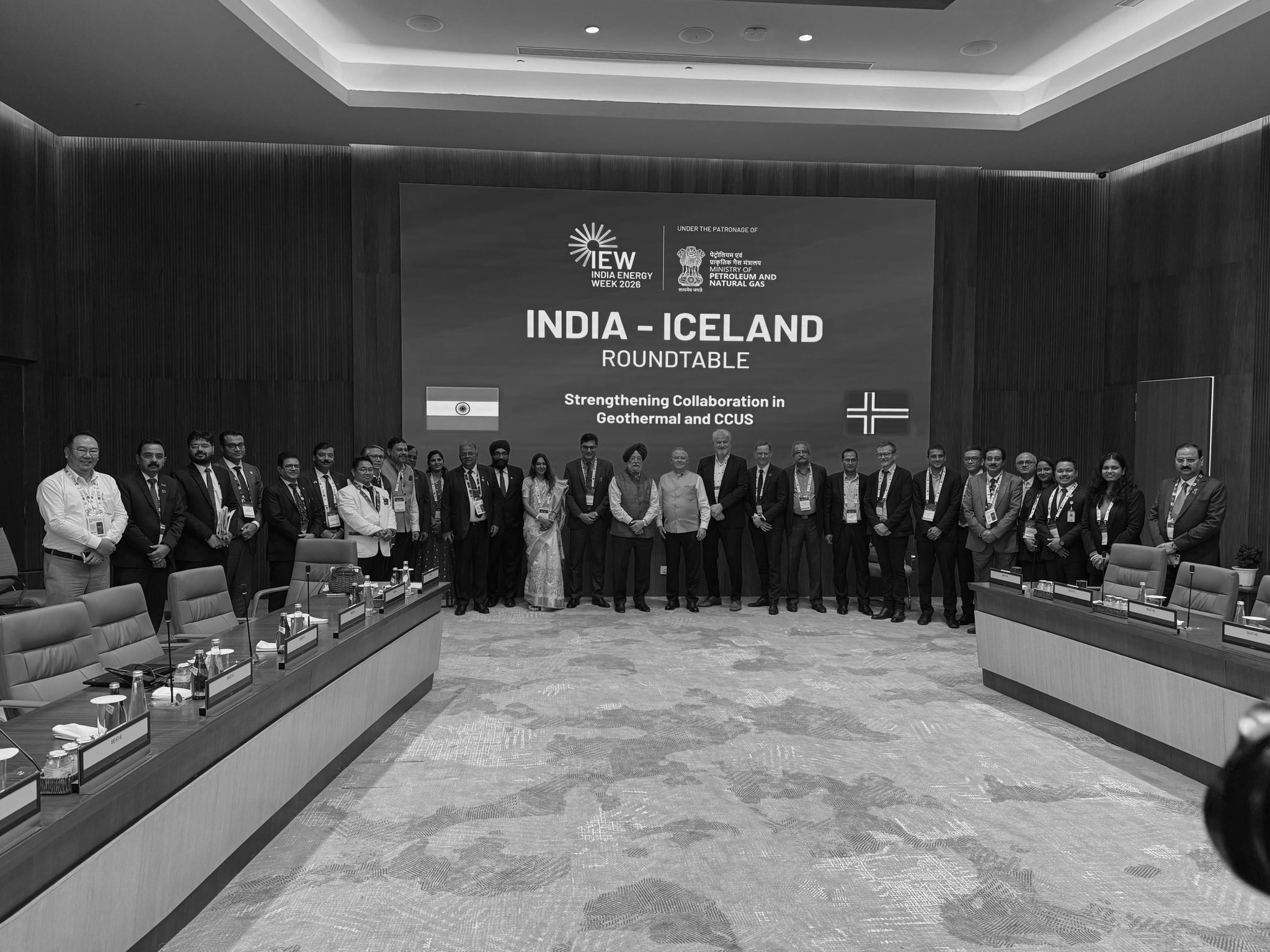
A significant diplomatic and strategic highlight was the India–Iceland energy cooperation roundtable , where opening remarks emphasised that although the two nations operate in different energy contexts, both share a commitment to sustainable, resilient and future-ready energy systems . The dialogue underscored that the global energy transition must remain practical, inclusive and grounded in reliable solutions that balance economic growth with climate objectives. Building on recent high-level engagements with Iceland’s energy ecosystem, cooperation is expected to rest on technology transfer, capacity building and long-term institutional partnerships .
Geothermal energy emerged as a key pillar of this collaboration. India’s geothermal potential is estimated at over 10 GW across more than 350 identified locations , and the sector is gaining importance as a stable, low-carbon energy source. Discussions also highlighted synergies with carbon capture and storage , as well as innovative pathways such as repurposing mature and abandoned oil and gas wells for geothermal recovery . India views Iceland not only as a technology provider but as a trusted partner for co-developing scalable and adaptable energy solutions.
A dominant theme across IEW sessions was that energy planning must anticipate economic growth . Former Petroleum Secretary Pankaj Jain cautioned that energy cannot “play catch-up,” calling for integration of data across oil, gas, coal and power sectors to strengthen macroeconomic planning and infrastructure readiness. Financial leaders, including Pradip Kumar Das , CMD of IREDA , stressed that data on intermittency, storage and supply chains must align with financing structures so projects remain bankable, scalable and investment-ready.
India’s clean energy expansion formed another core pillar. The country’s non-fossil power capacity has reached around 267 GW , with the ambition to exceed 600 GW by 2030 . Santosh Kumar Sarangi , Secretary, MNRE, emphasised that the next phase must focus on grid integration , storage deployment and stronger domestic manufacturing across solar and wind value chains. Industry leaders noted that India is evolving from an installation-driven market into a technology and manufacturing hub.
The National Green Hydrogen Mission drew strong attention. Abhay Bakre , Mission Director, said India’s target of 5 million tonnes annually by 2030 is moving from ambition to execution through competitive renewable pricing and demand creation. International speakers pointed to Europe’s emerging import frameworks, creating export opportunities for India, while technology experts confirmed green ammonia production has reached commercial maturity.
Bioenergy also featured prominently. Neeraj Mittal , Secretary, Ministry of Petroleum and Natural Gas, said India’s bioenergy sector could grow faster than overall energy demand, supporting rural development and emissions reduction. Ethanol blending has risen sharply, with similar scaling planned for biodiesel, compressed biogas and sustainable aviation fuel, supported by findings from the IEA India Bioenergy Market Report .
While clean energy dominated discussions, leaders reaffirmed that coal remains critical for energy security . Vikram Dev Dutt , Secretary, Ministry of Coal, stressed that tripling per capita energy consumption requires dependable baseload power, with a calibrated phase-down approach supported by cleaner coal technologies and gasification initiatives.
Finance and innovation were identified as central enablers. IREDA highlighted long-tenor lending and co-lending models to lower the cost of capital, while sessions on AI in upstream exploration and digital analytics showcased how technology is reshaping energy systems. The event concluded with awards recognising startups and industry leaders across clean technology, AI-driven monitoring, battery recycling, robotics and carbon capture.
IEW 2026 reinforced that India is competing globally not only in renewables but also in hydrogen, bioenergy, geothermal collaboration and clean manufacturing. As the event closed, the message was clear: India’s energy future will be diversified, execution-focused and driven by data-backed planning, financial viability and international cooperation, strengthening its role as a central force in the global energy system.