
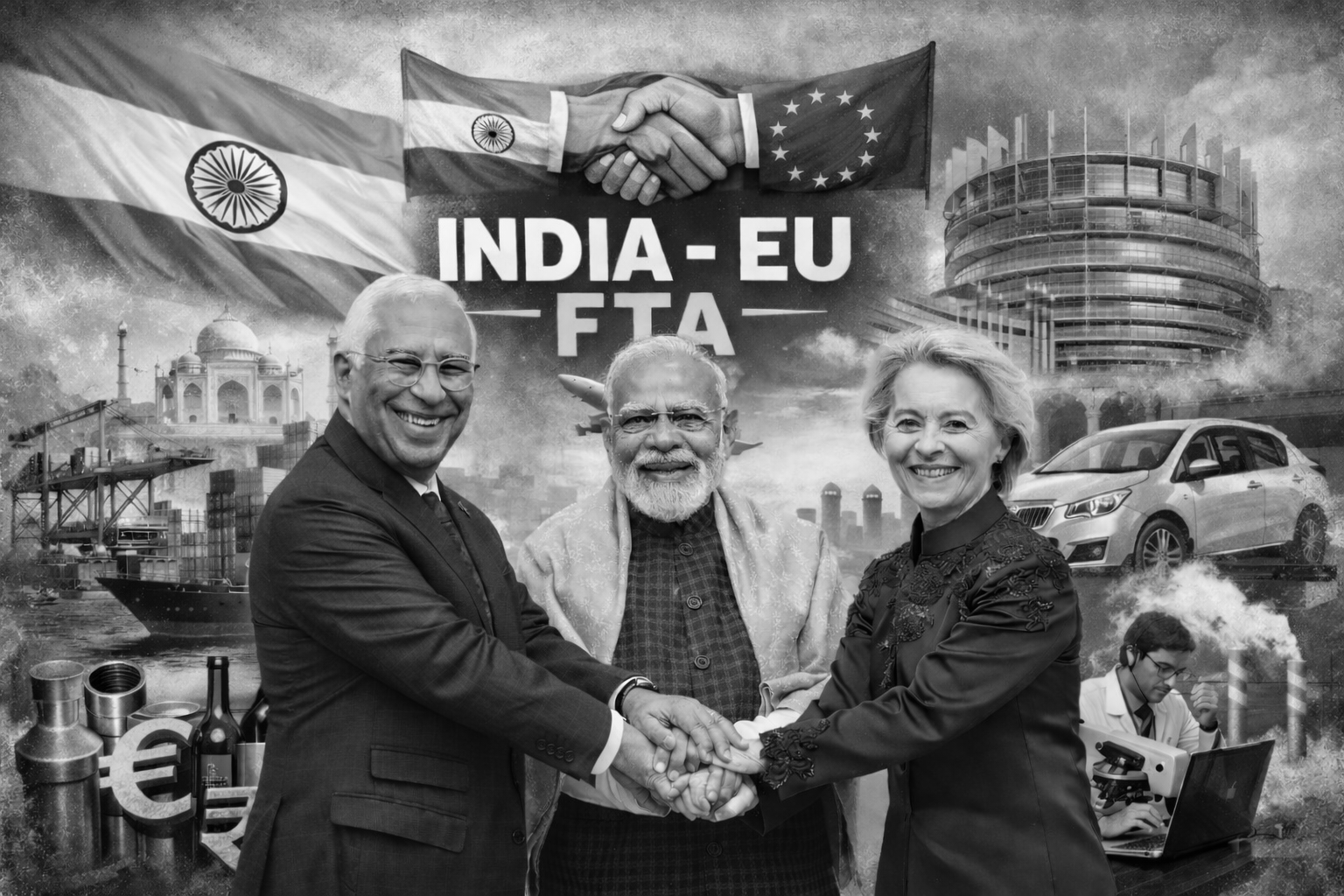
India–EU FTA: What Yesterday’s Headlines Missed About the ‘Mother of All Deals’
A day after India and the European Union announced what has been billed as the “mother of all trade deals,” several crucial details of the Free Trade Agreement (FTA) have come into sharper focus, revealing the true scale of the pact and why its announcement took many by surprise.
Though often described as a deal nearly 20 years in the making , negotiations were not continuous. Talks were first launched in 2007 but collapsed in 2013 over differences on agriculture, automobiles, visas, intellectual property and environmental clauses . Discussions remained frozen for almost nine years before being revived in June 2022 . The agreement unveiled this week is largely the result of intensive negotiations over the past three-and-a-half years .
The timing of the announcement also explains why few saw it coming. Until hours before the summit, European Commission President Ursula von der Leyen and European Council President Antonio Costa were widely perceived to be in India mainly as Republic Day guests . With no leaked drafts, no public deadlines and no final-round signals , the deal was concluded in near-total secrecy . In hindsight, the presence of the EU’s top leadership and the simultaneous unveiling of trade, defence and mobility agreements show that the visit was strategic rather than ceremonial .
The FTA involves major concessions from India. New Delhi has agreed to reduce or eliminate tariffs on about 97 per cent of EU trade value over ten years the largest market opening India has ever offered any partner . This includes phased reductions on automobiles , sharp duty cuts on wines and spirits , and elimination of tariffs on machinery, chemicals and pharmaceuticals . India has also opened 102 services sub-sectors to European firms, covering financial services, maritime transport, telecom-linked services and environmental solutions . Sensitive sectors such as dairy and cereals remain protected .
These concessions have triggered political criticism. The Congress flagged concerns over the absence of exemptions from the EU’s Carbon Border Adjustment Mechanism (CBAM) , which could impose climate-linked taxes on Indian steel and aluminium exports . The CPI(M) warned that reduced duties on cars and luxury goods could hurt domestic manufacturing and employment, while also widening India’s trade deficit .
Yet the deal also delivers major gains that were barely highlighted on Tuesday. Most significant is the creation of a structured mobility framework for Indian professionals . The FTA provides assured temporary entry and stay for business visitors, intra-corporate transferees, contractual service suppliers and independent professionals across sectors such as IT, engineering, research and higher education . Spouses and dependents are included , and both sides have agreed to work toward Social Security Agreements within five years a long-standing demand of Indian professionals working in Europe.
Industry response on Wednesday reflected cautious optimism. Textile and apparel exporters expect duty-free access to significantly boost shipments to the EU, while tea exporters welcomed new opportunities for green tea even as they flagged rising compliance and sustainability costs . European automakers termed the pact historic but ruled out immediate vehicle price cuts , citing phased tariff reductions and high local manufacturing content.
Compared with India’s other recent trade pacts, the EU agreement stands apart. The New Zealand FTA , expected to take effect by mid-2026 , involves a relatively small economy. The India–UK trade deal , likely to be operational in 2027 , offers strong goods access but limited professional mobility . The EU pact, covering a 27-nation bloc accounting for nearly 25 per cent of global GDP , is far broader in ambition and strategic depth.
Despite the announcement, the agreement will not come into force immediately. The nearly 2,000-page legal text must undergo legal vetting and ratification by the European Parliament and all 27 EU member states , pushing full implementation to late 2027 or early 2028 , though some tariff benefits may be applied earlier.
Beyond numbers and timelines, the FTA marks a rare diplomatic achievement . Bringing together 27 European nations amid global trade uncertainty required sustained engagement at the highest political level . For Prime Minister Narendra Modi , the pact stands as one of the most significant trade breakthroughs of his tenure , positioning India at the centre of emerging global supply chains and redefining its economic partnership with Europe.