
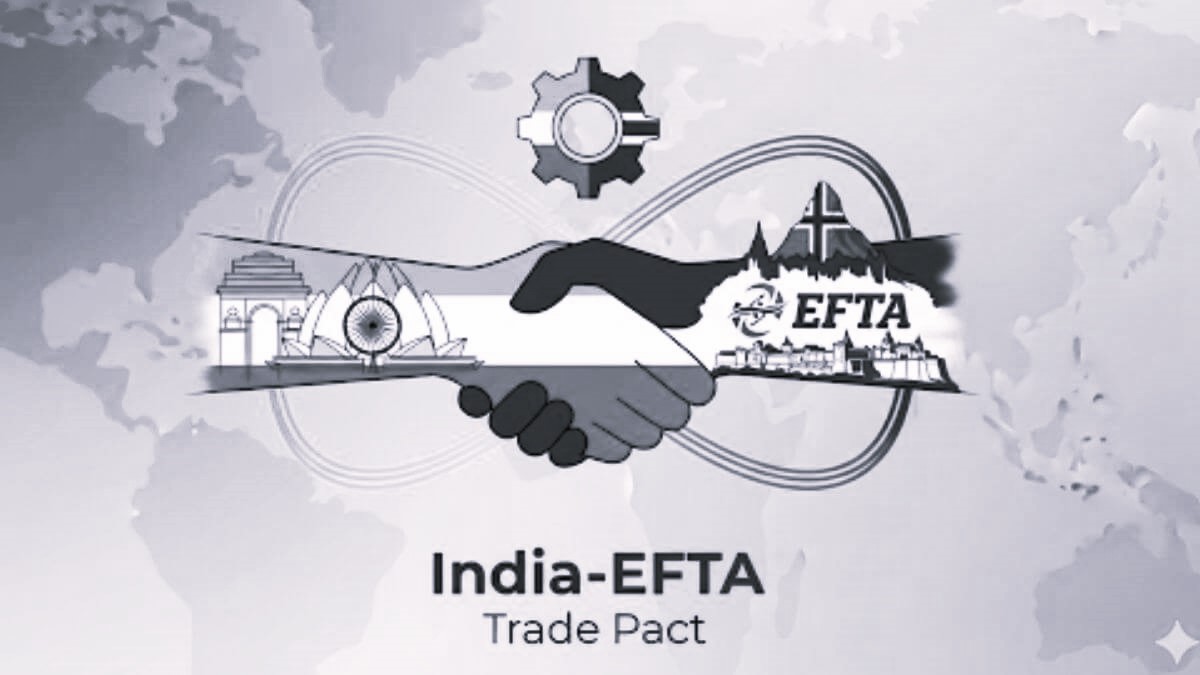
India-EFTA trade pact: A new era of investment, jobs, and global integration
The strategic partnership between India and the four nations of the European Free Trade Association (EFTA) has been formalized through the landmark Trade and Economic Partnership Agreement, widely known as TEPA. This deal, which came into effect on October 1, 2025, marks a historical first for India, establishing a Free Trade Agreement (FTA) with four highly developed European economies. The core of this agreement is a binding commitment unprecedented in Indian FTAs: the EFTA states have pledged to inject $100 billion in Foreign Direct Investment (FDI) into India over the next fifteen years, with the explicit goal of facilitating the creation of one million direct jobs.
The EFTA is an intergovernmental organization consisting of Switzerland, Norway, Iceland, and Liechtenstein. It stands as a significant economic bloc in Europe, focusing on the promotion of free trade and economic integration among its members. The resultant pact, TEPA, is designed as a modern and ambitious agreement that extends far beyond traditional tariff cuts. It features fourteen comprehensive chapters addressing market access for goods, trade in services, intellectual property rights, sustainable development, and crucially, investment promotion. This structured approach is the major effort underpinning the deal, ensuring long-term cooperation and stability.
The most profound business impact on India stems directly from the investment commitment. This capital infusion is structured to be capacity-building and long-term, with an initial $50 billion planned for the first ten years, followed by an additional $50 billion in the subsequent five years. These funds are targeted at core growth sectors in India, including renewable energy, life sciences, engineering, and digital transformation, directly supporting the 'Make in India' initiative. For the EFTA members, the job creation goal in India, contrasted with their own generally low unemployment rates (Switzerland and Norway typically operating below 5%, with Iceland and Liechtenstein also maintaining low figures), underscores the pact's objective: leveraging India’s vast and increasingly skilled workforce.
In terms of market access for goods, EFTA has offered significant tariff concessions, liberalizing access on lines covering 99.6% of India's exports, including immediate zero duty on virtually all non-agricultural goods. This change will notably benefit Indian exporters of machinery, organic chemicals, textiles, and processed foods, enhancing their competitiveness in high-value European markets. India, in turn, has offered access on 82.7% of its tariff lines, while strategically safeguarding key sensitive sectors like dairy, soya, and coal by placing them on an exclusion list. Furthermore, tariff reductions for products under India's Production Linked Incentive (PLI) schemes are phased over five to ten years, providing domestic industries a necessary period to adjust and scale up.
The deal also unlocks substantial opportunities in the services sector, which contributes over 55% to India's Gross Value Added. India has made specific commitments in 105 sub-sectors. Crucially, the pact enhances the mobility of skilled professionals through the inclusion of Mutual Recognition Agreements (MRAs) in fields like nursing, chartered accountancy, and architecture. This streamlined process for recognizing professional qualifications is expected to significantly boost India’s services exports in IT and business services, while offering greater certainty for the temporary stay of skilled Indian professionals in EFTA states. Ultimately, TEPA establishes India as a reliable partner in global supply chains, serving as a critical strategic entry point to Europe, which complements India's wider economic aspiration of achieving developed nation status.