
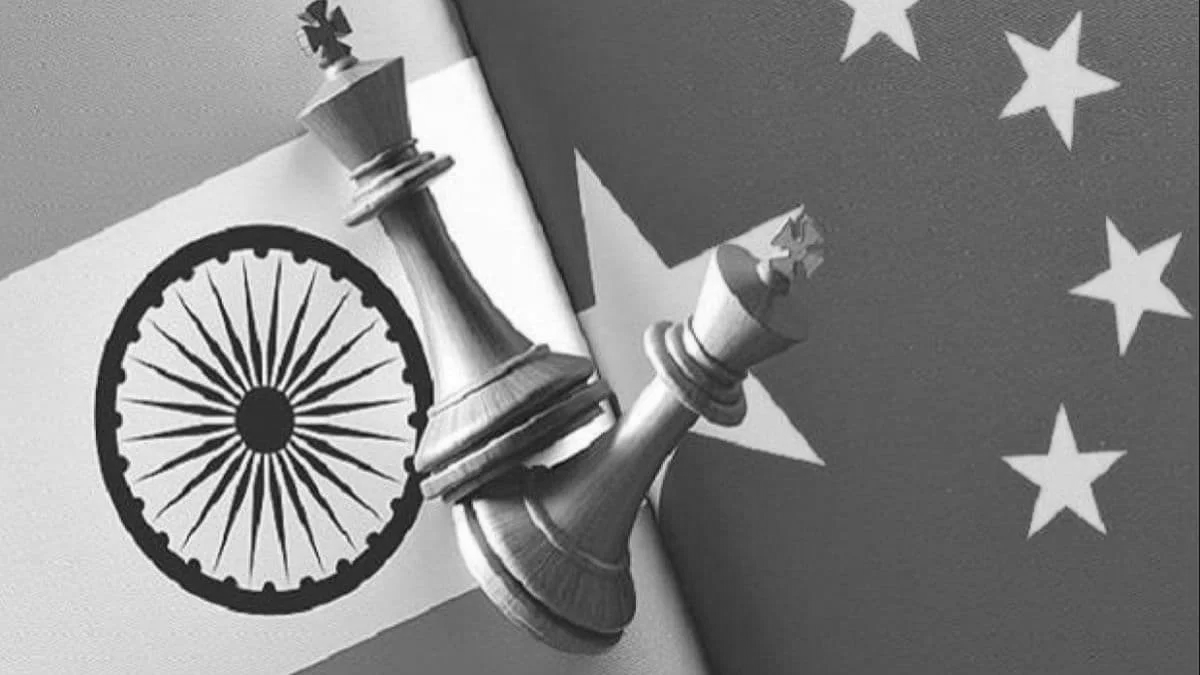
India vs China: Two Civilizations, Two Roads to Modernity
India and China together representing nearly 36% of humanity are not just neighbors; they are civilizational states reimagining modernity on their own terms. Emerging from colonial subju gation and imperial fragmentation, both began with similar challenges agrarian economies, mass poverty, and weak industrial bases.
Yet, by 2025, China has become the second-largest economy, while India stands as the fifth-largest and the fastest-growing major power. How did these trajectories diverge so sharply? And more crucially if current trends persist for another decade what will the world in 2035 look like?
1. Historical and Ideological Divergence (1947–1980)
Detailed reasons for divergence
• Governance philosophy:
• India adopted a democratic model emphasizing inclusion, debate, and gradual reform. Decision-making was slower but legitimate.
• China followed Mao’s centralized command, enforcing ideological unity at the expense of freedom.
Result: China achieved faster mobilization but suffered catastrophes like the Great Leap Forward famine (1958–62).
• Economic Planning:
• India’s Five-Year Plans focused on self-reliance and import substitution, but heavy licensing choked entrepreneurship.
• China emphasized state collectivization and later communal agriculture, causing inefficiencies until Deng Xiaoping’s reforms in 1978.
• Social Priorities:
• India focused on education, democracy, and agriculture (Green Revolution) to prevent famine.
• China prioritized mass literacy and land reforms , achieving social transformation faster.
2. Economic Growth and Development Trajectory
Decade-Wise GDP Growth (1950–2024)
Reasons for Economic Divergence
1. Reform timing
• China (1978) began reforms 13 years before India (1991). It liberalized agriculture first, then industry, and finally trade sequencing reforms for stability.
• India liberalized all sectors in one burst after the 1991 crisis, creating initial inflation and uneven growth.
2. Nature of Economic Model
• China: Export-driven, manufacturing-heavy, infrastructure-intensive.
• India: Services-driven, consumption-based, less manufacturing-oriented.
3. Bureaucracy and Regulation
• India’s License Raj stifled private enterprise till 1991.
• China empowered local officials with economic targets — creating “competitive federalism” decades earlier than India.
4. Investment and Infrastructure
• China invested 40–45% of GDP in infrastructure for decades; India averages 30%.
• Result: China built world-class logistics; India still catches up with highways, ports, and power grids.
5. Political Stability
• China’s authoritarian system enabled long-term vision (Five-Year Plans unbroken).
• India’s coalition politics (1989–2014) often diluted reform pace.
3. Year-Wise GDP Growth (2015–2024) SSS
Implications
China’s growth engine now slows due to:
• Debt-laden local governments, Shrinking labor force, Weak consumer demand.
India’s growth sustains due to:
• Young workforce, Digital economy, Political stability and infrastructure drive.
4. Industrialization and Manufacturing
Reasons for difference
• Scale & Clustering: China created massive industrial clusters (Shenzhen, Suzhou, Chengdu). India lacked such zoning efficiency until 2014’s “Make in India”.
• Labor & Land: Rigid Indian labor laws and land acquisition delays slowed factory growth. China’s centralized control facilitated industrial land use.
• Infrastructure: China’s logistics costs ~7% of GDP; India’s >13%.
If the Trend Continues (2025–2035):
• China: Will gradually move up the value chain semiconductors, green tech, robotics.
• India: Will emerge as the world’s alternative manufacturing hub , especially in electronics, autos, and defense.
5. Technology and R&D
Reasons
• China’s State-led tech nationalism invests trillions in AI, semiconductors, and 5G.
• India’s private-led innovation thrives in IT, fintech, and software (Aadhaar, UPI, CoWIN).
If the Trend Continues (2025–2035):
• China could dominate AI hardware, robotics, and green tech .
• India could lead digital public infrastructure, fintech exports , and space technology. The world may see a tech bipolarity “hardware made in China, software designed in India.”
6. Defence and strategic power
Reasons
• China’s economy allows massive investment in modernization (AI warfare, hypersonic weapons). India prioritizes deterrence and maritime reach.
• India face s a two-front threat, unlike China, necessitating steady 2% GDP defense spending.
If the trend continues (2025–2035):
• China will remain militarily superior in hardware and cyber power. India will gain strategic reach via naval expansion and QUAD alliances.
• Balance of power in the Indo-Pacific will depend on India’s naval modernization and defense self-r eliance.
7. Demographics and Human Capital
Reasons
• India’s fertility remains above replacement; China’s fell below 1.0 after the one-child policy.
• India’s education is improving but uneven; China achieved near-universal literacy by the 1990s.
If the Trend Continues (2025–2035):
• India’s labor force will add 100+ million workers, boosting consumption and services.
• China’s aging population may shrink its workforce by 70 million, increasing the pension burden.
• By 2035, India could be the world’s largest labor market ; China, an aging industrial power.
8. Health and Human Development
Reasons
• China’s universal healthcare coverage (post-2009 reforms).
• India’s fragmented public health; Ayushman Bharat improving coverage since 2018.
If Trend Continues (2025–2035):
• China’s aging will strain healthcare.
• India’s youth-centric system will need preventive care expansion.
• Both will invest heavily in biotech, telemedicine, and AI health systems.
9. Global Political Importance and Diplomacy
Reasons
• China built influence via economic leverage and BRI projects.
• India’s rise is based on values diplomacy, democracy, and diaspora .
If Trend Continues (2025–2035):
• China’s global influenc e may wane if debt-trap diplomacy backlash intensifies.
• By 2035, India could be the Global South’s diplomatic anchor, while China remains an economic superpower.
10. Environmental sustainability
Reasons
• China’s industrial scale produces 30% of global emissions.
• India focuses on renewable transition via solar, hydrogen, and green finance.
If Trend Continues (2025–2035):
• China will dominate EV and battery exports , but emissions remain high.
• India will emerge as a clean energy innovator , exporting green hydrogen and solar tech.
Technology and Cyber influence
Reasons
• India: Open internet, bottom-up innovation.
• China: Digital authoritarianism, state surveillance, but stronger execution.
If Trend Continues (2025–2035):
• India’s “Digital Democracy Model” may become the global standard for inclusion.
• China’s “Digital Control Model” may face pushback abroad but succeed domestically.
12. Possible scenarios (2025–2035)
Scenario 1: Divergent Growth
• China’s GDP growth stabilizes around 3–4%, India’s remains 6–7%.
• China maintains global manufacturing dominance; India dominates digital and services.
Scenario 2: Strategic rivalry intensifies
• Border tensions and the Indo-Pacific contest continue.
• Asia polarizes around QUAD (India, US, Japan) vs. BRI (China, Russia, Pakistan).
Scenario 3: Pragmatic cooperation
• Joint climate and trade cooperation to stabilize Asia.
• India–China trade surpasses $200 bn despite disputes.
• BRICS+ evolves into a developmental alternative to Western blocs.
Conclusion: Competing models of modernity
India and China embody two distinct pathways:
• China’s model : Authoritarian efficiency - fast, top-down, transformative.
• India’s model : Democratic resilience - slower, participatory, sustainable.
If current trends persist, by 2035:
• India could become the third-largest economy (behind the US and China).
• Asia’s power balance will depend on whether these two giants compete destructively or cooperate constructively.
The century of Asia is unfolding and its shape will be written not in Washington or Brussels, but in Beijing and New Delhi.