
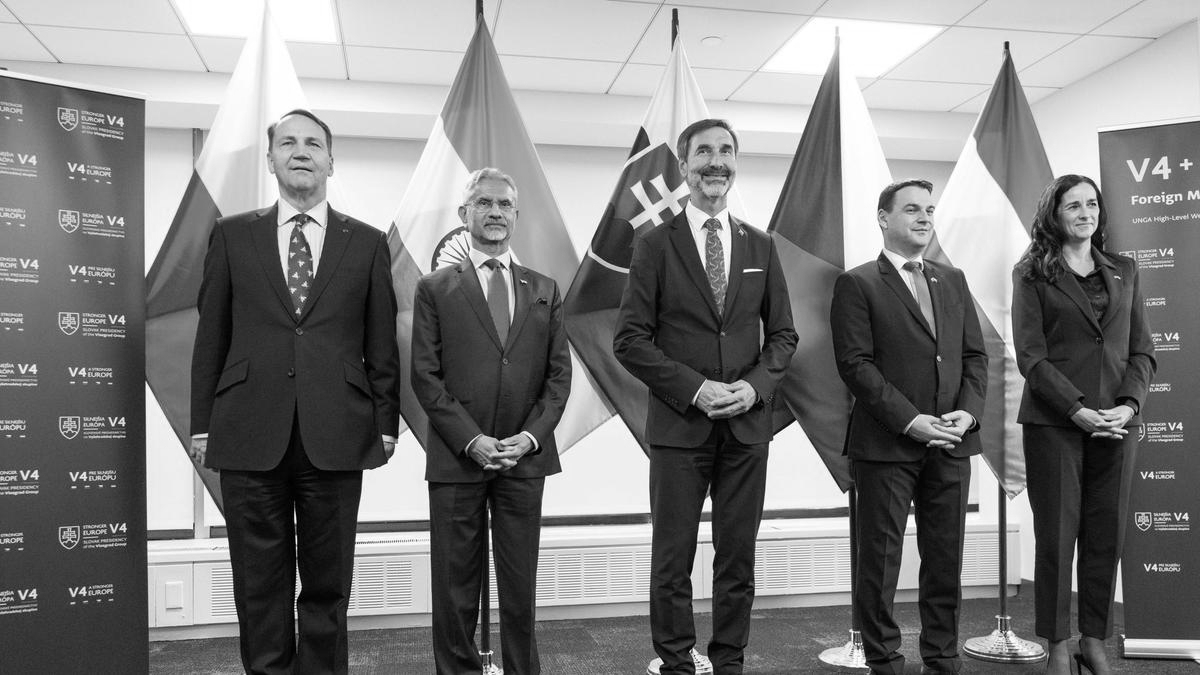
India, V4 Countries Agree to Deepen Political, Economic and Defence Ties
India and the four-member Visegrad Group (V4) of Central European countries have agreed to deepen political, economic, technology and defence cooperation at their first foreign ministers’ meeting, held on September 21 on the sidelines of the 81st session of the UN General Assembly.
External Affairs Minister S Jaishankar joined Poland’s Deputy Prime Minister and Foreign Minister Radek Sikorski, Hungary’s Deputy Prime Minister and Foreign Minister Anita Orban, Slovak Foreign and European Affairs Minister Juraj Blanar and Czech Foreign Minister Petr Macinka for the first meeting in the V4+India format.
Jaishankar described the gathering as a “new historic occasion”, saying the discussions were “very productive”. The Visegrad Group comprises the Czech Republic, Hungary, Poland and Slovakia and provides a platform for cooperation among the four Central European countries.
The ministers agreed to institutionalise the new format through annual foreign ministers’ meetings. They also agreed to create an Annual Business Forum to strengthen economic engagement between India and the V4 countries, particularly as India’s relationship with the European Union continues to deepen.
Technology, innovation, research and education emerged as other important areas of cooperation. The two sides also discussed space, connectivity and people-to-people mobility, while agreeing to further develop cultural cooperation.
Defence cooperation was another key focus. Jaishankar said India has a strong history of defence ties with all four V4 countries and that the partners want to “refresh and take forward” this cooperation. The ministers also exchanged views on major international developments, including the Ukraine conflict and developments in the Gulf.
The V4 countries have also voiced support for India’s bid for permanent membership of a reformed UN Security Council. Slovak Foreign Minister Juraj Blanar said the four countries agreed that India should have a permanent seat, highlighting its role in the Global South and the Indo-Pacific.