
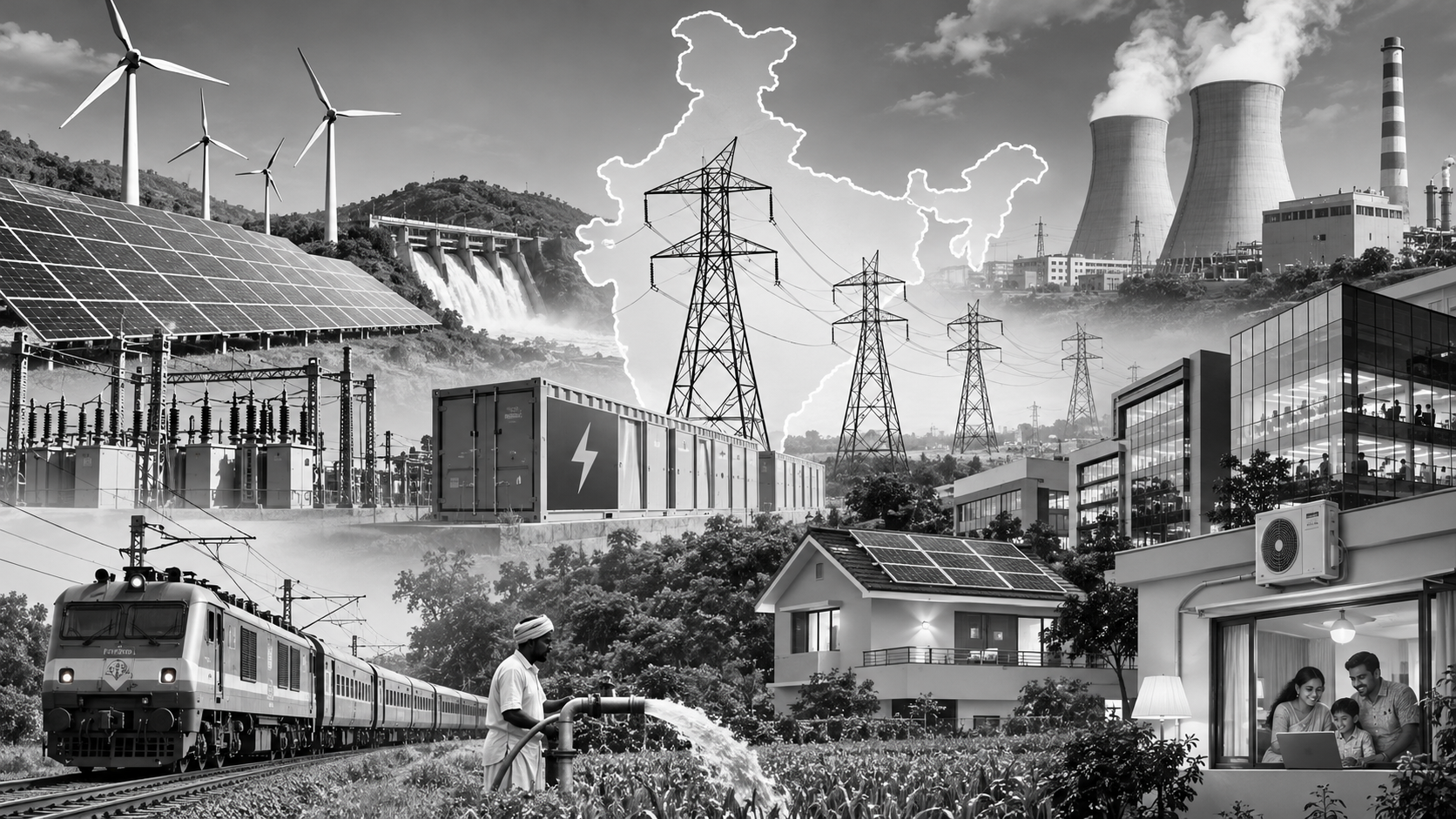
India Targets 900 GW Clean Power As Electricity Demand Surges
India’s plan to nearly triple its non-fossil electricity capacity to 900 GW by 2035 is placing transmission infrastructure, energy storage, distribution reforms and domestic manufacturing at the centre of its energy transition. With electricity demand projected to rise sharply, the country must overcome grid bottlenecks, coal dependence and financing constraints to turn its clean-energy ambition into a reliable power supply.
The target, covering solar, wind, hydropower and nuclear energy, goes beyond India's existing goal of achieving 500 GW of non-fossil capacity by 2030. The country has already crossed 300 GW, adding a record 55.29 GW during 2025–26. However, coal continued to account for approximately 71% of electricity generation in 2025, highlighting the gap between installed capacity and actual power supply.
To support the expansion, the government has announced nearly $20 billion in grid investments. The third phase of the Green Energy Corridor, with an outlay of ₹1.86 lakh crore, includes ₹1,36,378 crore for intra-state transmission infrastructure and ₹50,000 crore for 50 GWh of battery storage. Separately, the Central Electricity Authority's transmission plan envisages 1,37,500 circuit kilometres of lines and 8,27,600 MVA of substation capacity, requiring approximately ₹7.93 lakh crore by 2035–36.
Energy storage remains another major challenge. Estimates suggest India could require up to 250 GW of storage capacity over the coming decade. The CEA's 2031–32 projections include 47.24 GW/236 GWh of battery storage and 26.69 GW/175 GWh of pumped hydro, involving estimated investments of ₹3.49 lakh crore and ₹1.29 lakh crore respectively.
Electricity demand is adding to the pressure. CEA figures show India consumed 1,622.97 billion units (BU) in 2024–25. Industry accounted for 655.56 BU (40.39%), households 408.52 BU (25.17%), agriculture 260.28 BU (16.04%), commercial establishments 135.16 BU (8.33%), miscellaneous uses 128.95 BU (7.95%) and traction 34.50 BU (2.13%). Corporate and government offices are included in broader categories rather than reported separately.
The International Energy Agency expects Indian electricity demand to grow by an average 6.4% annually during 2026–30, adding more than 570 TWh. Industrial expansion, air-conditioning, urbanisation, electric vehicles and data centres are expected to drive consumption. Cooling alone could contribute more than 20% of additional demand.
Indian Railways consumed 25.39 BU for locomotives in 2024–25, while its broader CEA traction category stood at 34.50 BU. Agriculture's 260.28 BU consumption also offers opportunities for solar irrigation under PM-KUSUM.
However, DISCOM financial weakness, AT&C losses of around 15.04%, imported battery components, land constraints and renewable-energy curtailment threaten implementation. Experts also face the challenge of balancing coal-based reliability with cleaner generation.