
India Targets $500 Billion US Trade as Export Strategy Accelerates
India is intensifying its global trade outreach through a mix of strategic agreements, tariff negotiations, and industry consultations designed to expand export opportunities and reinforce competitiveness in major international markets. The government’s proactive approach comes as shifting supply chains and geopolitical realignments reshape global commerce.
Union Commerce and Industry Minister Piyush Goyal recently reassured textile exporters that India will remain competitive despite Bangladesh securing zero-duty access to the United States for garments made using American raw materials. The development had sparked concern among Indian manufacturers, who feared that lower-priced Bangladeshi apparel could gain a competitive advantage in the crucial US market. Goyal clarified that India is already negotiating similar provisions with Washington so that Indian textile exports using US inputs could also qualify for zero-tariff treatment once the detailed framework is finalized.
An analysis by SBI Research highlights why tariff parity is critical. According to the report, the United States imports roughly $7.5 billion worth of textiles each from India and Bangladesh annually, meaning even small tariff differences could shift competitive dynamics. The report warned that Bangladesh’s duty concession may influence sourcing decisions unless India secures comparable terms.
The interim India–US trade arrangement represents a significant reset in commercial ties. Tariffs on selected Indian exports to the US have reportedly dropped from about 50 percent to nearly 18 percent , a change expected to generate more export orders for sectors such as textiles, leather goods, and engineering products. Industry leaders say the reduction strengthens India’s price competitiveness in global markets.
Beyond the United States, India is widening its commercial footprint. A landmark free trade agreement with the European Union is expected to ease access for Indian goods to one of the world’s largest consumer markets once implemented. The deal is projected to remove duties on most product categories, benefiting labour-intensive industries and helping Indian firms integrate more deeply into global value chains .
These developments form part of a broader strategy to diversify export destinations and reduce dependence on any single market. India has concluded or advanced agreements with several partners, including a pact linked to an investment commitment of about $100 billion , which policymakers believe will strengthen industrial capacity and trade infrastructure.
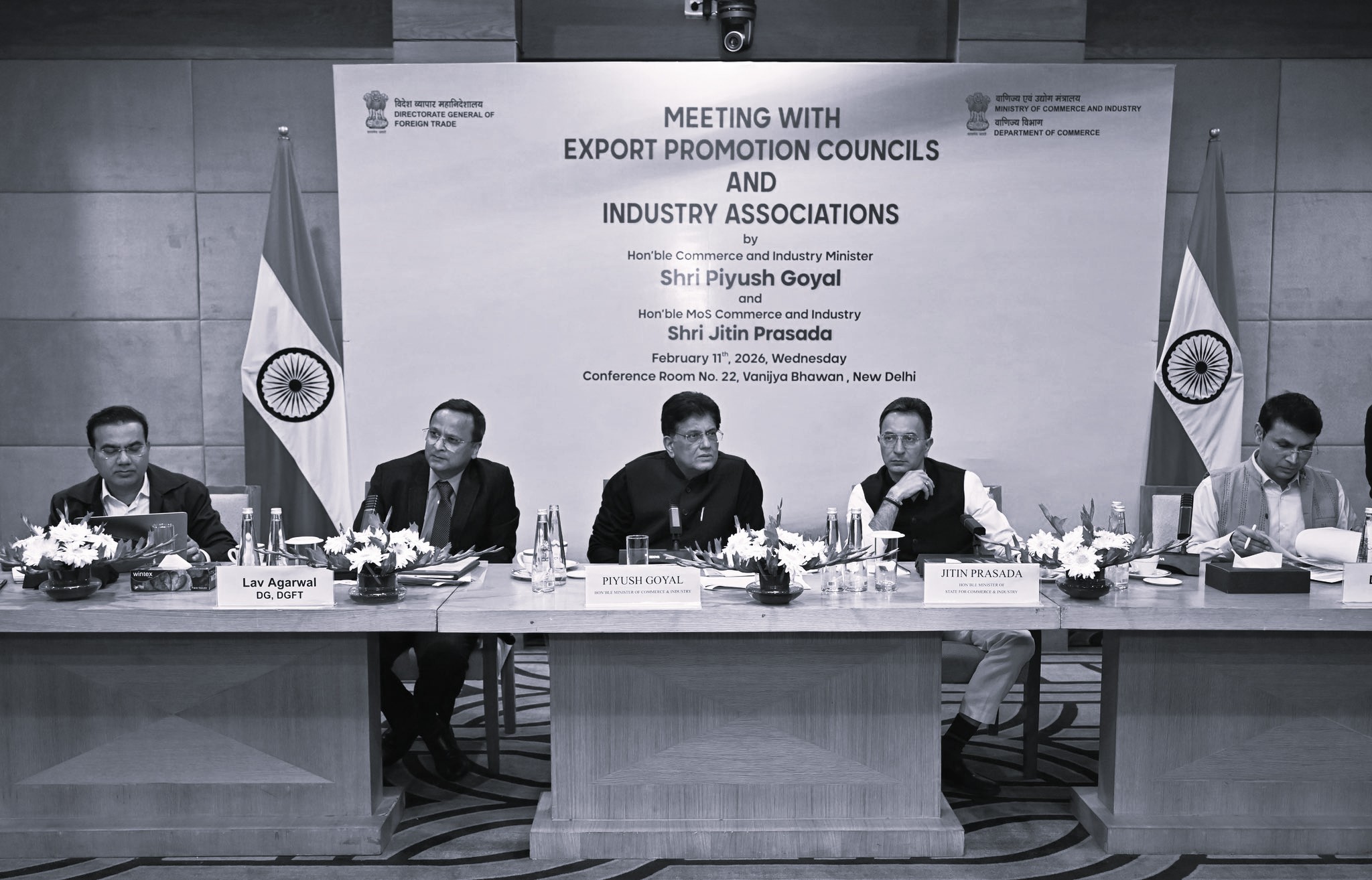
To ensure businesses capitalize on these opportunities, Goyal recently met export promotion councils and industry groups, urging them to improve quality, adopt international standards , and scale production. Representatives said government support measures would especially help micro, small, and medium enterprises expand globally.
Some domestic stakeholders remain cautious, arguing that certain trade concessions could affect local producers. Officials maintain that most sensitive agricultural sectors have been protected from tariff reductions to safeguard rural livelihoods while still enabling export-oriented industries to benefit.
Trade expansion is central to India’s long-term economic ambitions. The government aims to raise bilateral trade with the United States from about $191 billion to $500 billion by 2030, with exports playing a pivotal role in achieving the Viksit Bharat 2047 vision of transforming India into a developed economy.
Political exchanges have also accompanied the debate. Goyal recently criticized opposition leader Rahul Gandhi for alleging that Bangladesh had gained greater advantages than India in recent trade arrangements, calling the claim misleading and urging critics to verify facts before making public statements.
Taken together, India’s latest trade initiatives reflect a coordinated strategy combining diplomacy, market-access agreements, and domestic reforms. With major frameworks nearing completion, officials believe the country is positioning itself to capture a larger share of global trade while balancing international ambitions with domestic economic priorities.