
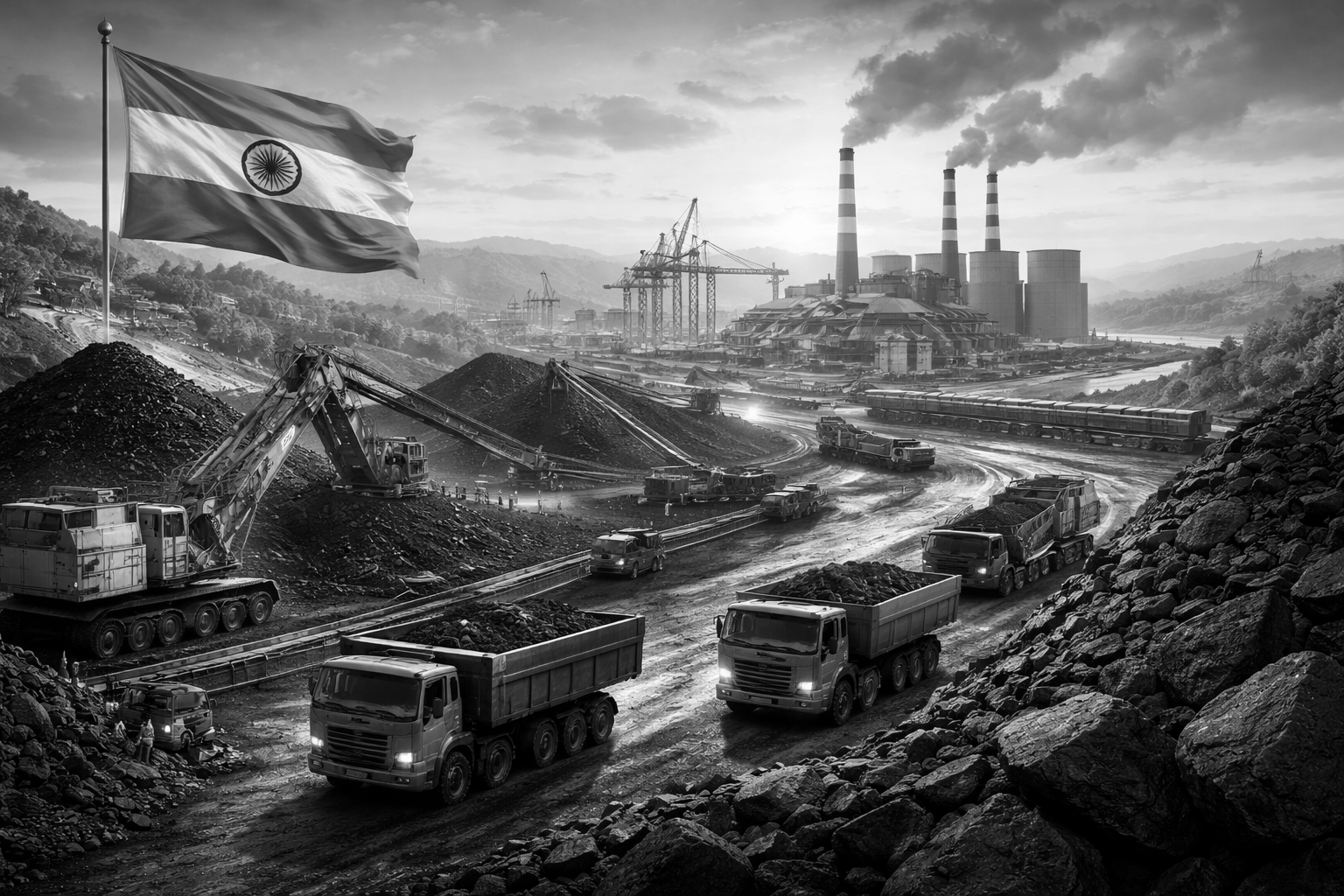
India Targets 1.5 Billion Tonnes Coal Output, Eyes Self-Reliance with Lower Imports
India is accelerating its coal sector reforms with the launch of the 15th round of commercial coal mine auctions , even as recent data shows a decline in coal imports and rising domestic production. Imports fell by 4.2% year-on-year to 213 million tonnes in FY26 (April–January) , with an additional 8.5% drop in February , driven by strong domestic stockpiles and improved output. The government is also pushing for blending domestic coal in plants designed for imported fuel and targeting a 30% reduction in thermal coal imports , signalling a clear shift toward self-reliance.
The latest auction round builds on the landmark 2020 reforms that opened coal mining to private players, ending the dominance of Coal India Limited and Singareni Collieries Company Limited . Since then, over 100 coal blocks have been auctioned , and captive and commercial mines have crossed 200 million tonnes of production in FY26 . Private players like the Adani Group , JSW Steel , and Vedanta Limited are expanding their footprint, creating a hybrid model of public and private participation.
India has crossed a major milestone, producing over 1.04 billion tonnes of coal in FY25 , with the government targeting 1.15 billion tonnes in FY26 and 1.5 billion tonnes by 2030 . Coal continues to supply over 70% of electricity , making it central to the country’s energy mix despite renewable expansion. However, the paradox persists—India holds over 400 billion tonnes of coal reserves , yet imported around 264 million tonnes in 2025 due to quality constraints.
The core issue lies in the quality mismatch : domestic coal is largely low-grade, while industries require high-quality coking coal , leading to imports of over 62 million tonnes annually, mainly from Indonesia and Australia. Logistics challenges and plant design constraints further sustain imports. At the same time, India has begun allowing limited exports to neighbouring countries, marking a shift toward regional trade participation.
Despite allowing 100% FDI under automatic route , foreign investment remains limited, with global players like BHP and Glencore acting more as suppliers than investors due to regulatory and market risks. To address structural gaps, the government is promoting coal gasification , improving logistics through connectivity projects, and boosting domestic coking coal under Mission Coking Coal.
Globally, India stands as the second-largest producer and consumer , a top importer, and among the top five in reserves, reflecting a complex energy structure. As reforms deepen, the success of the auction-driven model will depend on how effectively India bridges the gap between resource availability and industrial demand, transforming coal into a more efficient and strategic energy asset.