
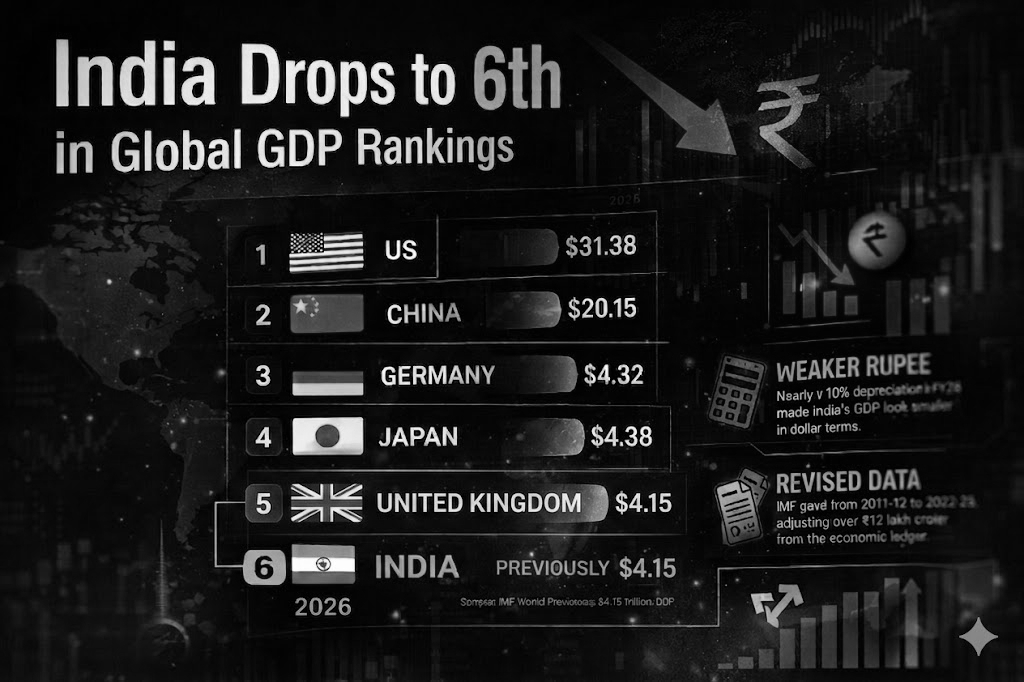
India slips to 6th largest economy: Fourth Was a Forecast Sixth Is the Fact, IMF revision puts UK in front
Not long ago, the Indian government announced with considerable fanfare that the country had become the world’s fourth-largest economy . The claim travelled fast, landed well on social media, and felt like the arrival of a long-awaited national moment. Finance ministry statements glowed. Headlines celebrated. The narrative of a rising India, finally taking its rightful place among the world's economic titans, seemed complete. It was not.
According to the IMF’s April 2026 World Economic Outlook , India has slipped to sixth place in global GDP rankings , with the United Kingdom moving back ahead , ending India’s three-year run as the fifth-largest economy. The fourth-place claim, it turns out, was built on projections that have since been revised downward . The celebration was premature.
The numbers are precise and unsparing. India’s GDP at current prices is estimated at $3.92 trillion (2025) and $4.15 trillion (2026) . The UK is projected at $4 trillion and $4.26 trillion , just enough to edge ahead. Japan sits higher at $4.43 trillion and $4.38 trillion . The margins are not enormous, but in global rankings, they are enough. India is behind both.
Two forces drove this reversal, and the full picture is more uncomfortable than official statements have acknowledged.
The first is the currency effect . The rupee depreciated by nearly 10% in FY26 , directly compressing India’s GDP in dollar terms, the global benchmark for rankings. The British pound held steady, giving the UK a quiet but decisive advantage. When the yardstick is a common currency, exchange rates matter as much as output .
But the currency story is only half of it.
In February 2026, India’s Ministry of Statistics shifted the GDP base year from 2011–12 to 2022–23, and in the process, over ₹12 lakh crore of nominal economic value was adjusted in the national accounts. The government called it routine. The timing, however, raised questions.
In late 2025, the IMF reportedly assigned India a ‘C’ grade for statistical quality , flagging discrepancies between different methods of calculating GDP. Soon after, the revision followed.
Those discrepancies became visible in the data. In Q2 FY26, while headline GDP growth was reported at 8.2% , underlying estimates suggested a figure closer to 4% when adjusted for inconsistencies. That is not a minor gap, it changes the interpretation of the economy itself.
The fiscal impact was equally concrete. India’s fiscal deficit target moved from 4.4% to 4.5% not because borrowing increased, but because the GDP base was revised downward , making ratios appear larger.
None of this means India is in economic trouble. Real growth remains strong, and India is still projected to expand between 6.2% and 6.9% in 2026 , far ahead of the US, UK, and Japan. By growth rate, India remains one of the fastest-growing major economies .
The IMF also projects India could return to fourth place by 2027 and move toward third by 2031 . The long-term trajectory remains intact.
But the episode exposes something deeper than rankings. It reflects a tendency to treat projections as achievements , and to let narratives run ahead of verified data. India’s rise is real. Its momentum is real. But so is the lesson that accompanied this correction: economic milestones are not declarations, they are confirmations. The fourth-largest economy is still within reach, but it was never something already secured.