
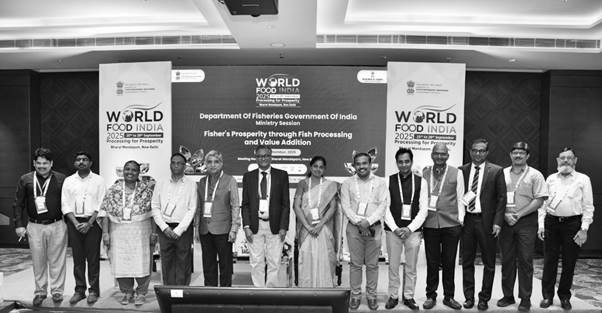
India showcases FishTech, secures ₹1 Lakh cr at world food India 2025
The Department of Fisheries (DoF), under the Ministry of Fisheries, Animal Husbandry and Dairying (MoFAHD), organised a technical session on Saturday in New Delhi, highlighting innovations and investment opportunities in India’s fisheries sector. The event was held on the sidelines of World Food India 2025 at Bharat Mandapam.
In his keynote address, Sagar Mehra, Joint Secretary, DoF, underlined the transformative role of technology in reducing post-harvest losses, ensuring quality, and expanding India’s fisheries exports. He emphasised that fish plays a crucial role in combating hunger and noted that over three crore Indians are directly dependent on the fisheries sector for their livelihood. He also acknowledged the significant role of women in both production and nutritional security.
Aligned with Prime Minister Narendra Modi’s vision of strengthening marine product processing through modern plants, cold chain facilities, and smart harbours, the session brought together policymakers, experts, and industry stakeholders. Discussions were centred on “Blue Revolution 2.0,” with a strong focus on retail transformation, cold chain infrastructure, processing facilities, and digital market access.
Mehra also announced the development of a National Framework for Traceability in collaboration with the Marine Products Export Development Authority (MPEDA) and the Export Inspection Council (EIC) to align India’s fisheries sector with global standards.
During the session, B. K. Behera, Chief Executive, National Fisheries Development Board (NFDB), presented advanced technologies such as Recirculatory Aquaculture Systems (RAS), Biofloc, Aquaponics, and inland cage culture clusters. He also highlighted the integration of AI-enabled systems and drone applications to promote sustainable aquaculture.
International collaboration was another key theme. Kari Logason, General Manager at Nautic, an Iceland-based naval architecture firm, participated virtually and shared insights on modern deep-sea fishing vessels and AI-integrated processing systems. He expressed interest in collaborating on customised vessel technologies for India.
The session also highlighted the importance of promoting value-added seafood products from underutilised species and by-products to reduce post-harvest losses and enhance export potential.
The technical session formed part of the larger World Food India 2025 summit, which witnessed significant investment commitments. On the second day alone, 21 companies signed Memorandums of Understanding (MoUs) worth over ₹25,000 crore. This took the total investment commitments over the first two days to more than ₹1 lakh crore.
The Ministry of Food Processing Industries (MoFPI) confirmed that the summit has emerged as a major platform for investment and international collaboration in the food processing sector. Over 25 knowledge sessions were conducted across the two days, featuring participation from global regulators, policymakers, startups, and industry leaders.