
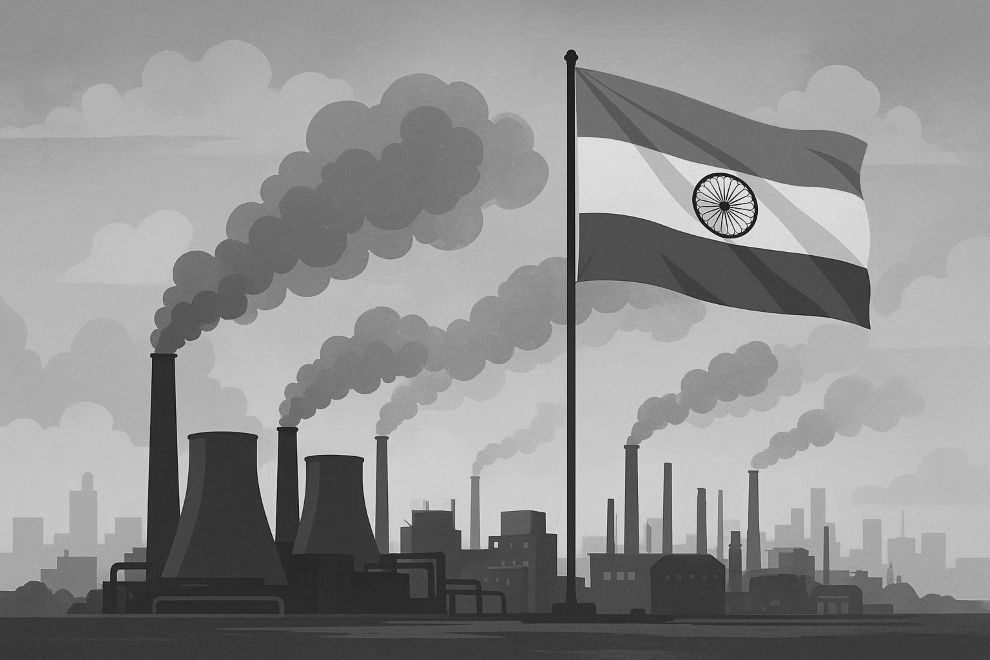
India sets first carbon emission limits for heavy industries
India has introduced its first legally binding rules to curb greenhouse gas emissions from major industries. The Greenhouse Gases Emission Intensity Target Rules, 2025 apply to 282 industrial units in sectors like aluminium, cement, pulp and paper, and chlor-alkali. Under these rules, issued under the Energy Conservation (Amendment) Act, 2022, factories must reduce the amount of greenhouse gases they emit per unit of production compared to 2023-24 levels. The compliance period runs from 2025-26 to 2026-27.
India has also operationalised a domestic carbon market under these rules. A carbon market is a system where companies that reduce their greenhouse gas emissions can earn tradable carbon credits, which represent the amount of emissions they have avoided. These credits can then be bought and sold, creating a financial incentive for industries to adopt cleaner technologies and reduce emissions.
Industries have two options under the rules. If a facility emits less than its assigned target, it earns carbon credits, certificates representing the amount of greenhouse gas saved. These credits can be sold to other industries that exceed their limits, allowing them to offset their excess emissions. If a facility exceeds its target, it must either purchase equivalent carbon credits or pay a penalty called environmental compensation, equal to twice the average trading price of carbon credits that year.
These credits can be sold to other industries that exceed their targets. If a facility exceeds its limit, it must either buy carbon credits or pay a penalty called “environmental compensation,” equal to twice the average carbon credit price of the year. The Bureau of Energy Efficiency (BEE) sets credit prices, while the Central Pollution Control Board (CPCB) monitors compliance.
For example: if a cement plant reduces its emissions by 5% while its target was 3.4%, it earns extra carbon credits. Another plant that exceeds its target by 2% can purchase these credits to offset the excess emissions instead of paying a penalty. This system encourages cleaner production and creates a market incentive for industries to reduce emissions.
The rules build on India’s Perform, Achieve and Trade (PAT) program, which focused on energy efficiency, but now directly limits carbon emissions. Top industries included in the first compliance cycle are:
• Aluminium: Vedanta, Hindalco, Nalco, Balco
• Cement: UltraTech Cement, Dalmia Cement, JK Cement, Shree Cement, ACC
• Pulp and Paper: Large industrial paper mills
• Chlor-Alkali: Factories producing chlorine and caustic soda
However, several other heavy industries are not yet covered, including steel and iron, petrochemicals and refineries, fertilizers, glass and ceramics, and mining or heavy machinery manufacturing. These sectors are highly carbon-intensive but may be included in future compliance cycles as monitoring and enforcement mechanisms improve.
The tradable carbon credit mechanism is likely to significantly affect industrial competitiveness and operations. Companies that reduce emissions efficiently can generate and sell credits, creating a new revenue stream and gaining a cost advantage. Industries that exceed limits may face higher costs from penalties or buying credits, encouraging them to invest in cleaner technologies, optimize operations, and adopt low-carbon processes to remain competitive, both domestically and globally.
The rules also help India align with global climate policies, such as the European Union’s Carbon Border Adjustment Mechanism (CBAM), which taxes carbon-intensive imports like cement, steel, and aluminium. Achieving these targets supports India’s Paris Agreement commitments, including reducing the emission intensity of GDP by 45% by 2030 and reaching net zero by 2070.
However, potential loopholes remain. Short compliance periods, limited industry coverage, baseline manipulation, and weak penalties if carbon credit prices remain low could allow companies to meet targets on paper without meaningful reductions. To prevent this, the Central Pollution Control Board (CPCB) can impose stricter measures, including suspending operations, revoking licenses, or ordering closure of non-compliant facilities. Repeated violations may also harm a company’s reputation, market credibility, and access to international markets, ensuring industries adopt cleaner technologies and responsible practices rather than relying on fines as a substitute for real emission cuts.
Despite these challenges, the rules mark a significant step toward cleaner, accountable industrial growth, showing India’s determination to balance economic development with environmental responsibility.