
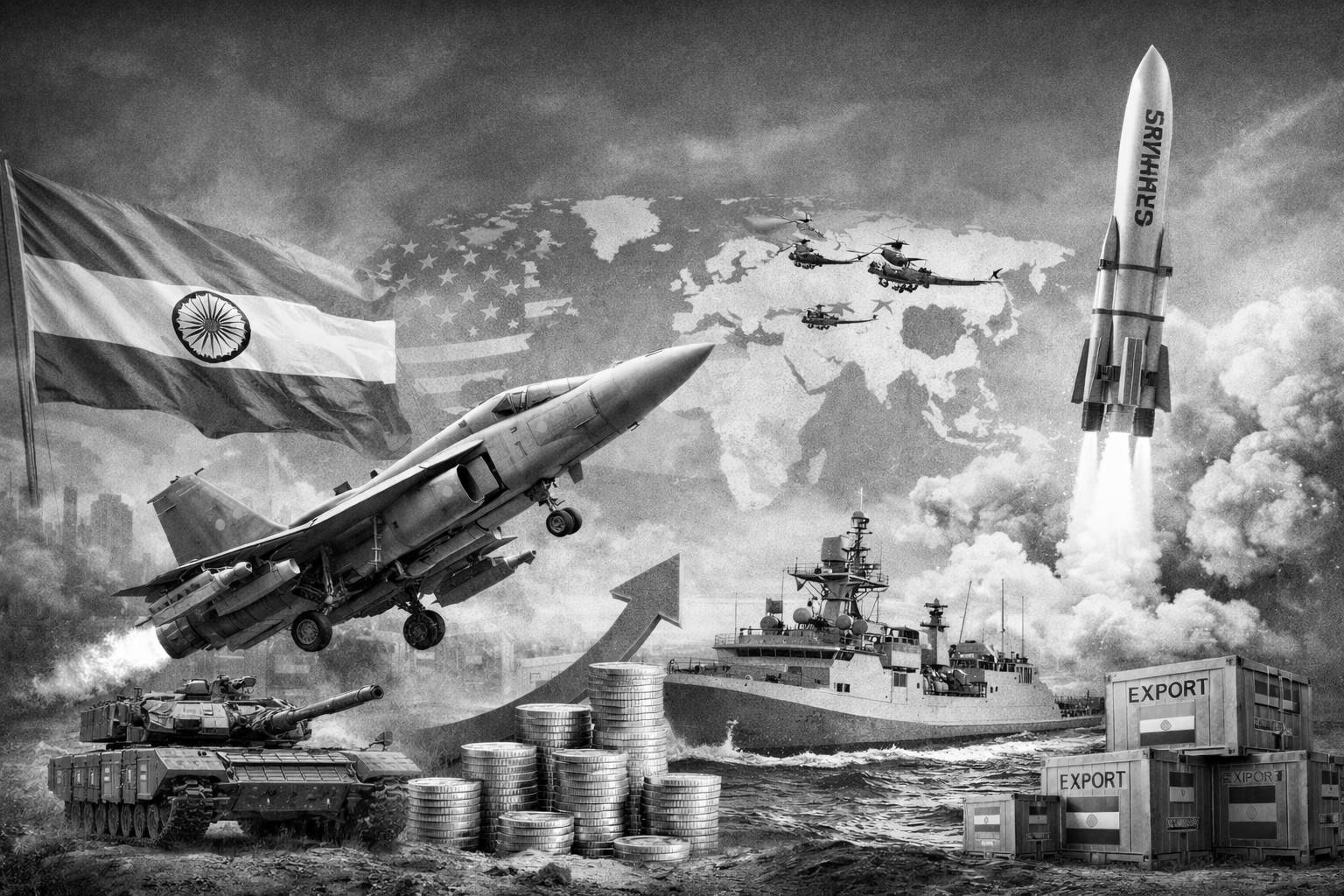
India sees 62% rise in defence exports, hits ₹38,424 crore mark in FY26
India has recorded a historic surge in defence exports , with shipments touching ₹38,424 crore in FY 2025–26 , marking a sharp 62.66 percent growth over the previous year. Announced by Defence Minister Rajnath Singh , the milestone reflects growing global trust in India’s indigenous capabilities and its emergence as a credible player in the international arms market.
This rise is part of a broader transformation. India’s defence exports have expanded dramatically from just ₹8,434 crore in 2020–21 to current levels an increase of more than 4.5 times in five years . The growth trajectory shows steady acceleration, with exports rising to ₹12,814 crore in 2021–22 , ₹15,920 crore in 2022–23 , ₹21,083 crore in 2023–24 , and ₹23,622 crore in 2024–25 , before the record-breaking jump this year. Over the past decade, exports have surged from below ₹1,000 crore , signaling a structural shift rather than temporary growth.
A defining feature of this expansion is the strong contribution from both DPSUs and private sector firms , highlighting a maturing and self-reliant defence ecosystem . In FY 2025–26, DPSUs contributed ₹21,071 crore , while the private sector added ₹17,353 crore , reflecting a balanced and collaborative industrial base. Government reforms particularly improvements in ease of doing business , simplified export approvals, and a revamped digital portal have played a crucial role in enabling this growth.
India’s defence export basket has also diversified significantly. The country now exports a wide range of advanced military systems , including missiles like BrahMos and Akash , aircraft such as Tejas and Dhruv helicopters , naval platforms like patrol vessels, artillery systems including ATAGS , and radars, electronic warfare systems, and defence electronics . Beyond complete platforms, India is increasingly supplying components and sub-systems, integrating itself into global defence supply chains.
Geographically, India’s defence footprint has expanded to over 80 countries , spanning regions such as Southeast Asia, the Middle East, Africa, and Europe . Key buyers include nations like the United States, France, Armenia, and several Indian Ocean partners , with India supplying equipment ranging from coastal surveillance systems to advanced weapon platforms . The number of exporters has also grown from 128 to 145 , indicating rising participation and diversification within the domestic industry.
Despite this rapid growth, India’s position in the global defence export hierarchy remains modest. According to international estimates, the global market is dominated by countries like the United States (around 42 percent share) , followed by France, Russia, Germany, and China . India is still outside the top 20 exporters , with a global share of less than 1 percent . In value terms, India’s exports approximately $4.5–5 billion are significantly lower than major players such as the United States (over $150 billion) or even mid-level exporters like Israel (around $12 billion) .
However, this gap also highlights India’s potential. Unlike established exporters, India is transitioning from being one of the world’s largest arms importers to an emerging exporter , driven by policy initiatives like Make in India and Atmanirbhar Bharat . The current growth momentum, combined with increasing global demand for diversified suppliers, positions India as a reliable and cost-effective alternative in the global defence market.
Looking ahead, India has set an ambitious target of achieving ₹50,000 crore in defence exports , aiming to break into the top tier of global exporters . If current trends continue, supported by innovation, private sector participation, and strategic partnerships, India’s defence export story could become a key pillar of its economic strength and geopolitical influence .