
India Rises to Third Place in Global AI Race, Stanford Index Shows
Artificial Intelligence (AI) has emerged as one of the most decisive technologies of the modern era, shaping economic power, governance, national security, and everyday life. While the global AI race is overwhelmingly dominated by the United States and China, India has rapidly scaled up to secure the third position globally , competing with far richer nations and steadily marching ahead in the AI ecosystem race. According to Stanford University’s Global AI Vibrancy Tool (2025), India now ranks third worldwide with a score of 21.59 , trailing only the United States and China. This rise is significant not because India has achieved human-level intelligence, but because it has built a competitive, large-scale AI ecosystem driven by talent, digital public infrastructure, policy support, and widespread adoption.
Artificial intelligence development is commonly understood in three stages. The first stage is Artificial Narrow Intelligence (ANI), where AI systems are designed to perform specific tasks such as chatbots, recommendation systems, image recognition, autonomous driving features, and generative AI tools. These systems can outperform humans in narrow domains but lack general reasoning or understanding. All AI systems currently in use worldwide fall under this first stage. The second stage, Artificial General Intelligence (AGI), would involve human-level reasoning across domains, but no country, company, or laboratory has achieved AGI so far . The third stage, Artificial Superintelligence (ASI), remains theoretical.
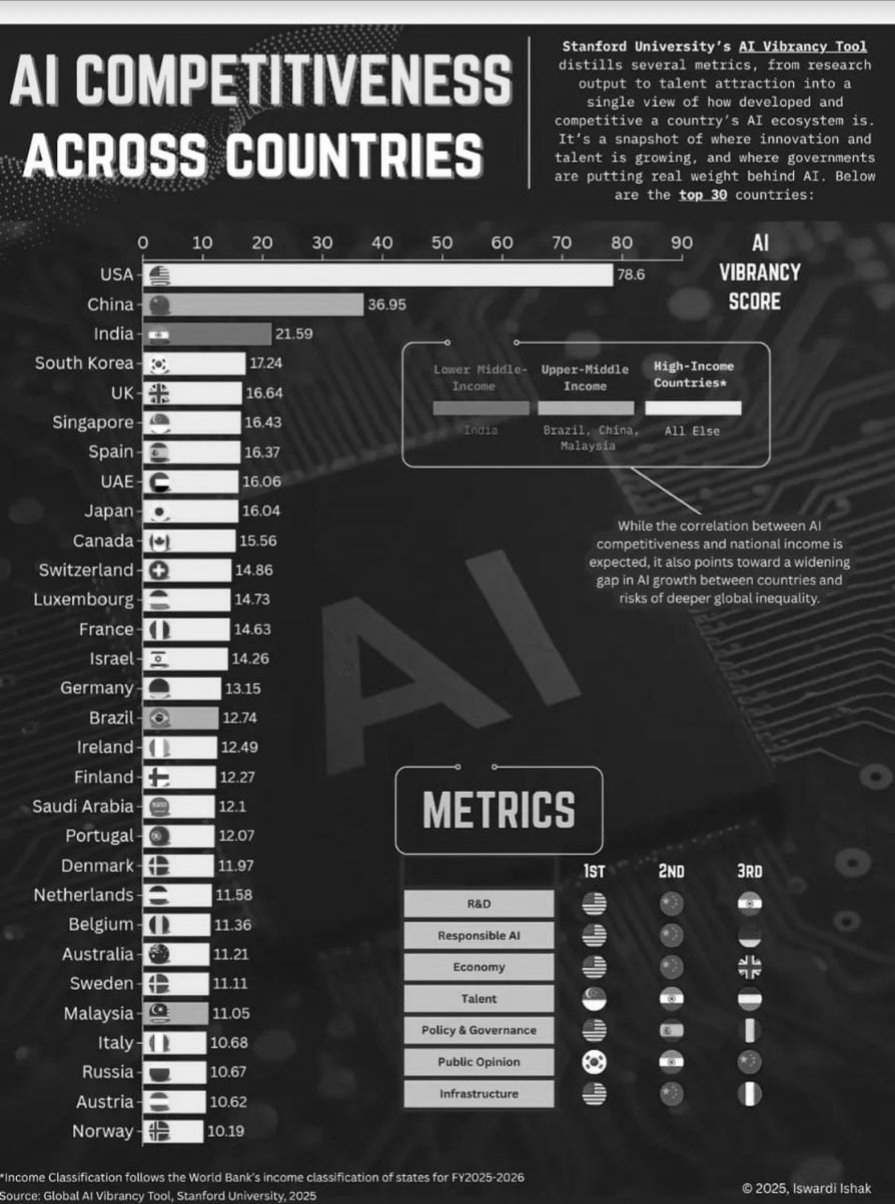
The data shown in the widely shared photograph is based on Stanford University’s Global AI Vibrancy Tool , which measures national AI competitiveness using a composite score drawn from multiple indicators. These indicators include research and development, AI economy and private investment, talent availability, infrastructure, policy and governance, responsible AI, and public opinion and adoption . The ranking is designed to assess the overall strength of a country’s AI ecosystem rather than the intelligence level of its AI systems.
According to the Stanford ranking, the United States leads the world by a wide margin with an AI Vibrancy Score of 78.6 , making it the undisputed global leader. China ranks second with a score of 36.95 , which is less than half of the US score, highlighting a massive gap at the top. India ranks third with 21.59 , followed by South Korea at 17.24 , the United Kingdom at 16.64 , Singapore at 16.43 , Spain at 16.37 , the United Arab Emirates at 16.06 , Japan at 16.04 , and Canada at 15.56 . Most countries ranked from fourth to tenth are tightly clustered between scores of 15 and 17, underscoring how sharply the United States stands apart.
One of the most striking insights from the data is that India is the only lower-middle-income country in the top tier of global AI rankings . Despite economic constraints, India ranks ahead of advanced economies such as Japan, Germany, France, Australia, Italy, and Sweden . This makes India a clear outlier, outperforming many wealthier nations in AI competitiveness.
The United States dominates global AI because it controls the core engines of AI power. American companies such as OpenAI, Google DeepMind, Meta, Anthropic, and Microsoft lead the world in foundational AI model development. The US also dominates AI hardware through NVIDIA , whose GPUs power most advanced AI systems globally. Cloud infrastructure provided by Amazon Web Services, Microsoft Azure, and Google Cloud enables massive-scale AI training and deployment, supported by deep venture capital markets and world-leading universities.
China is the only near-peer competitor to the United States. Chinese companies including Baidu, Alibaba, Tencent, Huawei, SenseTime, and iFlytek deploy AI across e-commerce, surveillance, healthcare, logistics, and smart cities. China’s advantage lies in population-scale deployment and state-backed adoption , though restrictions on access to advanced semiconductors limit its ability to fully match the US in frontier AI research.
Japan’s recent prominence in AI-related news reflects leadership in policy and governance , not entry into Artificial General Intelligence. Japan has adopted a soft regulatory approach , relying on voluntary AI guidelines instead of strict laws, and allows broad use of copyrighted material for AI training. It is also investing heavily in advanced semiconductor manufacturing through initiatives such as Rapidus . Japan’s AI Vibrancy Score of 16.04 places it firmly in the global middle tier.
India, like all other countries, remains in the Artificial Narrow Intelligence stage. However, its third-place global ranking reflects strong performance in talent, adoption, policy, and digital infrastructure. India’s AI ecosystem is driven by breadth rather than a handful of frontier research labs. Major IT companies such as TCS, Infosys, Wipro, HCLTech, and Tech Mahindra deploy AI across global enterprises, while platforms like Reliance Jio, Flipkart, Paytm, Swiggy, and Zomato apply AI at population scale.
India’s AI startup ecosystem also contributes to its vibrancy score. Companies such as Fractal Analytics, Uniphore, SigTuple, Niramai, and Tiger Analytics strengthen innovation and commercial adoption. In addition, global technology firms including Google, Microsoft, Amazon, IBM, and Intel operate large AI research and engineering teams in India, boosting the country’s talent and research indicators.
Government initiatives play a central role in India’s AI rise. Programmes such as the IndiaAI Mission , NITI Aayog’s National AI Strategy , Bhashini for Indian language AI , Digital Public Infrastructure platforms like Aadhaar, UPI, DigiLocker, and ONDC , AI Centres of Excellence , and large-scale skilling initiatives have strengthened India’s performance in policy, governance, inclusion, and public trust key components of the Stanford index.
Despite its strong showing, India still lags behind the United States and China in critical areas. It lacks frontier AI labs comparable to OpenAI or DeepMind, has limited access to large-scale AI computing infrastructure, does not yet manufacture advanced AI chips, and attracts lower levels of private investment in core AI research. These gaps explain why India’s score of 21.59 remains far below the US score of 78.6 .
A crucial takeaway from the Stanford data is that no country has reached Artificial General Intelligence . The United States, China, India, and Japan are all competing within advanced forms of Artificial Narrow Intelligence. Claims of AGI leadership often confuse ecosystem strength with human-level intelligence.
The global AI race today shows a clear structure: the United States far ahead, China as the only near-peer, and a competitive second tier led by India, which has surged to third place globally . India’s rise highlights the power of talent, digital public infrastructure, and inclusive policy. The race to Artificial General Intelligence remains open and no nation has crossed that threshold yet.