
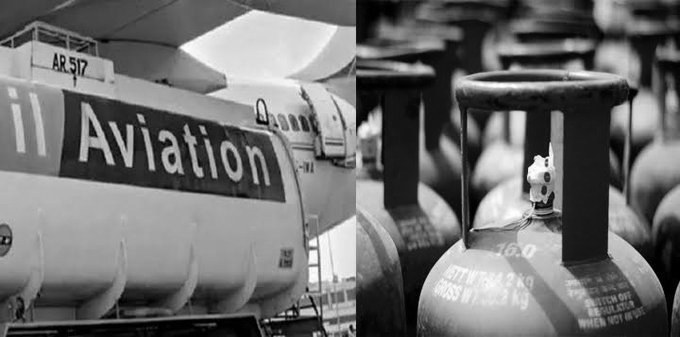
India raises jet fuel, commercial LPG prices as Mideast crisis drives global surge
What began as a geopolitical tremor in West Asia has now landed squarely on the kitchen fires of India's most vulnerable workers. As the U.S.-Israeli war on Iran chokes global energy supply lines, India, the world's second-largest LPG importer , is reeling under what experts are calling its worst gas crisis in decades , with ripple effects reaching far beyond boardrooms and airline terminals, all the way to the roadside dhabas and food stalls that millions of migrant workers call their workplace.
On April 1, 2026 , state-owned fuel retailers raised the price of commercial LPG by ₹195.50 , pushing a 19-kg cylinder in Delhi to ₹2,078.50 , the fifth price hike since January 2026, and the third within the month of March alone, with the cumulative increase crossing ₹300 since the Middle East conflict began. The trigger, as the government acknowledged without apology, is a 44% surge in the Saudi Contract Price , driven by the fact that 20% to 30% of global LPG supplies are currently bottlenecked in the Strait of Hormuz. That India sources approximately 90% of its LPG imports from the Middle East , with imports accounting for 60% of total consumption , makes the country's exposure to this crisis not merely uncomfortable but structurally alarming.
Aviation Turbine Fuel (ATF) has surged over 114% to ₹2.07 lakh per kilolitre , the first time jet fuel has crossed the ₹2 lakh mark, surpassing even the peak seen during the 2022 Russia–Ukraine war . The spike reflects disruptions in global energy supply routes amid the West Asia conflict, placing India’s aviation sector, already operating on thin margins, under intense cost pressure.
To soften the blow, the government asked state-run oil marketing companies, in consultation with the civil aviation ministry, to pass on only a partial and staggered hike of about 25% to domestic airlines , temporarily shielding them from the full increase. Even so, fuel already accounts for around 40% of airline operating costs , leaving carriers little room to absorb further shocks.
The situation is worsened by regional airspace restrictions linked to the conflict, which have forced airlines to take longer routes to western destinations, increasing fuel consumption per flight. Civil Aviation Minister Ram Mohan Naidu has urged state governments to consider reducing value-added tax (VAT) on aviation fuel, which ranges from about 18% to 29% in major aviation hubs such as Delhi and Maharashtra to ease pressure on airlines.
Industry sources say phased increases in ATF and other premium fuel variants may follow if global prices remain elevated, suggesting airlines could face sustained cost pressures. With margins already thin, carriers may eventually be forced to pass on part of the burden to passengers, raising the likelihood of higher airfares in the coming weeks.
For now, the government has drawn a clear line: the 14.2-kg domestic cooking gas cylinder remains unchanged at ₹913 , a move aimed at shielding households from the immediate price shock. While the decision offers some relief, its limits are already becoming visible on the ground.
Commercial cylinders, vital for India’s vast informal food economy, have been fully exposed to market forces, and the impact is being felt quickly by eateries, caterers and small vendors. But the pressure is not confined to businesses alone. A widening price gap between domestic and commercial LPG has begun encouraging diversion, with some small suppliers redirecting stocks meant for households to commercial buyers willing to pay higher rates. As a result, the shortage the government sought to contain within the commercial segment is gradually spilling into the domestic market. In several localities, households are reporting delays in deliveries and increasing difficulty obtaining cylinders at the regulated price.
Compounding the problem, black-market trading in LPG has reportedly increased alongside the formal price hikes. Enforcement agencies have struggled to keep pace with the scale of diversion. At the same time, market signals suggest changing consumer behaviour: sales of induction cooktops have risen in recent weeks as some households, frustrated by uncertain supply and rising costs, begin shifting away from LPG dependence.
The government has attempted to address the supply pressure by increasing domestic LPG production to about 50,000 metric tonnes per day, roughly a 40 per cent rise, though this remains below the estimated daily demand of around 80,000 tonnes. Indian companies have also secured around 800,000 tonnes of LPG cargoes from alternative suppliers, including the United States, Russia and Australia, to reduce dependence on disrupted Middle Eastern supply routes.