
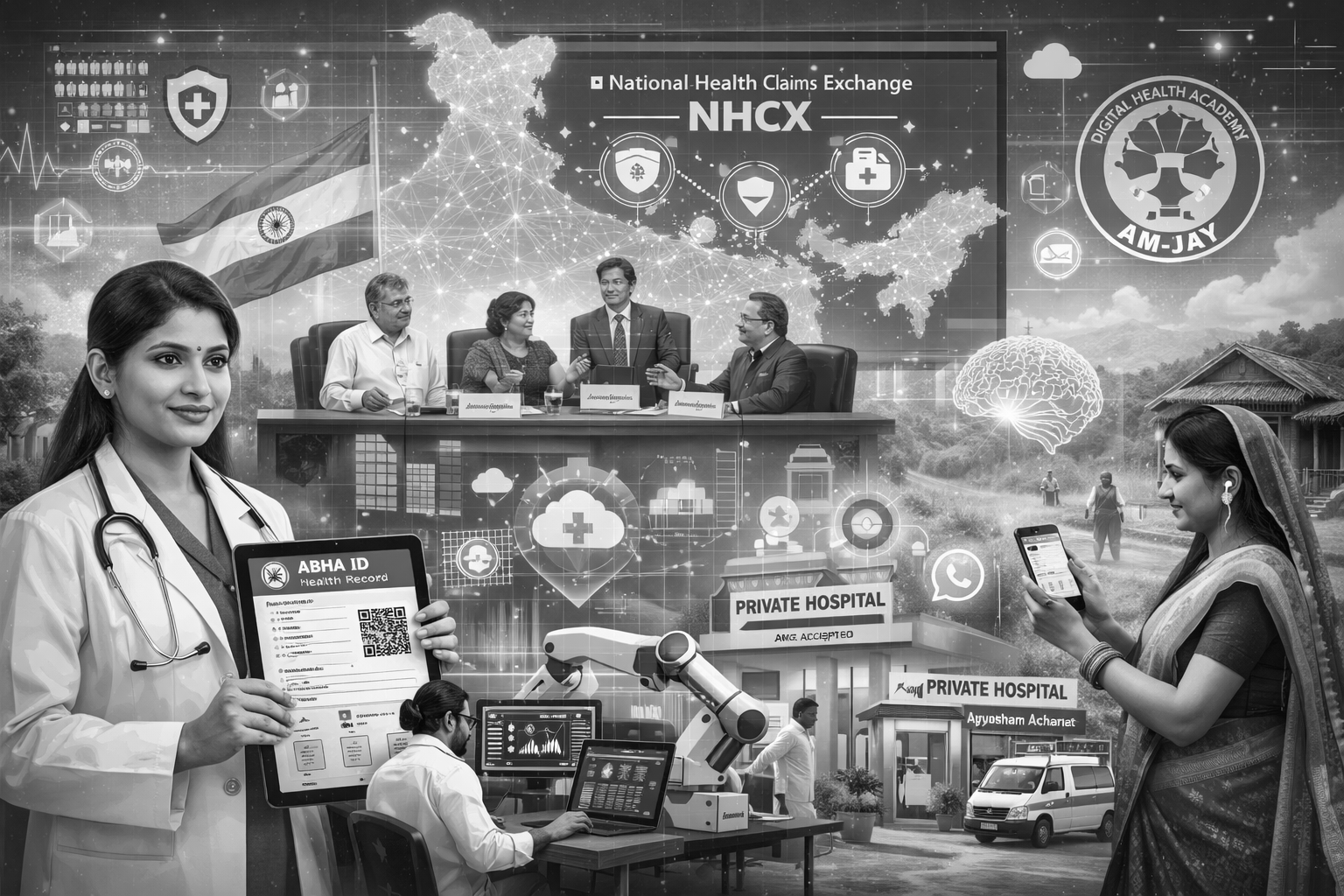
India Pushes Digital Health Transformation with AI and Unified Claims System at NHA Meet
India’s healthcare reform agenda received a significant push as the National Health Authority (NHA) convened a two-day Chintan Shivir in Pune to review and accelerate the implementation of Ayushman Bharat PM-JAY and the Ayushman Bharat Digital Mission (ABDM) . The gathering brought together senior officials from the Centre and States, marking a crucial step toward building a future-ready, technology-driven healthcare system aligned with the vision of Viksit Bharat 2047 .
Inaugurating the session, Maharashtra’s Minister of State for Public Health Meghana Sakore-Bordikar underscored the need to shift India’s healthcare model from curative to preventive care , powered by digital technologies and artificial intelligence . She highlighted the growing emphasis on women’s health initiatives and expressed confidence that Maharashtra would continue to lead in implementing national health programmes effectively.
A series of major initiatives announced during the Shivir reflected a strong push toward standardisation and interoperability . The release of a Compendium of Guidelines aims to streamline PM-JAY implementation, while the NHCX Strategy Paper seeks to establish a unified health claims ecosystem . Additionally, the ABDM Index Reference Guidebook will enable structured assessment of digital health progress across States and Union Territories. In a key capacity-building measure, the Digital Health Academy was launched to develop a skilled healthcare workforce equipped to operate in an increasingly digital environment.
Central to the discussions was the National Health Claims Exchange (NHCX) , identified as a transformative reform to address long-standing inefficiencies in insurance claim processing. By enabling auto-adjudication, real-time processing, and standardisation , NHCX is expected to reduce delays, curb fraud, and enhance transparency. This, in turn, could improve hospital participation and strengthen trust in PM-JAY , which remains the world’s largest government-funded health insurance scheme covering over 50 crore beneficiaries .
The Shivir also highlighted the rapid expansion of India’s digital health ecosystem under ABDM , which aims to create a nationwide, interoperable infrastructure built around ABHA health IDs and patient-controlled data sharing. Officials emphasised that India’s approach combining scale with a privacy-focused, federated architecture positions it among the most ambitious digital health programmes globally.
Technology-driven service delivery emerged as a key theme, with tools like the Ayushman App and WhatsApp chatbot improving accessibility and reducing dependence on intermediaries. The integration of artificial intelligence and advanced data analytics is expected to enhance diagnostics, enable fraud detection, and support faster decision-making, while maintaining a human-centric approach to care.
State-level innovations further reinforced the spirit of cooperative federalism . Andhra Pradesh showcased its use of AI in healthcare delivery, while Maharashtra highlighted progress in scheme implementation and digital adoption. These experiences are expected to inform a broader national strategy that balances local innovation with central standardisation .
At the same time, the Shivir addressed critical governance aspects such as fund utilisation, financial discipline, and accountability , emphasising the need for outcome-based healthcare financing. Experts noted that while India has made rapid strides, challenges such as the digital divide, data privacy concerns, and uneven adoption across regions must be addressed to ensure inclusive growth.
Overall, the deliberations signal a decisive shift in India’s healthcare trajectory from fragmented, treatment-focused systems to an integrated model that is digital-first, AI-enabled, and preventive in approach . If effectively implemented, this transformation could not only improve health outcomes domestically but also position India as a global model for scalable and affordable healthcare innovation .