
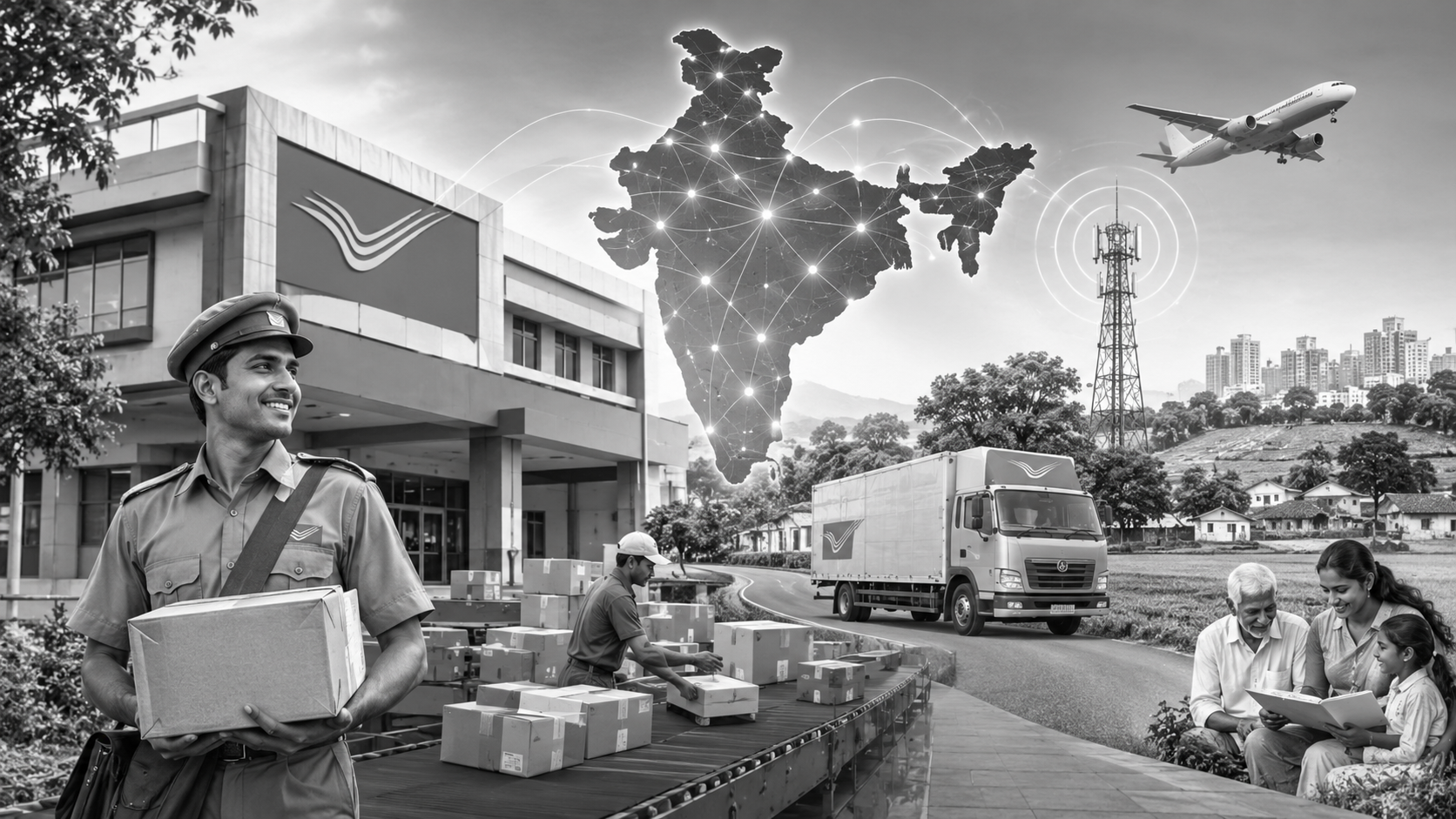
India Post's Big Makeover: Government Targets Infrastructure, Technology and Rural Growth
The Union Cabinet, chaired by Prime Minister Narendra Modi, has approved a combined investment of ₹2,632 crore to modernise India's postal network over the next five years, as the government seeks to transform India Post into a technology-enabled logistics, financial inclusion and citizen-service platform. The approvals include ₹1,491 crore for the continuation of the Estates Management Scheme and ₹1,141 crore for the Postal Operations Scheme during the 16th Finance Commission period, covering FY 2026–27 to FY 2030–31. The twin initiatives aim to upgrade ageing postal buildings, expand parcel-processing infrastructure, improve rural connectivity, strengthen international mail operations and support digital service delivery across one of the world's largest postal networks.
Revamping Ageing Infrastructure
The Estates Management Scheme will focus on transforming the department's physical infrastructure through construction, reconstruction, renovation and standardisation of postal facilities. An allocation of ₹280 crore will support the construction of 190 departmental postal buildings on vacant government land, enabling post offices operating from rented premises to relocate to government-owned buildings and reduce recurring rental expenditure. Another ₹108 crore has been earmarked for reconstructing 50 dilapidated buildings to improve structural safety and working conditions. The department will spend ₹318 crore on renovating 2,550 departmental sub-post offices and establishing a uniform brand identity, while ₹37.50 crore will be used to modernise another 2,500 post offices operating from rented premises.
The programme also seeks to preserve India's postal heritage, with ₹180 crore allocated for conserving 20 historically significant postal buildings. Another ₹357.50 crore will support the comprehensive renovation of 150 high-demand residential colonies to improve employee welfare. Under the ₹100-crore provision for supportive and inclusive activities, postal buildings will receive solar energy systems, rainwater harvesting facilities, wheelchair ramps and Braille signage, besides women's toilets and feeding rooms. A further ₹100 crore will establish permanent infrastructure for the Centre for Excellence in Postal Technology (CEPT) in Bengaluru to support Advanced Postal Technology services and an indigenous open-source technology stack.
Rural Connectivity and Financial Inclusion
The modernisation drive comes as India Post undergoes a significant change in its traditional business model. With digital communication reducing dependence on conventional letter services, the department is increasingly diversifying into parcel delivery, e-commerce logistics, financial services and citizen-centric activities. India operates approximately 1.65 lakh post offices, including 1,49,385 in rural areas, according to the department's published network statistics as of March 31, 2025. The network serves an average population of around 7,339 people per post office and covers an average geographical area of 19.92 square kilometres, making it an important service network for remote communities.
Beyond mail delivery, post offices provide Post Office Savings Bank services, India Post Payments Bank (IPPB), Postal Life Insurance, Aadhaar enrolment and updation, Passport Seva facilities and export support through Dakghar Niryat Kendras. The department has also expanded its presence in underserved regions, opening more than 4,900 Branch Post Offices between 2017 and 2022 in districts affected by Left-Wing Extremism and more than 5,700 post offices in unbanked villages during FY 2023–24. Improved buildings and facilities could strengthen access to banking, insurance and government services, particularly for rural households with limited access to conventional financial institutions.
Revenue Growth and the Parcel Economy
The infrastructure investment coincides with improving financial performance at the Department of Posts. India Post generated ₹15,373 crore in revenue during FY 2025–26, compared with approximately ₹11,500 crore in 2016. The department recorded a single-year revenue increase of ₹2,100 crore, against its historical annual growth of around ₹200–300 crore. Its parcel and logistics segment registered 70% growth during FY 2025–26, with the government identifying a potential to generate up to ₹10,000 crore from parcel services.
The growth momentum continued into FY 2026–27, with India Post recording revenue of ₹8,212.7 crore during April–September 2026, registering 24% growth over ₹6,636 crore in the corresponding period of the previous year. Second-quarter revenue reached ₹4,201.5 crore, marking 25% year-on-year growth and taking quarterly revenue above ₹4,000 crore for two consecutive quarters for the first time. During the first half, parcel revenue increased 71%, Postal Life Insurance and Rural Postal Life Insurance grew 44%, international relations and global business advanced 38%, mail services increased 36%, and Post Office Savings Bank recorded 18% growth. The department has identified agro-logistics, international business, MSMEs, One District One Product initiatives, tourism and rural logistics as potential growth areas.
Strengthening Logistics and Export Infrastructure
The ₹1,141-crore Postal Operations Scheme will address the operational requirements of the expanding network. Its allocations include ₹120 crore for rural business and access to the postal network, ₹575 crore for mail network optimisation, ₹278 crore for parcel network optimisation, ₹8 crore for international mail infrastructure, ₹100 crore for marketing and quality-of-service improvements, and ₹60 crore for philately operations. The programme envisages centralised delivery systems, mechanisation, GIS-based services, upgraded mail-handling facilities, improvements to road transport networks and modern 24-hour smart letter boxes.
The parcel component will support dedicated parcel hubs and expanded Parcel Packaging Units to reduce handling points, address capacity constraints and improve transit times. Upgrades to Foreign Post Offices and Sub Foreign Post Offices will strengthen international consignment processing and export logistics. These improvements could help India Post compete more effectively in the expanding e-commerce market, where reliable last-mile delivery is increasingly important. Its extensive rural presence offers opportunities to connect small manufacturers, agricultural producers and rural artisans with wider domestic and international markets through postal export services and Dakghar Niryat Kendras.
Digital Transformation and Indigenous Technology
The infrastructure programme builds on India Post's ongoing digital transformation under IT Modernisation Project 2.0. The department rolled out its indigenous, cloud-based Advanced Postal Technology platform nationwide on August 4, 2025, integrating approximately 1.70 lakh offices across 23 postal circles. Developed by the Centre for Excellence in Postal Technology and hosted on the MeghRaj 2.0 cloud platform, the system supports transaction processing, digital payments, real-time tracking and improved customer services. Branch post offices have received smartphones running the Digital Rural Enterprise Application for Mobile, while 25,022 departmental post offices are connected through the Core Banking Solution. Postmen and Gramin Dak Sevaks have also been equipped with smartphones and biometric devices to facilitate doorstep banking. The broader IT 2.0 modernisation initiative carries a separate investment of ₹5,800 crore.
Economic Opportunities and Implementation Challenges
The combined investment could generate wider economic benefits through construction activity, demand for building materials, engineering services and local employment. Modernised postal facilities could improve the delivery of financial and public services, while stronger parcel infrastructure could support rural entrepreneurs, MSMEs and e-commerce businesses. Shifting from rented premises to government-owned buildings could also reduce recurring rental expenditure, while solar energy and rainwater harvesting may improve long-term resource efficiency.
Aligned with Digital India, Atmanirbhar Bharat and Viksit Bharat, the initiatives reflect an effort to reposition India Post as a modern public-service and logistics network. However, their success will depend on timely project execution, appropriate location selection, effective maintenance and measurable improvements in delivery efficiency and customer experience. With the proposed construction and renovation targets covering only a portion of India's extensive postal network, the five-year programme will test how effectively the department can translate infrastructure investment and technological capabilities into sustainable growth while retaining its vital role in connecting rural and urban communities.