

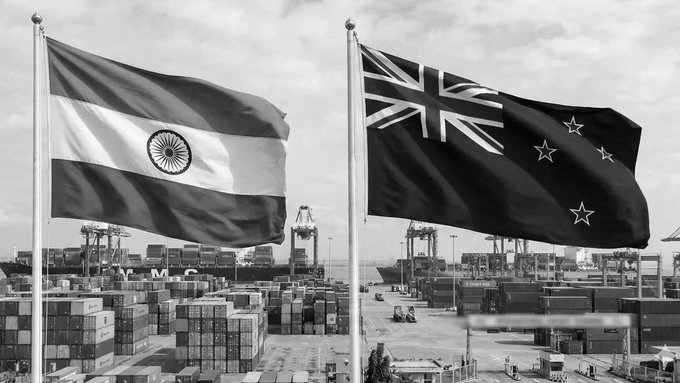
India-New Zealand FTA: Zero Tariffs Start Oct 20, But Can They Deliver A 77% Trade Jump By 2030?
The India-New Zealand Free Trade Agreement will come into force on October 20, after both countries completed the required ratification process, opening wider market access for Indian exporters while also bringing selected New Zealand farm and food products into India under tightly controlled concessions.
Commerce and Industry Minister Piyush Goyal announced the implementation date on Monday. New Zealand's Parliament had approved the legislation on September 16 by 93 votes to 29, and the formal ratification process was completed on September 21. The agreement was signed in New Delhi on April 27 after negotiations that were concluded in December 2025.
The biggest immediate gain for India is zero-duty access for 100 per cent of its exports to New Zealand. This covers labour-intensive sectors such as textiles, apparel, leather and footwear, as well as gems and jewellery, engineering goods and processed food. India will also get duty-free access to inputs such as wooden logs, coking coal and metal waste and scrap, potentially lowering manufacturing costs.
But the agreement is not a one-sided tariff opening. India has offered concessions on 70.03 per cent of its tariff lines, while keeping 29.97 per cent excluded, including sensitive dairy and agricultural products such as milk, cheese, whey, onions, chana, peas, corn, sugar and edible oils. Another 35.6 per cent of tariff lines will see duties phased out over three, five, seven or 10 years, while a small group will receive tariff reductions rather than complete elimination.
There will nevertheless be greater competition in selected farm products. New Zealand apples will receive a reduced tariff within a quota, while kiwifruit gets duty-free access within a quota that rises over time. Mānuka honey also gets preferential treatment. These imports are subject to tariff-rate quotas, minimum import prices and seasonal restrictions, while India and New Zealand have also agreed on productivity programmes and Centres of Excellence for apples, kiwifruit and honey.
The agreement also goes well beyond merchandise trade. India has secured opportunities in 118 services sectors, with most-favoured-nation treatment across about 139 sub-sectors. New Zealand has opened pathways for Indian professionals, including a temporary employment quota of 5,000, while Indian STEM graduates can receive up to three years of post-study work rights and doctoral graduates up to four years. A dedicated health and traditional-medicine framework also covers areas such as Ayurveda and yoga.
New Zealand has committed to promote US$20 billion of private-sector investment in India over 15 years. This should not be interpreted as a $20-billion government cheque or an amount already invested; it is an investment-promotion commitment. India will establish a dedicated New Zealand Investment Desk to assist investors.
The agreement also contains rules of origin, customs facilitation and bilateral safeguard provisions. Goods can be denied preferential treatment if they fail origin requirements, while either country can use safeguards if a surge in imports causes or threatens serious injury to domestic industry. Customs procedures are also intended to become faster and more predictable.
The bigger question is whether all this will actually produce a major increase in trade. Two-way trade stood at about NZ$3.95 billion in 2025, and the two countries have an aspirational goal of reaching NZ$7 billion by 2030. That requires trade to rise by roughly 77 per cent in only four years, an ambitious pace.
Zero tariffs can lower costs and make Indian products more competitive, but they do not automatically create buyers. Logistics, standards, certification, distribution networks, exchange rates, demand and actual use of the FTA will determine whether tariff savings become new export orders.
For New Zealand, the agreement provides preferential access for 95 per cent of its current exports to India over time, including forestry, sheep meat, wool, seafood, horticulture and wine. Its current exports include about NZ$399 million of forestry products and NZ$114 million of horticulture, including apples and kiwifruit.
The FTA therefore removes an important barrier, but October 20 is the starting point, not proof that trade will double. Its real success will be measured by whether Indian companies use the new access to win substantially more business—and whether the resulting growth is large enough to make the 2030 target more than an aspiration.