
India-Netherlands MoUs Give Fresh Push To Gujarat’s Long-Pending Kalpasar Project
India and the Netherlands have given a fresh technical push to Gujarat’s ambitious Kalpasar Project, signing two tripartite MoUs aimed at strengthening engineering expertise, capacity building and planning for a project that has been under study for decades.
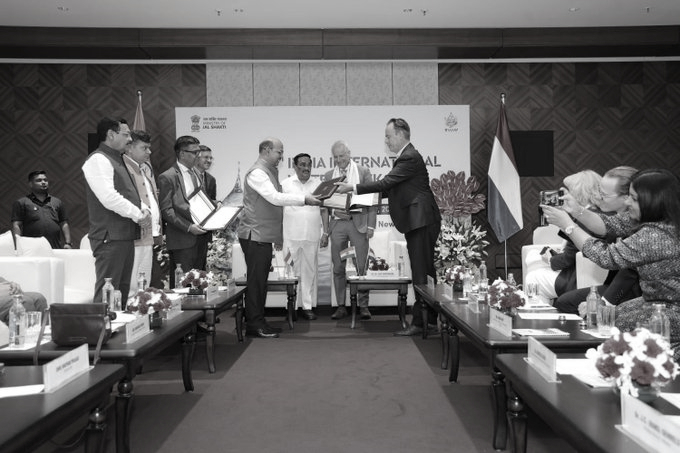
The agreements were signed between the Central Water Commission (CWC), Gujarat’s Kalpasar Department and Dutch institutions Deltares and TU Delft during the India International Water Week in New Delhi. The partnership will cover hydraulic and hydrological modelling, coastal and structural engineering, salinity management, climate resilience, technical review and digital applications.
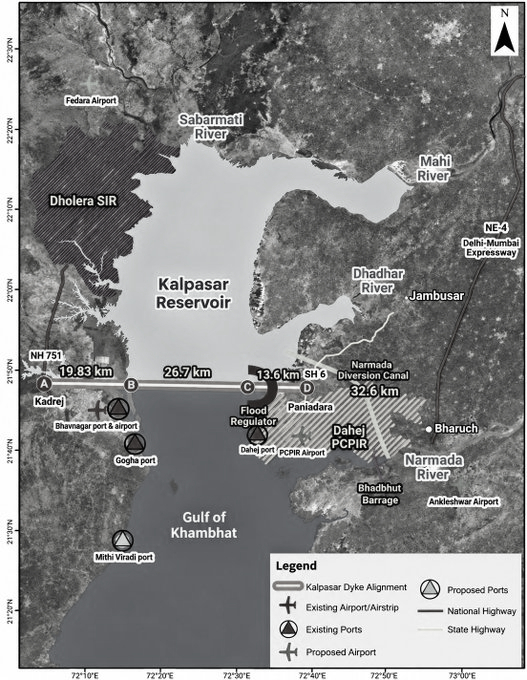
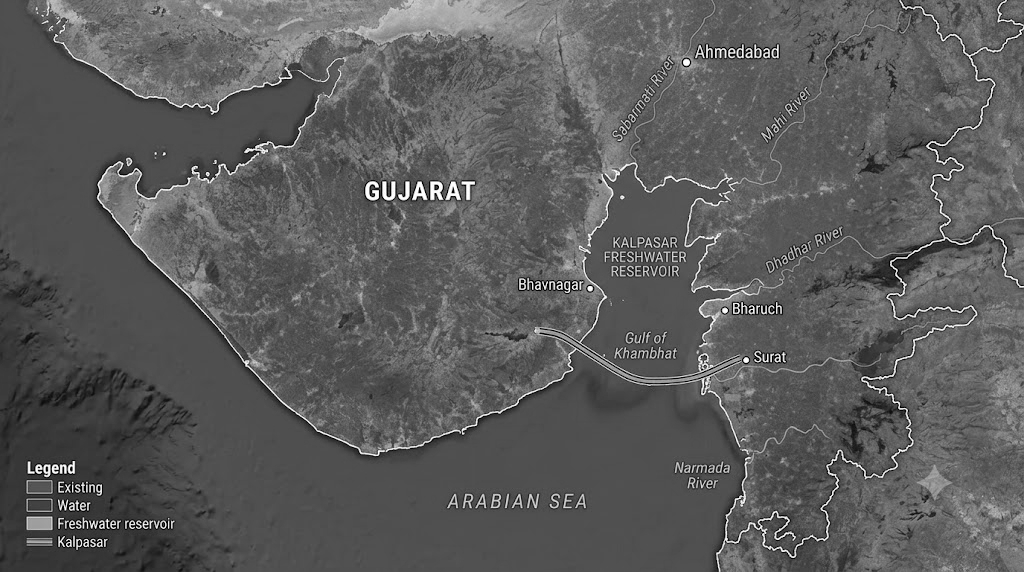
Kalpasar envisages constructing a massive dyke across the Gulf of Khambhat to create a freshwater reservoir aimed at improving water availability for the water-stressed Saurashtra region. The current proposal also includes a highway-cum-rail corridor over the structure and renewable-energy facilities on reclaimed land.
According to the Centre, the proposed transport corridor could reduce the distance between Bhavnagar and Surat from about 356 km to 177 km, cutting roughly 179 km from the existing land route. The project also envisages around 2,470 MW of hybrid renewable-energy capacity, with some of the electricity proposed to be used for pumping freshwater for irrigation in coastal Saurashtra.
But Kalpasar remains a project under development, rather than one that has entered construction. Its complexity helps explain the unusually long gestation period. The proposed dyke is about 60.13 km long, including roughly 26.7 km across the Gulf, according to environmental-clearance documents. The project requires detailed studies of tidal behaviour, sedimentation, salinity, coastal ecology, geology, disaster risks and the impact of altering the Gulf’s natural water flows.
The government said in July that the Detailed Project Report was at an advanced stage of finalisation. The latest Dutch cooperation is expected to strengthen that process with international expertise, particularly on coastal engineering and salinity control.
The partnership follows a May 2026 Letter of Intent between India and the Netherlands on technical cooperation. Dutch experience with major coastal and water-management infrastructure, including the Afsluitdijk, is being seen as relevant to the engineering challenges posed by Kalpasar.
For now, therefore, the latest MoUs mark technical momentum rather than the start of construction, with the project’s final design, clearances and implementation still to be worked through.