
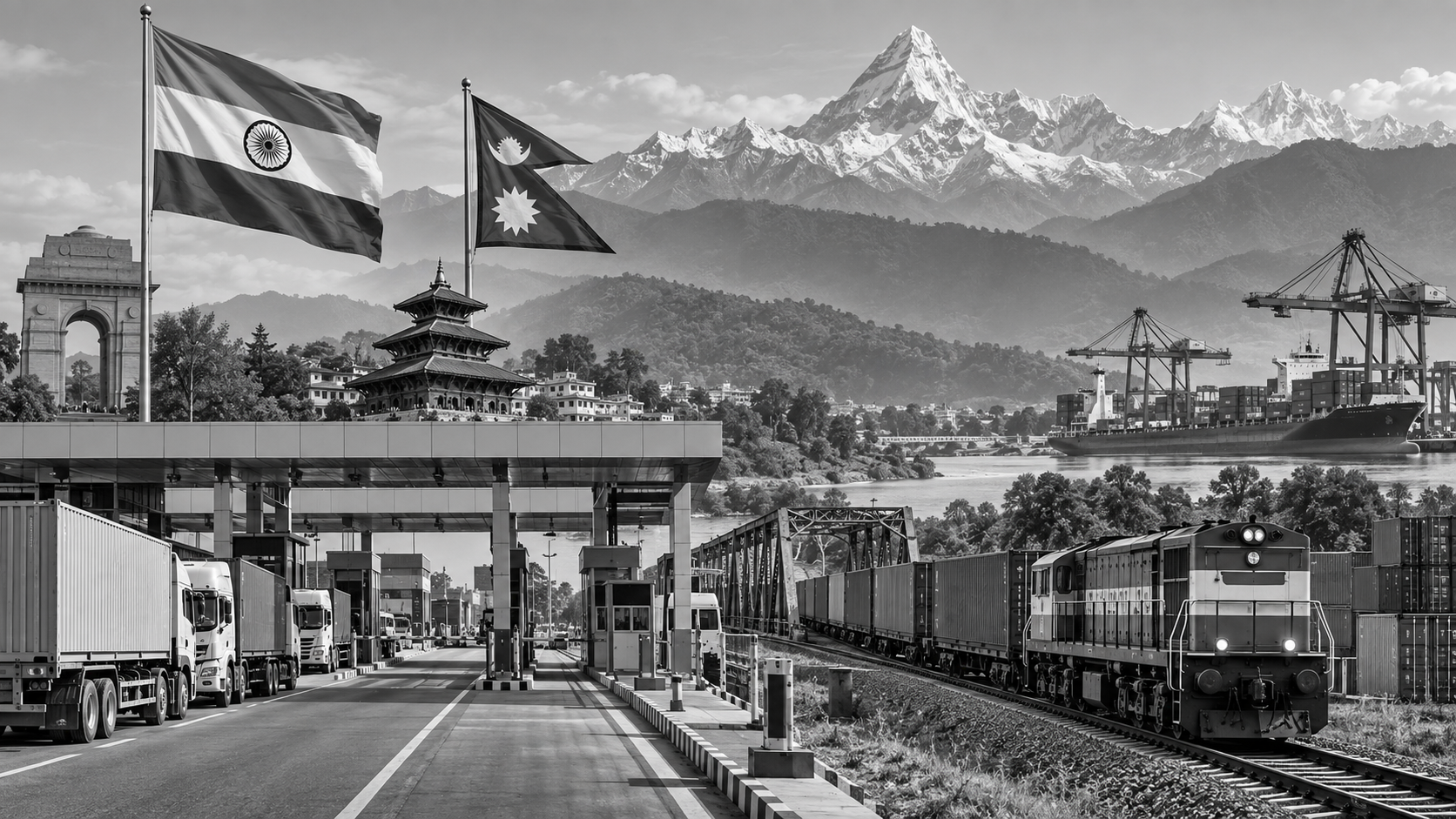
India, Nepal Step Up Trade Cooperation and Border Security
India and Nepal are moving to make their deeply integrated border economy faster, more transparent and more secure, with the two countries combining trade facilitation, digital Customs systems, expanded rail and road connectivity and stronger mechanisms against unauthorised trade and trans-border crime.
The latest step came at the India-Nepal Inter-Governmental Sub-Committee (IGSC) on Trade, Transit and Cooperation to Control Unauthorised Trade, held in New Delhi on September 16–17, 2026. The Indian delegation was led by Ujjwal Kumar Ghosh, Joint Secretary, Department of Commerce, while Nepal’s delegation was headed by Buddha Bahadur Gurung, Joint Secretary, Ministry of Industry, Commerce and Supplies. Both sides reviewed market access, Customs facilitation, food safety, phytosanitary measures, pharmaceuticals, medical devices, AYUSH products and border infrastructure.
The talks assume significance as bilateral merchandise trade reached $9.39 billion in 2025–26, with Indian exports at $7.45 billion and Nepalese exports at $1.94 billion. India accounted for about 62.3% of Nepal’s total merchandise trade, while 81.1% of Nepal’s exports went to India in 2024–25.
The two countries discussed pre-arrival information exchange, electronic verification of Certificates of Origin and Customs digitalisation, seeking quicker clearance while preventing misuse of preferential trade arrangements and commercial fraud. The 2009 Treaty of Trade and Agreement on Cooperation to Control Unauthorised Trade, renewed in 2023, provide the broader framework.
Transit connectivity is also expanding. The revised Treaty of Transit, signed in 2023, and subsequent rail arrangements have opened wider freight options. In July 2026, a 40-wagon direct container freight train carrying canola travelled from Kolkata Port to Biratnagar Customs Yard, reducing border transshipment and potentially lowering logistics costs and transit time.
India is also supporting Integrated Check Posts at Birgunj, Biratnagar and Nepalgunj, with Bhairahawa under construction and preparatory work underway at Dodhara Chandani. These facilities are intended to improve both cargo processing and border control.
Security cooperation is advancing in parallel. The 14th Joint Working Group on Border Management, held in August 2026, reviewed trans-border crime, border infrastructure, boundary pillars and the use of ICPs, roads and railways. India’s SSB reported rescuing 661 trafficking victims and apprehending 6,324 people involved in illegal activities during 2025–26.
A February 2026 Mutual Legal Assistance Agreement in Criminal Matters has further strengthened judicial cooperation. Together, these measures point towards an India-Nepal border that is designed to facilitate legitimate trade while strengthening mechanisms against unauthorised commerce, fraud and cross-border crime.