
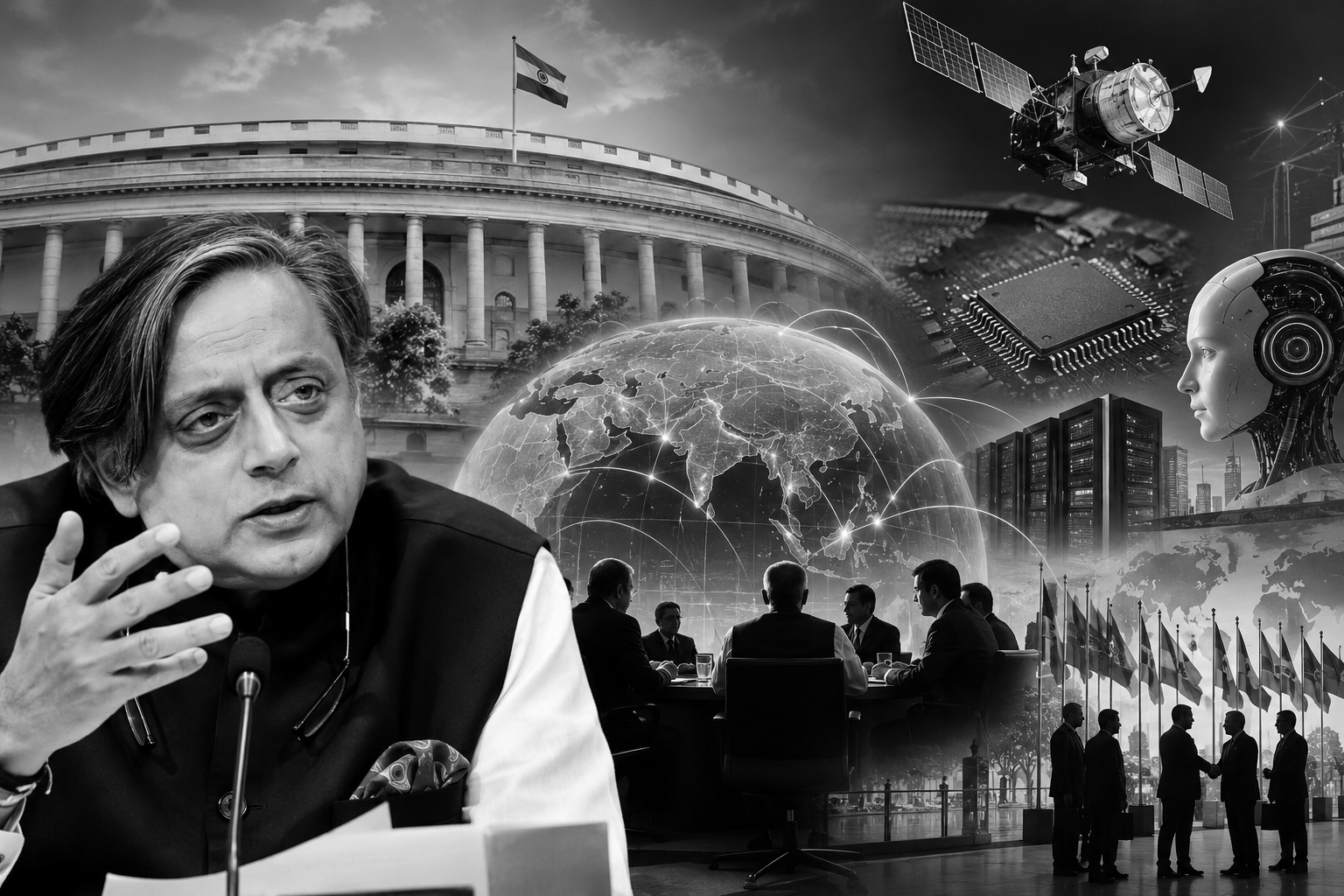
India Needs Coordinated Strategy to Expand Global Technology Partnerships: Parliamentary Panel
India needs a coordinated national strategy to translate its growing technological capabilities into stronger international partnerships, greater strategic autonomy and a more influential role in global technology governance, a parliamentary panel has recommended, calling for a formal inter-ministerial mechanism chaired by the Ministry of External Affairs (MEA).
The Parliamentary Standing Committee on External Affairs, headed by Congress leader Shashi Tharoor, made the recommendations in its nearly 260-page report on India's role in global technology diplomacy, digital governance, space diplomacy, artificial intelligence (AI) and emerging innovations. The panel proposed an inter-ministerial body involving the Ministry of Electronics and Information Technology (MeitY), Department of Science and Technology, Department of Space and Ministry of Commerce and Industry, with regular meetings to monitor commitments and coordinate priorities.
The committee also recommended a public Technology Vision and Strategy Document and a complementary Technology Diplomacy Strategy, developed through consultations with industry, academia and research institutions. Technology should be integrated into country-specific diplomatic assessments rather than treated as a separate technical subject, it said.
Highlighting India's AI ambitions, the panel flagged inadequate computing capacity, limited access to advanced chips, unreliable infrastructure data and insufficient private investment in frontier AI development. It called for revising India's existing AI strategy to account for rapid technological developments, including large language models. The committee also questioned widely cited estimates that India accounts for 20 per cent of global data but only 3 per cent of data centre capacity, noting that the figures had not been officially verified.
India's IndiaAI Mission, approved in March 2024 with an outlay of approximately Rs 10,372 crore, and India Semiconductor Mission 2.0, announced in the Union Budget 2026-27, are among initiatives aimed at strengthening domestic capabilities. The panel urged India to diversify its sources of critical hardware, advanced components and AI models.
Existing partnerships, including the India-US critical technology initiative and the India-EU Trade and Technology Council, offer platforms for cooperation in semiconductors, AI, research and resilient supply chains. The proposed mechanism could improve coordination and implementation across such arrangements.
The committee also called for stronger safeguards on cross-border personal data, appropriate AI use within the MEA, and greater participation by developing countries in shaping global technology standards. It recommended maintaining a consolidated register of technology partnerships to track commitments and outcomes.
The panel said sustained coordination, domestic investment and measurable implementation would be essential for India to strengthen its global technological influence while reducing strategic dependencies.