
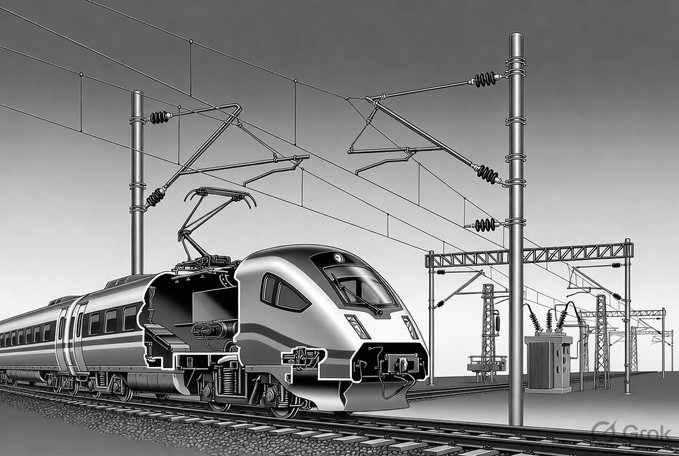
India Nears 100% Railway Electrification, Becomes World's Second Most Electrified Rail Network
India has emerged as one of the world's leaders in railway electrification, with an impressive 99.6% of its broad gauge network now running on electric traction. The achievement places the country second only to Switzerland and ahead of several major economies with much larger railway systems.
According to the latest International Union of Railways (UIC) report released in June 2025, Switzerland tops the list with 100% railway electrification, followed by India (99.6%). China has electrified 82% of its railway network, while Spain (67%), Japan (64%), France (60%), and the United Kingdom (39%) lag behind. The rankings underline India's rapid progress in building one of the world's largest fully electrified railway networks.
The milestone marks one of the fastest infrastructure transformations undertaken by any major rail system globally. According to the Ministry of Railways, nearly 48,072 route kilometres have been electrified since 2014, compared to 21,801 route kilometres completed over the previous six decades before 2014. The remaining sections are also under active electrification, while all new railway lines and multi-tracking projects are being built with electric infrastructure from the outset.
The rapid expansion has significantly reduced India's dependence on diesel. Diesel consumption for railway traction has fallen from 293 crore litres in 2015-16 to just 108 crore litres in 2024-25, resulting in savings of 185 crore litres of fuel. Besides reducing fuel imports and saving valuable foreign exchange, the transition has substantially lowered carbon emissions.
Rail transport is already among the cleanest modes of transportation. According to a NITI Aayog study, transporting one tonne of freight by rail emits only 11.5 grams of CO₂ per kilometre, compared to 101 grams by road, making rail nearly 89% cleaner than road transport.
Beyond environmental benefits, electrification enables higher train speeds, improved haulage capacity, shorter travel times and greater operational efficiency. It also allows Indian Railways to integrate renewable energy into its operations more effectively.
To support its green energy goals, Indian Railways has already commissioned around 1,161 MW of solar power and 103 MW of wind power as of June 2026. The national transporter plans to increasingly meet its electricity requirements through renewable sources, including solar, wind and hybrid energy systems, further reducing its carbon footprint.
Several railway zones, including Central, Northern, Western, Eastern, South Central and Konkan Railway, have achieved 100% electrification. States such as Andhra Pradesh, Bihar, Delhi, Gujarat, Kerala, Madhya Pradesh, Maharashtra, Telangana, Uttar Pradesh and West Bengal have also fully electrified their railway networks.
The government said the electrification drive has been carried out in mission mode despite the challenge of upgrading railway lines while keeping train services operational. Dedicated monitoring mechanisms, assured funding and faster project execution have helped accelerate the programme.
With the final stretches nearing completion, Indian Railways is on the verge of achieving 100% broad gauge electrification, strengthening its position as one of the world's most sustainable, energy-efficient and environmentally friendly railway networks.