
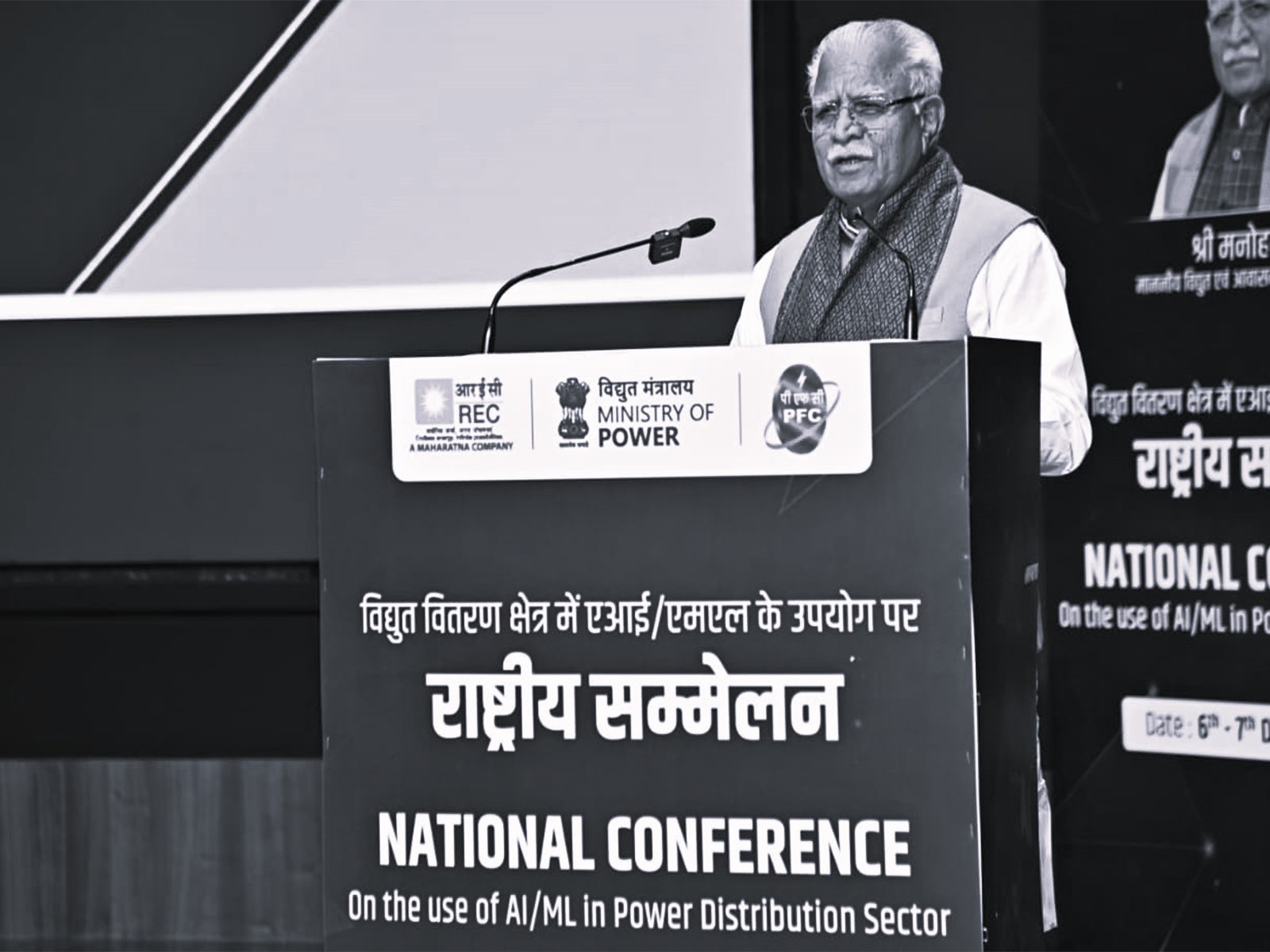
India moves towards data-driven, AI-powered electricity distribution
Artificial Intelligence (AI) and Machine Learning (ML) technologies were projected as key enablers in building intelligent, consumer-centric, and self-optimising power distribution networks during a national conference held at Bharat Mandapam in the capital.
Union Minister of Power Manohar Lal Khattar
stated that AI/ML driven applications were being increasingly recognised as essential for transforming electricity distribution through smart meter analytics, digital twins, predictive maintenance systems, theft detection intelligence, appliance-level consumer insights, automated outage prediction, and Generative AI-based decision support platforms. It was emphasised that these tools could significantly enhance both consumer experience and operational efficiency.
Across India, several DISCOMs have already begun integrating AI/ML technologies into their operations. In Andhra Pradesh, APEPDCL has deployed AI-powered systems for monitoring faulty poles, analysing smart meter data for load forecasting, revenue protection, and detecting faulty or tampered meters. The DISCOM has also rolled out lakhs of smart and prepaid meters to improve billing accuracy, reduce losses, and enable real-time consumer monitoring. Other utilities across the country, including TPDDL in Delhi, have combined smart meters with AI-driven billing, consumption analysis, demand-response systems, and operational automation, demonstrating how data-driven solutions are improving efficiency, reducing losses, and enhancing consumer service nationwide.
According to an official release from the Ministry of Power, active participation from industry, state utilities, innovators, academia, and technology partners was acknowledged, and the solutions presented by Distribution Companies (DISCOMs), Advanced Metering Infrastructure Service Providers (AMISPs), Technology Solution Providers (TSPs), and Home Automation Solution Providers (HASPs) were appreciated.
DISCOMs across the country were urged to collaborate closely with ecosystem stakeholders so that a transition towards smart, reliable, and consumer-focused distribution systems could be accelerated. It was underscored that consumers must be actively engaged and that misinformation surrounding new technologies should be addressed to secure public confidence and support for technology adoption.
It was highlighted that AI/ML-based solutions were being viewed as a means to restore trust through technology, enable households to manage energy consumption more effectively, prevent outages before their occurrence, protect honest consumers from the financial burden of power theft, and assist DISCOMs in reducing losses, optimising power procurement costs, and reinvesting in stronger infrastructure. Such developments were described as positioning India as an emerging global leader in digital electricity reforms and future-ready grid governance.
Power Secretary Pankaj Agarwal stated that the Ministry’s commitment to strengthening digitalisation across DISCOMs was being reinforced through the promotion of AI/ML-based solutions that deliver measurable operational and financial improvements. The importance of capacity building, secure data-sharing frameworks, and system interoperability was stressed to enable nationwide scaling of innovations.
The conference featured a national call for innovation that received 195 applications from DISCOMs, AMISPs, technology solution providers, and home automation companies. After an initial screening, 51 solutions were shortlisted for detailed jury evaluation on the first day of the conference.
Following the evaluation process, TNPDCL of Tamil Nadu and MP East of Madhya Pradesh were selected as winners in the DISCOMs category. Tata Power and Apraava were chosen in the AMISP category, while Pravah and Flock Energy were selected in the solution provider category. Tata Power was also declared the winner in the home automation solutions category.
During the final session, winning organisations presented data-driven innovations, including advanced smart meter analytics for revenue protection, accurate consumer indexing to reduce losses, behavioural demand response systems, AI-based operational automation, unified real-time grid intelligence, and appliance-level analytics. User-friendly platforms for monitoring and controlling household energy use were also showcased.
The award winners were felicitated by the Power Minister and were encouraged to scale up the deployment of such solutions across states.
During the event, the Strategic Expansion for Long Term Load Adequacy and Resilience (STELLAR) framework, developed by the Central Electricity Authority, was launched to enable DISCOMs to undertake resource adequacy studies and prepare long-term planning frameworks. In addition, the India Smart Grid Forum unveiled a handbook on AI, ML, AR/VR, and robotics applications for electric utilities, outlining 174 use cases, including 45 drawn from Indian utilities.