
India Moves to Build Its Own 1000-kg Aerial Bomb, Cutting Reliance on Imports
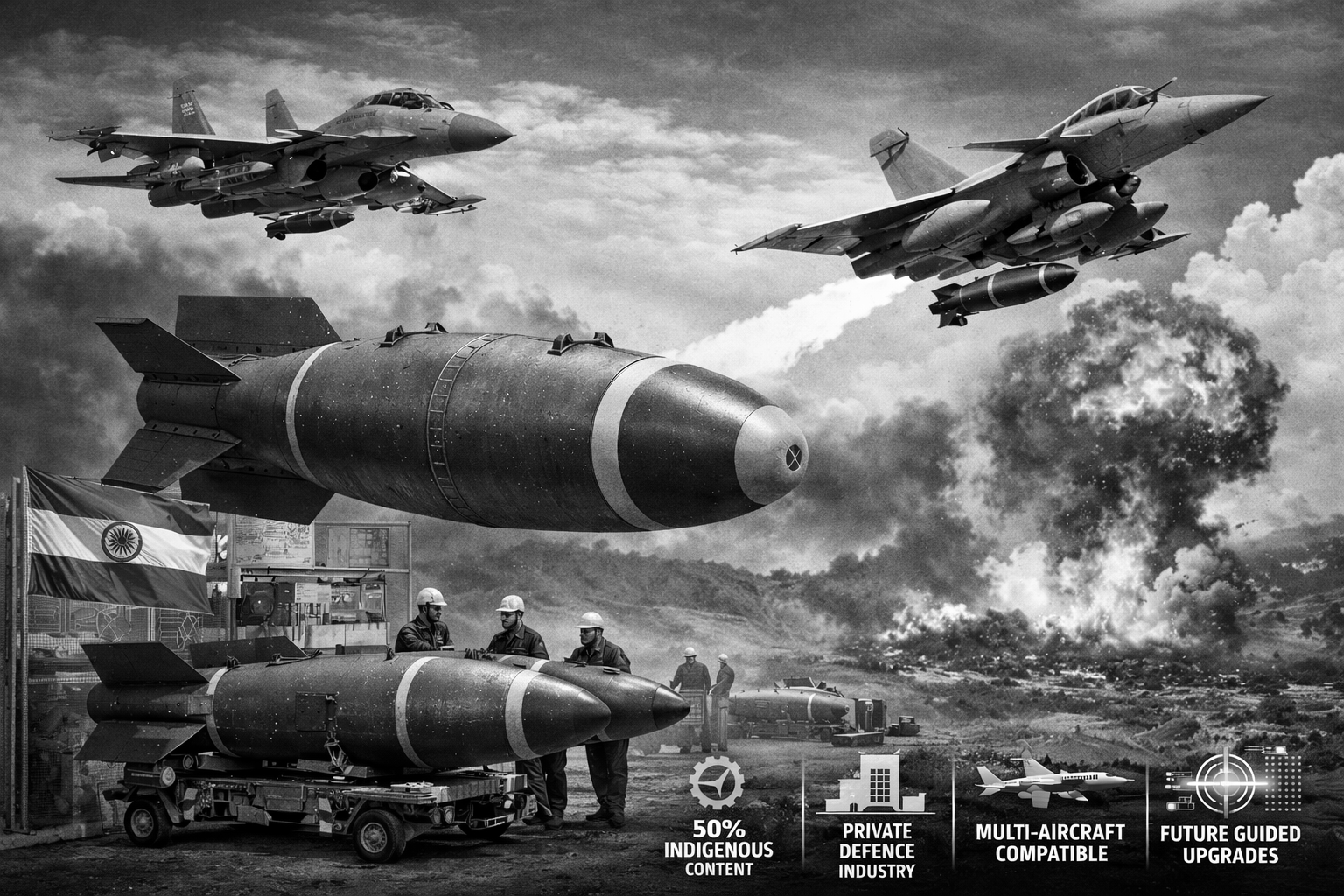
India has taken a decisive step toward strengthening its defence self-reliance with the Ministry of Defence initiating the indigenous design and development of a 1,000-kg aerial bomb , comparable to the widely used Mk-84 class munition . The project, launched under the Defence Acquisition Procedure (DAP) 2020 , reflects a broader push toward Aatmanirbhar Bharat by reducing dependence on foreign-origin heavy bombs currently used by the Indian Air Force (IAF) .
At present, the IAF relies on imported Mk-84 class bombs and associated kits for high-impact strike missions. These bombs are known for their powerful blast effect, natural fragmentation, and high peak over-pressure (PoP) , making them effective against hardened targets and infrastructure. The new indigenous version aims to replicate and eventually enhance these capabilities while ensuring compatibility across India’s diverse fleet, including aircraft like the Sukhoi Su-30MKI , Dassault Rafale , Mirage 2000 , and SEPECAT Jaguar .
The programme is structured in two phases. The first involves the development of six prototypes both live and inert along with tail units and associated systems. This phase includes rigorous testing such as Single-Stage Composite Trials (SSCT) and the transition from preliminary to final operational requirements. A key mandate is achieving at least 50 per cent indigenous content , even when foreign collaboration is involved. The second phase will see procurement under the ‘Buy (Indian–IDDM)’ category, with the IAF planning to acquire around 600 bombs , indicating a clear shift toward mass production rather than limited acquisition .
Unlike traditional government-led manufacturing, this project follows the ‘Make-II’ (industry-funded) model, opening participation to private Indian defence companies , alongside public sector units and potential foreign partners through technology transfer or joint ventures. However, strict conditions ensure that design and manufacturing remain domestically controlled . The final manufacturer will be selected only after prototype evaluation based on technical capability, infrastructure, and compliance with operational requirements.
While the government has not disclosed the official cost, estimates based on global benchmarks suggest that a basic Mk-84 class bomb costs around ₹13–15 lakh per unit. With 600 units planned and additional expenditure on research, testing, and infrastructure, the overall programme cost could range between ₹200–500 crore , making it a cost-effective long-term investment compared to repeated imports.
Beyond immediate operational benefits, the project holds deeper strategic significance. By developing a scalable bomb platform , India is laying the foundation for future upgrades such as precision-guided kits, glide capabilities, and smart munitions , aligning with modern warfare trends. In essence, this initiative is not merely about producing a bomb it is about building a sustainable, flexible, and indigenous strike capability that can support India’s evolving air power requirements for decades to come.