
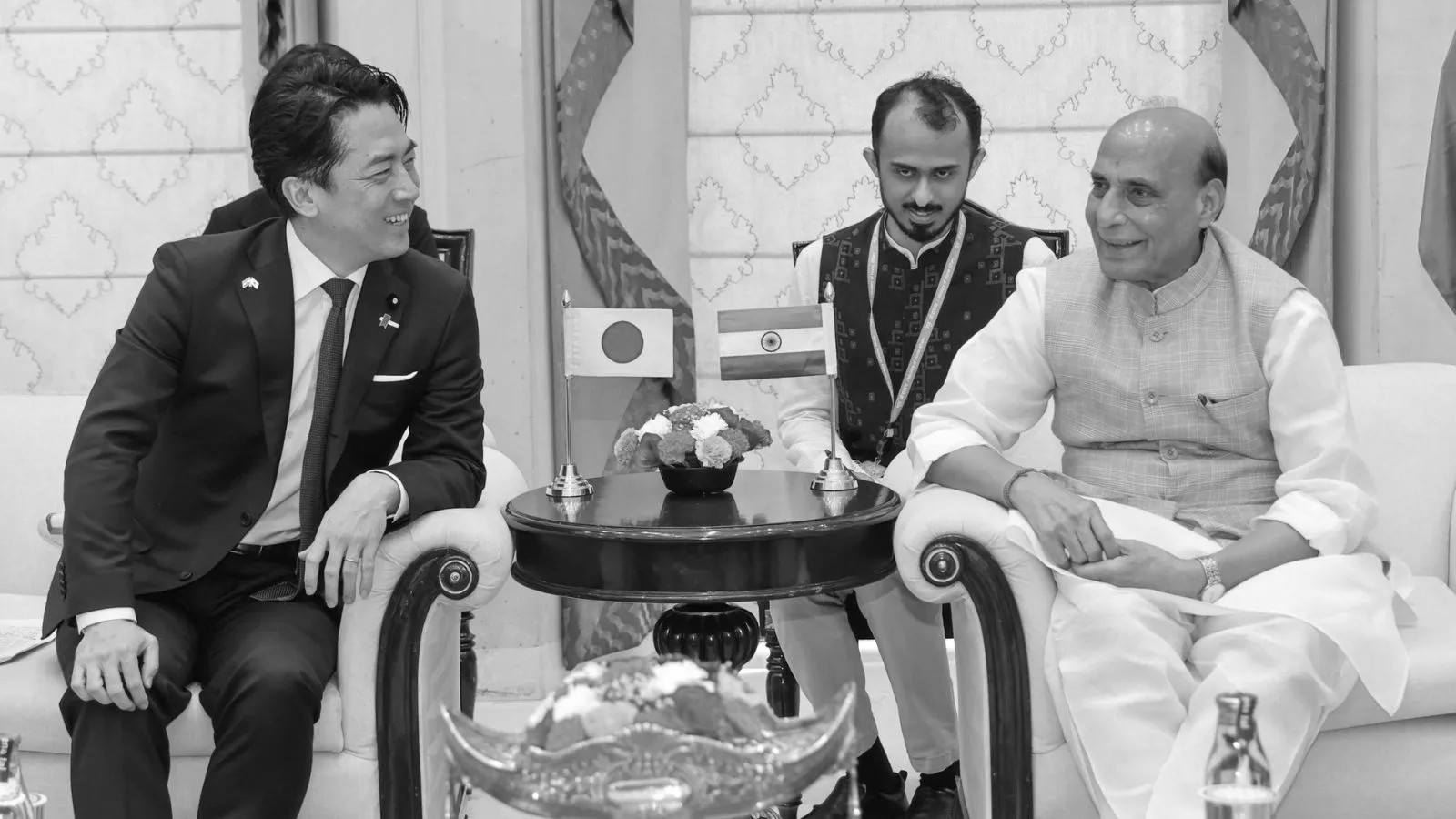
India-Japan Forge Stronger Defence Link, From UNICORN to Joint Naval Shipbuilding
India and Japan are expanding their defence partnership from strategic alignment to practical cooperation aimed at strengthening security and stability across the Indo-Pacific.
Defence Ministers Rajnath Singh and Shinjiro Koizumi agreed to deepen maritime cooperation, including information sharing for Maritime Domain Awareness (MDA), naval exercises, search and rescue, and Humanitarian Assistance and Disaster Relief (HADR). The countries will also coordinate to protect vital Sea Lines of Communication through naval visits, joint drills, personnel and expert exchanges, and access to ports, maintenance and repair facilities.
Joint exercises will be a major pillar. Existing Army exercise Dharma Guardian and maritime drill JAIMEX will be expanded, while Veer Guardian 26 will mark the first visit of Japanese fighter aircraft to India for the bilateral air exercise. Future exercises are expected to become more complex, incorporate unmanned systems and be conducted at short notice when opportunities arise. Special Operations Forces exchanges will also grow.
The partnership has a strong defence-industrial focus. India and Japan will pursue the shipborne UNICORN integrated communications antenna system, described as their first defence equipment transfer project. They will explore joint naval shipbuilding and ship design, combining Japan’s technological expertise with India’s production capacity under Make in India. Cooperation will also cover mine-countermeasure capabilities, reciprocal ship-repair facilities, and advanced defence research between DRDO and Japan’s ATLA. A Defence Industry Forum is planned.
Regional cooperation will extend beyond the two countries. Their first trilateral naval PASSEX with Indonesia in February provides a model for deeper engagement with third countries through exercises, exchanges and other initiatives. The Indo-Pacific Logistics Network will support partner countries during natural disasters by moving personnel and supplies.
To turn these commitments into action, India and Japan will establish a Director-General/Joint Secretary-level Working Group covering operations, intelligence, equipment, technology and industry. It will coordinate priorities, maximise synergies and accelerate implementation while respecting both countries’ sovereign choices, while reinforcing freedom of navigation and overflight regionwide.
Together, these measures could create a more connected, resilient and responsive regional security network.