
India Has the World's Largest Cotton Area - Can It Become the Most Productive?
Cotton, often called "White Gold," has been woven into India's civilisational, economic and agricultural fabric for more than 5,000 years. From the ancient cotton fabrics traded across Asia, the Middle East and Europe to the textile mills of Mumbai, Ahmedabad and Kolkata that powered India's industrial growth, the crop has played a defining role in the country's development. Ahmedabad's emergence as the "Manchester of India" and the prominence of cotton during the Swadeshi Movement further cemented its place as a symbol of self-reliance. Today, cotton remains the backbone of India's textile industry, supporting nearly 6 million farmers and providing livelihoods to another 40–50 million people engaged in ginning, spinning, weaving, garment manufacturing, trading and allied sectors.
India's Position in the Global Cotton Industry
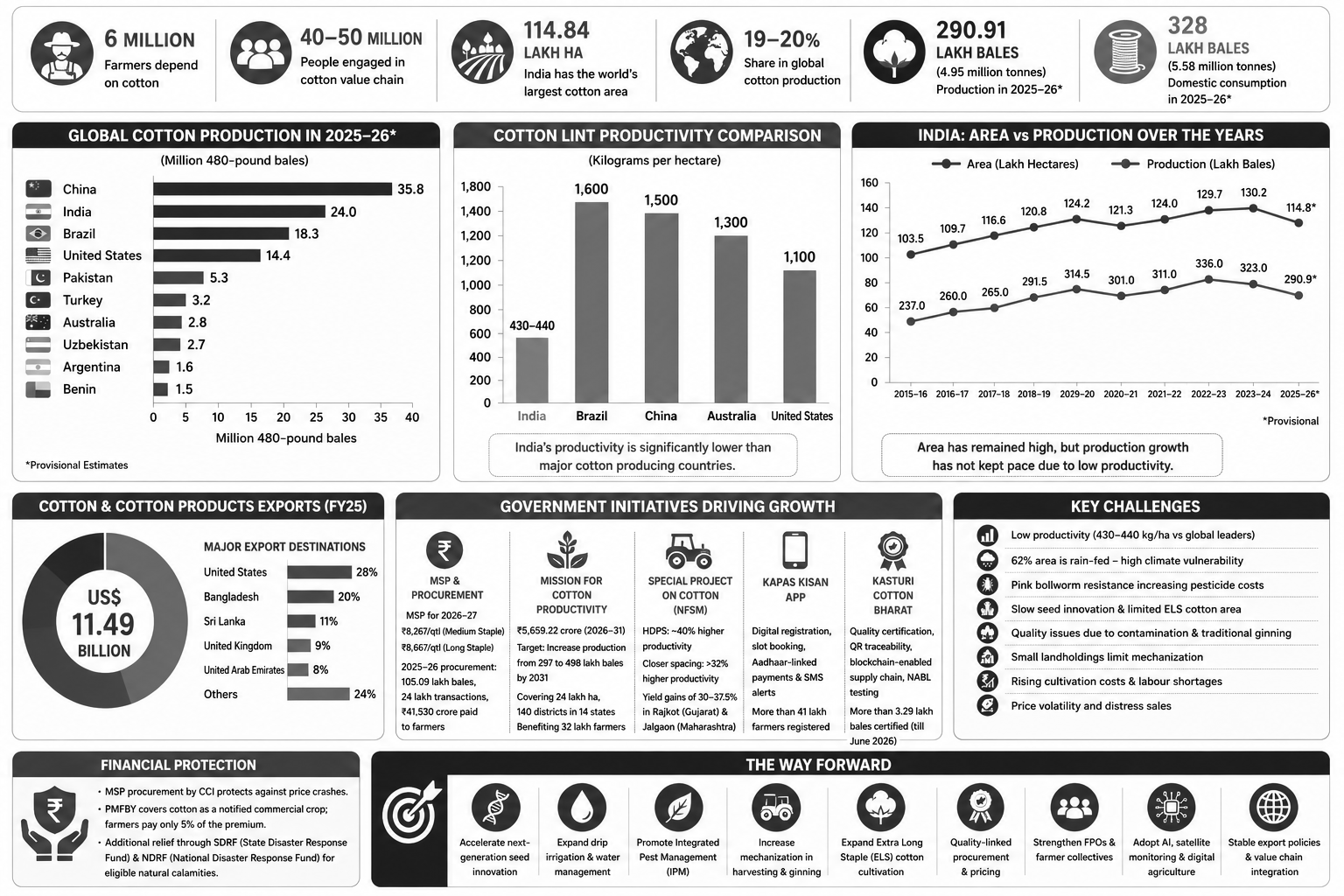
India occupies a unique position in the global cotton economy as the only country cultivating all four recognised cotton species Gossypium arboreum, Gossypium herbaceum, Gossypium hirsutum and Gossypium barbadense. The country also has the largest cotton cultivation area in the world, covering 114.84 lakh hectares, or nearly 38 per cent of the global cotton acreage. It is the second-largest producer after China and the second-largest consumer, driven by one of the world's biggest textile industries. During 2025–26 (provisional), India produced 290.91 lakh bales (4.95 million tonnes) while domestic consumption reached 328 lakh bales (5.58 million tonnes), accounting for nearly 19–20 per cent of global cotton production.
Globally, China leads cotton production with 35.8 million 480-pound bales, followed by India (about 24 million bales), Brazil (18.3 million), the United States (14.4 million), Pakistan (5.3 million), Turkey (3.2 million), Australia (2.8 million), Uzbekistan (2.7 million), Argentina (1.6 million) and Benin (1.5 million). India is also among the leading exporters of cotton and cotton products, with exports worth US$11.49 billion in FY25, mainly to the United States, Bangladesh, Sri Lanka, the United Kingdom and the United Arab Emirates.
Cotton Across India's Diverse Agro-Climatic Regions
Cotton cultivation spans 11 states across three major agro-climatic zones. The Northern Zone comprises Punjab, Haryana and Rajasthan, the Central Zone includes Gujarat, Maharashtra and Madhya Pradesh, while the Southern Zone covers Telangana, Andhra Pradesh and Karnataka. The crop is also cultivated in Tamil Nadu and Odisha, making it one of India's most geographically widespread commercial crops.
Bt Cotton Revolution and Its Changing Reality
A landmark transformation occurred in 2002 with the introduction of Bt Cotton, a genetically modified variety containing genes from the bacterium Bacillus thuringiensis. The technology significantly reduced bollworm infestation, lowered insecticide use and improved yields during its early years. However, the emergence of pink bollworm resistance has gradually reduced its effectiveness, forcing farmers to spend more on pesticides while productivity has stagnated in several regions.
Cotton's Role Beyond the Textile Industry
Cotton's economic value extends far beyond textiles. Nearly two-thirds of the harvested cotton boll consists of seed, which is processed into edible cottonseed oil, widely known as "Heart Oil," along with protein-rich cottonseed meal for livestock, poultry and fisheries. Cotton stalks are increasingly used as biomass fuel, while absorbent cotton remains indispensable in healthcare, making the crop important to agriculture, food processing, renewable energy and medical industries.
Challenges Limiting India's Cotton Potential
Despite its global leadership, India's cotton sector faces several structural challenges. The biggest concern is low productivity. Although the country has the world's largest cotton acreage, average lint productivity remains only 430–440 kilograms per hectare, well below that of Brazil, China, Australia and the United States. Nearly 62 per cent of India's cotton area is rain-fed, making cultivation highly vulnerable to erratic monsoons, droughts, floods, heatwaves and climate change.
The increasing resistance of the pink bollworm has emerged as another major challenge, while slow development and approval of climate-resilient, drought-tolerant, pest-resistant, high-yielding and Extra Long Staple (ELS) cotton varieties have constrained productivity gains. Additional concerns include contamination during harvesting and ginning that affects fibre quality, fragmented landholdings that limit mechanisation, rising expenditure on labour, fertilisers, pesticides, diesel and irrigation, labour shortages during harvesting, and volatile market prices that often compel farmers to sell immediately after harvest.
Government's Multi-Pronged Strategy to Strengthen Cotton Farming
To overcome these challenges, the Government has adopted a comprehensive strategy centred on price protection, productivity enhancement, technology adoption and quality improvement. The Cotton Corporation of India (CCI) procures cotton under the Minimum Support Price (MSP) mechanism whenever market prices fall below the notified rates, protecting farmers from distress sales. For the 2026–27 season, the MSP has been fixed at ₹8,267 per quintal for Medium Staple Cotton and ₹8,667 per quintal for Long Staple Cotton. During 2025–26, CCI procured 105.09 lakh bales through nearly 24 lakh procurement transactions, disbursing over ₹41,530 crore to farmers. To strengthen procurement operations, the Union Cabinet approved ₹1,718.56 crore in support for the CCI.
Mission for Cotton Productivity: A Roadmap to 2031
Recognising that the future of the sector depends on productivity rather than expanding acreage, the Government has approved the ₹5,659.22 crore Mission for Cotton Productivity (2026–31). The mission aims to increase cotton production from 297 lakh bales to 498 lakh bales by 2031, substantially improve lint productivity, promote climate-resilient and pest-resistant varieties, expand cultivation of Extra Long Staple cotton, encourage advanced breeding and biotechnology, and cover 24 lakh hectares across 140 districts in 14 cotton-growing states, benefiting nearly 32 lakh farmers. The programme aligns with the Government's 5F Vision—Farm, Fibre, Factory, Fashion and Foreign, strengthening the entire cotton value chain from farms to exports.
Technology and Quality Initiatives Driving the Sector
The Special Project on Cotton under the National Food Security Mission (NFSM) is promoting High Density Planting System (HDPS), closer spacing techniques and improved agronomic practices. Demonstrations have recorded productivity improvements of nearly 40 per cent under HDPS and over 32 per cent under closer spacing, while farmers in Rajkot, Gujarat, and Jalgaon, Maharashtra, have reported yield gains ranging between 30 and 37.5 per cent.
Technology has also transformed procurement through the Kapas Kisan App, enabling farmers to self-register, book procurement slots, receive Aadhaar-linked payments and track transactions digitally. More than 41 lakh farmers have already registered on the platform. Meanwhile, Kasturi Cotton Bharat is positioning Indian cotton as a premium global brand through fibre certification, QR code-based traceability, blockchain-enabled supply chains and NABL-accredited testing, with more than 3.29 lakh certified bales registered by June 2026.
Financial Protection for Cotton Farmers
Unlike some crops, the Centre does not operate a separate compensation scheme exclusively for cotton farmers. Instead, growers receive protection through CCI's MSP procurement, the Pradhan Mantri Fasal Bima Yojana (PMFBY) under which cotton is a notified commercial crop and farmers pay only 5 per cent of the insurance premium and disaster assistance through the State Disaster Response Fund (SDRF) and National Disaster Response Fund (NDRF) for eligible natural calamities.
The Road Ahead: From Largest Grower to Most Productive Producer
Experts believe India's next cotton revolution will depend not on expanding cultivation but on producing more from every hectare. Faster approval of next-generation seed technologies, wider adoption of drip irrigation, Integrated Pest Management, mechanised harvesting, expansion of ELS cotton, quality-linked procurement, stronger Farmer Producer Organisations, digital agriculture powered by artificial intelligence and satellite monitoring, along with stable export policies and closer integration between farmers, ginners, textile mills and exporters, will be critical.
With sustained investments in research, innovation and policy reforms, India is well positioned to transform its "White Gold" into a globally competitive, climate-resilient and high-value agricultural enterprise while ensuring better incomes for millions of cotton-growing families. The Mission for Cotton Productivity, supported by modern technology, quality certification and farmer-centric policies, has the potential to redefine India's cotton sector and reinforce its leadership in the global cotton economy for decades to come.